

Amenaza emergente del ortobunyavirus Oropouche en Paraguay: La importancia de la vigilancia genómica y de herramientas diagnósticas innovadoras
DOI:
https://doi.org/10.18004/mem.iics/1812-9528/2025.e23152501Palabras clave:
Orthobunyavirus oropoucheense, Arboviruses, Rapid diagnostics, Paraguay public healthResumen
The Orthobunyavirus oropoucheense (formerly known as Oropouche virus, OROV) is emerging as a significant public health concern in South America. This arbovirus has shown a remarkable ability to evolve and adapt. OROV has been increasingly reported throughout numerous countries within South America, including Brazil, Peru, Bolivia, Colombia, Venezuela, Panama, and Ecuador1. Following a recent outbreak in Brazil during 2022 and 2023, a new viral lineage emerged due to intraspecies reassortment. This new lineage has been linked to an array of severe clinical manifestations, such as neurological complications, vertical (mother-to-child) transmission as a potential mode of transmission, and even fatalities. The typical clinical symptoms of OROV are similar to those of other arboviruses, such as Dengue, Chikungunya, and Zika virus. The emergence of new clinical manifestations highlights the critical need for effective virological surveillance. As such, OROV poses a serious threat to public health in Paraguay, thus underscoring a critical need to prepare through genomic surveillance and innovative diagnostic strategies2-4.
Furthermore, the ecological and climate conditions in Paraguay heavily favour increased activity of the primary vector, Culicoides paraensis, thereby further exacerbating the dissemination of OROV. The existence of non-human reservoirs, such as sloths and primates, further elevates this risk, as these animals can facilitate spillover events. In addition, Paraguay shares open borders with Brazil and Bolivia, where OROV is currently endemic. This geographic proximity increases the likelihood of viral introduction via human travel or vector migration5,6. It is worth noting that, to date, there are no published reports confirming the presence or distribution of Culicoides paraensis in Paraguay, according to the Servicio Nacional de Erradicación del Paludismo (SENEPA), the national authority responsible for vector control and surveillance7. Given the species’ role as the primary vector of OROV, this absence of entomological data highlights an important knowledge gap. Addressing this gap should be considered a priority within broader surveillance efforts, as understanding local vector dynamics is essential for accurately assessing the country's risk profile. Additionally, recent evidence indicates that Culex spp. mosquitoes, which are widespread in regions such as Paraguay, may exhibit potential competence as secondary vectors of OROV8. While Culicoides paraensis remains the principal vector, the involvement of Culex species in the transmission cycle warrants further laboratory and field investigation9.
Genomic surveillance is essential for tracking viral evolution and detecting the emergence of novel, potentially more virulent strains. These data are crucial for informing public health responses and highlight the need for innovations in diagnostics, vaccine development, and targeted therapeutics4,10,11.
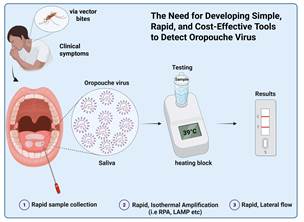
Although reverse transcription polymerase chain reaction (RT-PCR) remains the diagnostic gold standard, its use is often limited in low-resource settings. Therefore, alternative rapid and field-deployable methods are gaining traction. Techniques such as reverse transcription loop-mediated isothermal amplification (RT-LAMP) and recombinase polymerase amplification (RT-RPA) provide efficient and sensitive diagnostics, making them valuable tools for early detection of OROV and similar viruses in remote or underserved areas12,13. However, these techniques should be thoroughly evaluated for sensitivity and specificity before being implemented in diagnostic settings to ensure their reliability and accuracy.
Although OROV has been detected in saliva, and this sample type shows great potential as a diagnostic tool14,15 its use has not yet been systematically evaluated for clinical application. Further research is needed to validate its effectiveness. Saliva could serve as an alternative specimen when serum samples are unavailable, as illustrated in Figure 1.
The World Health Organization’s Global Arbovirus Initiative emphasizes the importance of international collaboration in fighting emerging arboviral threats. Regional coordination, through shared genomic data, standardized surveillance strategies, and public education, is crucial for controlling the spread of viruses. Equally important is community engagement to promote awareness of OROV symptoms, transmission routes, and preventive measures16.
In conclusion, the emergence of a novel, more virulent OROV lineage underscores the urgent need for robust entomological vector and genomic surveillance, rapid diagnostic innovations, and coordinated public health responses in Paraguay and across the region.
Descargas
Referencias
1. CDC Countries and Territories with Recent or Previous Oropouche Virus Transmission Oropouche; CDC. https://www.cdc.gov/oropouche/data-maps/countries-and-territories-at-risk-for-oropouche.html visited in July , 17, 2025
2. Naveca FG, Almeida TAP, Souza V, Nascimento V, Costa CF, Motta F, et al. Human outbreaks of a novel reassortant Oropouche virus in the Brazilian Amazon region. Nat Med. 2024. https://www.nature.com/articles/s41591-024-03300-3
3. da Silva AF, Azevedo EAN, da Silva VG, Medeiros VBP, Luz SLB, Moraes F, et al. Genomic and phenotypic characterization of an Oropouche virus strain implicated in the 2023-24 large-scale outbreak in Brazil. bioRxiv [Preprint]. 2024 [cited 2025 Apr 2]. https://www.biorxiv.org/content/10.1101/2024.08.02.606252
4. Forato J, Claro IM, Hua X, Rodrigues PT, Silva JPB, Sampaio M, et al. Re-emergence of Oropouche virus between 2023 and 2024 in Brazil: an observational epidemiological study. Lancet Infect Dis. 2025. https://www.thelancet.com/journals/laninf/article/PIIS1473-3099(24)00619-4/fulltext
5. Delatorre E, de Colombo GM, Gatti FD, Souza JP, Zini N, de Souza F, et al. Oropouche Virus Outbreak in Southeast, Brazil: Expanding Beyond the Amazonian Endemic Region. medRxiv [Preprint]. 2024 [cited 2025 Apr 2]. https://www.medrxiv.org/content/10.1101/2024.12.11.24318883
6. Gräf T, Delatorre E, Ferreira CN, Silva CS, Teixeira M, Oliveira J, et al. Long-range spread and sustained transmission of Oropouche virus outside the endemic Brazilian Amazon region. SSRN [Preprint]. 2024 [cited 2025 Apr 2]. https://papers.ssrn.com/sol3/papers.cfm?abstract_id=4932381
7. SENEPA. La vigilancia entomológica como plan de acción en la estrategia para prevenir el Oropouche y otras enfermedades - Servicio Nacional de Erradicación del Paludismo. https://senepa.gov.py/2024/05/17/la-vigilancia-entomologica-como-plan-de-accion-en-la-estrategia-para-prevenir-el-virus-oropouche-y-otras-enfermedades/
8. Gravina HD, Suzukawa AA, Zanluca C, Cardozo Segovia FM, Tschá MK, Martins da Silva A, et al. Identification of insect- specific flaviviruses in areas of Brazil and Paraguay experiencing endemic arbovirus transmission and the description of a novel flavivirus infecting Sabethes belisarioi. Virology. 2019 Jan 15; 527: 98-106. 10.1016/j.virol.2018.11.008. Epub 2018 Nov 24. PMID: 30476788.
9. Navarro JC, Romero-Alvarez D, Escobar LE. Oropouche Fever: A Growing Threat in Latin America. In: Emerging Viruses in Latin America. Springer 2024: 119-141. 10.1007/978-3-031-68419-7_6
10. Zhang Y, Liu X, Wu Z, Wang H, Tan Z, Fang Y. Oropouche virus: A neglected global arboviral threat. Virus Res. 2024; 331: 199122. https://www.sciencedirect.com/science/article/pii/S016817022400011X
11. Azevedo RSS, Costa CF, Motta F, Silva EV, Oliveira RS, Vasconcelos PFC. Congenital Oropouche in Humans: Clinical Characterization of a Possible New Teratogenic Syndrome. Viruses. 2025; 17(3): 397. https://www.mdpi.com/1999-4915/17/3/397
12. Cunha MS, Esposito DL, Nogueira JS, Rocco IM, Maeda AY, Vasami FG, et al. Molecular epidemiology and evolution of Oropouche virus. J Clin Virol. 2021; 136: 104759.
13. Priye A, Bird SW, Light YK, Ball CS, Negrete OA, Meagher RJ. A smartphone-based diagnostic platform for rapid detection of Zika, chikungunya, and dengue viruses. Sci Rep. 2017;7:44778.
14. Nascimento VAD, Santos JHA, Monteiro DCDS, Pessoa KP, Cardoso AJL, Souza VC, Abdalla LF, Naveca FG. Oropouche virus detection in saliva and urine. Mem Inst Oswaldo Cruz. 2020 Feb 27;115:e190338. doi: 10.1590/0074-02760190338. PMID: 32130368; PMCID: PMC7046135
15. Fonseca LMDS, Carvalho RH, Bandeira AC, Sardi SI, Campos GS. Oropouche Virus Detection in Febrile Patients' Saliva and Urine Samples in Salvador, Bahia, Brazil. Jpn J Infect Dis. 2020 Mar 24;73(2):164-165. doi: 10.7883/yoken.JJID.2019.296. Epub 2019 Nov 29. PMID: 31787741
16. World Health Organization (WHO). Global Arbovirus Initiative [Internet]. Geneva: WHO; 2022 [cited 2025 Apr 2].
 Un vistazo a nuestro día a día en la oficina de Memorias del IICS