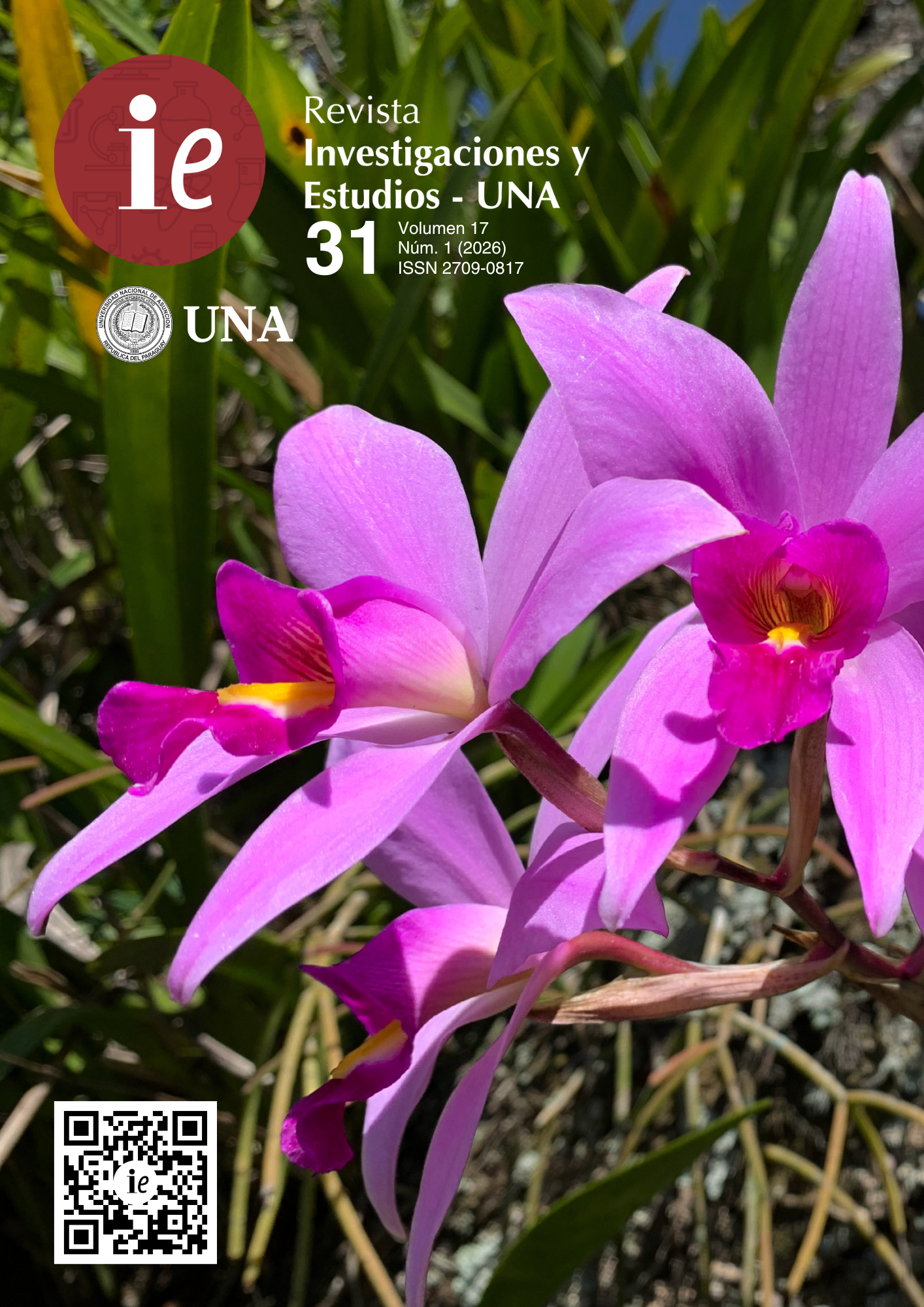
Influence of biotic and abiotic parameters on the pollination of the wild orchid Laelia anceps Lindl. subsp. anceps
DOI:
https://doi.org/10.18004/ieuna2709-0817/3117015829.2026Keywords:
forest canopy, ecological conservation, reproductive success, Bombus, XylocopaAbstract
The objective was to evaluate the influence of ecological parameters on the reproduction of Laelia anceps Lindl. subsp. anceps. A field study was conducted on 74 individuals located on 41 Quercus phorophytes under open (direct sunlight) and closed (shade) canopy conditions. Population structure, floral phenology, and visiting fauna were characterized. Results indicated that canopy type significantly influenced (p < 0,05) population abundance and floral production. The closed canopy exhibited higher values of individual density per phorophyte (1,7-fold), number of flowers (2,0-fold), and number of inflorescences per individual (1,1-fold). Reproductive success (capsules to flowers) was 15,1% higher under closed canopy, where 53,6% of flowers were recorded in October during the flowering peak. The high diversity of epiphytes such as Domingoa purpurea, Isochilus unilateralis, and Tillandsia spp. on closed canopy phorophytes denotes the preference of the orchid and its associated species for lower solar incidence. Bombus medius was identified as an effective pollinator, and Xylocopa tabaniformis as a new floral visitor. These findings highlight the ecological specialization of Laelia anceps and the need to conserve oak forests with closed canopy to ensure its reproductive cycle.
Downloads
References
Aini, N., Chikmawati, T., Sulistijorini, S., Djuita, N. R., & Ariyanti, N. S. (2022). Diversity and Distribution Patterns of Epiphytic Orchid in the Nirmala Tea Plantation, Bogor West Java. Journal of Biology & Biology Education, Biosaintifika, 14(1). https://doi.org/10.15294/biosaintifika.v14i1.35076
Alanís-Méndez, J. L., Martínez-Castillo, I. A., Viveros-Valencia, J., Sosa-Constantino, F. G., & Limón-Salvador, F. (2023). Archaeological Sites as a Safeguard for Orchid Diversity: A Study in El Tajin, Veracruz, Mexico. Natural Areas Journal, 43(3), 179-184. https://doi.org/10.3375/22-23
Alanís-Méndez, J. L., Ortíz-Santos, L. del C., Chamorro-Florescano, I. A., Pech-Canché, J. M., & Limón-Salvador, F. (2019). Polinizadores y visitantes florales de dos orquídeas en un área natural protegida en Tuxpan, Veracruz. Ecosistemas y recursos agropecuarios, 6(17), 361–368. https://doi.org/10.19136/ERA.A6N17.1922
Alvarez, C. C., López, A. M., Torres, D. G. C., Rico, D. T., & Miranda, J. J. M. (2023). Orquídeas: amenazas de su existencia, formas de conservación y protección. Jandiekua, Revista Méxicana de Educación Ambiental, 7(9), 44–59. https://leka.uaslp.mx/index.php/jandiekua/article/view/378
Baldelomar, M., Atala, C., & Molina-Montenegro, M. A. (2019). Top-Down and Bottom-Up Effects Deployed by a Nurse Shrub Allow Facilitating an Endemic Mediterranean Orchid. Frontiers in Ecology and Evolution, 7. https://doi.org/10.3389/fevo.2019.00466
Brasero, N., Vandame, R., Sagot, P., Martinet, B., Valterová, I., & Rasmont, P. (2019). Thoracobombus from Mexico: a description of the male species-specific cephalic labial gland secretions. Apidologie, 50(2), 184-194. https://doi.org/10.1007/s13592-018-0629-4
Cardoso, J. C. F., Johnson, S. D., & Oliveira, P. E. (2024). Incomplete resupination during floral development leads to pollination failure in a slipper orchid. Plant Biology, 26(1), 34-40. https://doi.org/10.1111/plb.13587
Cervantes-Llamas, M., Treviño-Carreón, J., Coronado-Blanco, J. M., & Hernández-López, T. J. (2018). Visitantes florales de las orquídeas. Boletín de la Sociedad Mexicana de Entomología, 4 (2), 49–52. https://revistas.acaentmex.org/index.php/boletin/article/view/187
Damon, A., & Salas-Roblero, P. (2007). A survey of pollination in remnant orchid populations in Soconusco, Chiapas, Mexico. Tropical Ecology, 48(1).https://www.researchgate.net/publication/237295262_A_survey_of_pollination_in_remnant_orchid_populations_in_Soconusco_Chiapas_Mexico
de Camargo, M. G. G., Lunau, K., Batalha, M. A., Brings, S., de Brito, V. L. G., & Morellato, L. P. C. (2019). How flower colour signals allure bees and hummingbirds: a community-level test of the bee avoidance hypothesis. New Phytologist, 222(2), 1112–1122. https://doi.org/10.1111/NPH.15594
Rodríguez Flores, L. R., & Barney-Guillermo, H. B. & Vázquez-Torres, M. M. (1996). Registro de la polinización en Laelia anceps LDL.(Orchidaceae). Repositorio institucional Universidad Veracuzana. https://cdigital.uv.mx/bitstreams/e2d8ab25-81ec-4a2d-8a78-79f1e2aa6d60/download
Hartvig, I., Kosawang, C., Rasmussen, H., Kjær, E. D., & Nielsen, L. R. (2024). Co-occurring orchid species associated with different low-abundance mycorrhizal fungi from the soil in a high-diversity conservation area in Denmark. Ecology and Evolution, 14(2), e10863. https://doi.org/10.1002/ece3.10863
Hernández-García, A., Zavala-Ruiz, J., Jaén-Contreras, D., & Baltazar-Bernal, O. (2021). Laelia anceps Lindl. (Orchidaceae) adaptation on phorophytes within an anthropized landscape, Amatlán de los Reyes, Veracruz, Mexico. Agro Productividad. https://doi.org/10.32854/agrop.v14i12.2148
Instituto Nacional de Estadística y Geografía (INEGI). (2010). Compendio de información geográfica municipal 2010. Naolinco, Veracruz de Ignacio de la Llave. INEGI. www.inegi.org.mx/contenidos/app/mexicocifras/datos_geograficos/30/30112.pdf
Krahl, D. R. P., Schmal, P., Chiron, G., Da Silva, J. B. F., Krahl, A. H., & Cantuária, P. D. C. (2024). Catasetum queirozii (Orchidaceae: Catasetinae): a new species from the Brazilian Amazon. Acta Amazonica, 54(1), e54bc23180. https://doi.org/10.1590/1809-4392202301801
Lee Espinosa, H. E., Cerda, A. L., González, J. M., Martínez, P. E., Andreu, L. I., Rosas, B. G., Barredo Pool, F. A., & Buzzy, N. S. (2008). In vitro Regeneration of Laelia Anceps ssp. Dawsonii. Revista UDO Agrícola, 7 (1), 58-67. http://hdl.handle.net/1807/45386
Li, W. G., Liu, J. R., Sun, H., Liu, J. Y., Sun, K., & Wang, L. (2024). The Controversial of Phylogenetic Status in an Unknown Orchidaceae Genus. Russian Journal of Genetics, 60(5), 595–603. https://doi.org/10.1134/S1022795424700030/METRICS
Muñoz-Hernández, A. E., Figueroa-Castro, D. M., & Campos-Villanueva, Á. (2020). Seasonal variation in the diversity of flowering orchids at Santa Catarina Lachatao, Oaxaca, Mexico. Botanical Sciences, 98(3). https://doi.org/10.17129/BOTSCI.2516
Olivares-Juárez, M. I., Burgos-Hernández, M., & Santiago-Alvarádo, M. (2022). Patterns of Species Richness and Distribution of the Genus Laelia s.l. vs. Laelia s.s. (Laeliinae: Epidendroideae: Orchidaceae) in Mexico: Taxonomic Contribution and Conservation Implications. Plants, 11(20). https://doi.org/10.3390/plants11202742
Parra-H, A., Otero, J. T., Sandino, J. C., & Ospina, T. R. (2016). Abejas de las orquídeas (Hymenoptera: Apidae Euglossini) y su importancia como polinizadoras de amplio rango en ecosistemas naturales. En G. Nates, Iniciativa Colombiana de Polinizadores. Capítulo 9, (pp. 141-155). Bogotá. Universidad Nacional de Colombia. https://www.researchgate.net/publication/311103607_ABEJAS_DE_LAS_ORQUIDEAS_HYMENOPTERA_APIDAE_EUGLOSSINI_Y_SU_IMPORTANCIA_COMO_POLINZADORAS_DE_AMPLIO_RANGO_EN_ECOSISTEMAS_NATURALES
Parra-Tabla, V., Abdala-Roberts, L., Rojas, J. C., Navarro, J., & Salinas-Peba, L. (2009). Floral longevity and scent respond to pollen manipulation and resource status in the tropical orchid Myrmecophila christinae. Plant Systematics and Evolution, 282(1), 1–11. https://doi.org/10.1007/S00606-009-0206-4
Romano-Ávila, V. H., Rivero-Bautista, N. Del, Caamal-Velázquez, J. H., Sol-Sánchez, Á., Mayo-Mosqueda, A., & Pech, R. G. A.-. (2025). Efecto de la iluminación LED sobre la multiplicación in vitro de Laelia anceps Lindl. Ecosistemas y Recursos Agropecuarios, 12(2), e4241. https://doi.org/10.19136/ERA.A12N2.4241
Secretaría de Medio Ambiente y Recursos Naturales. (2010). NOM-059-SEMARNAT-2010. Protección ambiental - Especies nativas de México de flora y fauna silvestres - Categorías de riesgo y especificaciones para su inclusión, exclusión o cambio - Lista de especies en riesgo. Diario Oficial de la Federación. https://www.dof.gob.mx/normasOficiales/4254/semarnat/semarnat.htm
Tejeda-Sartorius, O. (2023). Jardín urbano de la orquídea Laelia anceps Lindley (Orchidaceae) y sus polinizadores naturales. Agro-Divulgación, 3(4), 65-70. https://doi.org/10.54767/AD.V3I4.230
Tejeda-Sartorius, O., Soto-Hernández, R. M., Miguel-Chávez, R. S., Trejo-Téllez, L. I., & Caamal-Velázquez, H. (2022). Endogenous Hormone Profile and Sugars Display Differential Distribution in Leaves and Pseudobulbs of Laelia anceps Plants Induced and Non-Induced to Flowering by Exogenous Gibberellic Acid. Plants, 11(7), 845. https://doi.org/10.3390/plants11070845
Téllez-Velasco, M. A. A. & Tejeda-Sartorius, O. (2013). La importancia de los aromas en la polinización de las Orquídeas. Agro Productividad, 6(3), 42-49. https://revista-agroproductividad.org/index.php/agroproductividad/article/view/463
Ticktin, T., Charitonidou, M., Douglas, J., Halley, J. M., Hernández-Apolinar, M., Liu, H., Mondragón, D., Pérez-García, E. A., Tremblay, R. L., & Phelps, J. (2023). Wild orchids: A framework for identifying and improving sustainable harvest. Biological Conservation, 277, 109816. https://doi.org/10.1016/J.BIOCON.2022.109816
Downloads
Published
Issue
Section
License
Copyright (c) 2026 Abraham Méndez Hernández, Miguel Ángel Lozano Rodríguez, Ivette Alicia Chamorro Florescano, Francisco Javier Sanabria Perez, Jose Luis Alanís Méndez

This work is licensed under a Creative Commons Attribution 4.0 International License.