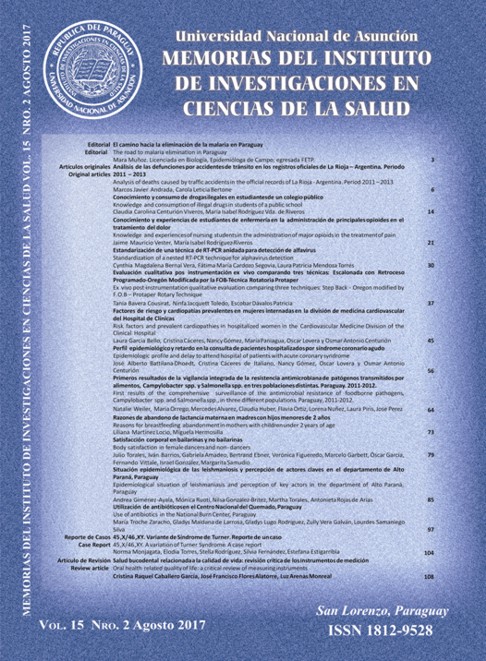

45,X/46,XY. Variante de Síndrome de Turner. Reporte de un caso
Keywords:
Síndrome de Turner, mosaicismo, monosomía, cariotipo, fenotipo.Abstract
El síndrome de Turner es una anomalía cromosómica descrita por primera vez por el Dr. Henry Turner en 1938 que se manifiesta principalmente por talla baja, cuello ancho, pterigyumcolli, cubitus valgo e infantilismo sexual. Tiene una prevalencia de 1 en 1800 a 5000 recién nacidos vivos femeninos y se caracteriza por la ausencia total o parcial del segundo cromosoma X. Con las técnicas citogenéticas una gran variedad de presentaciones han sido reconocidas, siendo la más común la monosomía del cromosoma X (constitución cromosómica: 45,X) y los menos frecuentes los mosaicismos, entre los que se incluyen cromosomas marcadores que corresponderían a fragmentos o la totalidad de un cromosoma Y; la presencia de este cromosoma podría conferirle al paciente características fenotípicas masculinas. Se reporta el caso de una niña de 14 años de edad con fenotipo de síndrome de Turner que presentó una constitución cromosómica en mosaico 45,X/46,XY. Madre y padre de 32 años, no consanguíneos, la niña fue traída a la consulta por ausencia de vello axilar y pubiano, y ausencia de desarrollo mamario En el nacimiento la paciente presentó genitales ambiguos, labios abiertos, en bolsa derecha el testículo se presentó atrofiado y el izquierdo en pelvis, ambos fueron extirpados a los 3 y 6 meses de vida respectivamente. Se realiza una revisión de la literatura y se propone el asesoramiento genético adecuado a lo hallado en el cariotipo.
Downloads
References
Tamar SC, Contreras NC, Fonseca DJ. Utilidad de la Citogenética en la medicina actual. Visión Histórica y Aplicación. Educación y Practica de la Medicina. [internet]. Acta Medica Colombiana, 2.088; 33 (4). 309-16. [citado: 04 de agosto del 2017] Disponible en:
http://www.actamedicacolombiana.com/cont.php?id=24&id2=162
Saldarriaga Gil W, Ávila Sánchez F, Isaza C. Síndrome de Turner con mosaicismo 45X/46XY: Reporte de caso. Rev Chil Obstet Ginecol. [internet] 2011; 76(1):47-51. [citado: 07 de agosto del
Disponible en: http://www.scielo.cl/scielo.php?script=sci_arttext&pid=S0717-75262011000100010
Stankiewicz P, Lupski JR. Gene, Genomic, and Chromosomal Disorders. [ internet] In: Goldman L, Schafer AI, eds. Cecil Medicine. 24th ed. Philadelphia, Pa: Saunders Elsevier; 2011. [citado: 04 de agosto del 2017] .Disponible en: http://www.nlm.nih.gov/medlineplus/spanish/ency/article/001317.htm.
Gordillo-González G, Escorcia P, Salvatierra I, Osorio G, Escobar- Ospina A. Disgenesia gonadal mixta por monosomía en mosaico: reporte de caso. [internet] Iatreia Revista Médica Universidad de Antioquia. 23(4). [citado 04 de agosto del 2017]. Disponible: www.iatreia.udea.edu.co
Richter-Unruh A, Knauer-Fischer S, Kaspers S, Albrecht B, Gillessen-Kaesbach G, Hauffa BP. Short stature in children with an apparently normal male phenotype can be caused by 45,X/46,XY mosaicism and is susceptible to growth hormone treatment.[ internet] Eur J Pediatr. 2004; 163(4-5): 251-6. [citado 04 de agosto del 2017]. Disponible en: https://www.ncbi.nlm.nih.gov/pubmed/14986122
Machado-Rosa RF, Bartel-D'Ecclesiis WF, Papandreus-Dibbi R, Cardoso-Manique R, Trevisa P, Graziadio C, et al. Mosaicismo 45, X/46,XY: relato de 14 pacientes de um hospital do Brasil. Um estudo retrospectivo. [internet] Sao Paulo Med J. 2014; 132(6): [citado 07 de agosto del 2017]. Disponible en: https://www.ncbi.nlm.nih.gov/pubmed/2
Doi: 10.1590/1516-3180.2014.1326729
Rosenberg C, Frota-Pessoa O, Vianna-Morgante AM, Chu TH. Phenotypic spectrum of 45,X/46,XY individuals. [internet] Am J Med Genet. 1987; 27(3):553-9. DOI: 10.1002/ajmg.1320270308. [citado 07 de agosto del 2017] Disponible en: https://www.ncbi.nlm.nih.gov/labs/articles/3631129/
Telvi L, Lebbar A, Del Pino O, Barbet JP, Chaussain JL. 45,X/46,XY mosaicism: report of 27 cases. Pediatrics. [internet] 1999; 104(2 Pt 1): 304-8. [citado 07 de agosto del 2017]. Disponible en: https://www.ncbi.nlm.nih.gov/pubmed/10429013
Tosson H, Rose SR, Gartner LA. Description of children with 45,X/46,XY karyotype. .[ internet] Eur J Pediatr. 2012;171(3):521-9. [Ultimo acceso: 07 de agosto del 2017]. Disponible en: https://www.ncbi.nlm.nih.gov/pubmed/21997800
Knudtzon J, Aarskog D. 45, X/46,XY mosaicism. A clinical review and report of ten cases. [ internet] Eur J Pediatr. 1987; 146(3):266-71. [Ultimo acceso: 07 de agosto del 2017]. Disponible en: https://www.ncbi.nlm.nih.gov/pubmed/3595646
Gantt PA, Byrd JR, Greenblatt RB, McDonough PG. A clinical and cytogenetic study of fifteen patients with 45, X/46,XY gonadal dysgenesis. [ internet] Fertil Steril. 1980; 34(3):216-21. [Ultimo acceso: 07 de agosto del 2017] Disponible en: https://www.ncbi.nlm.nih.gov/pubmed/7409242