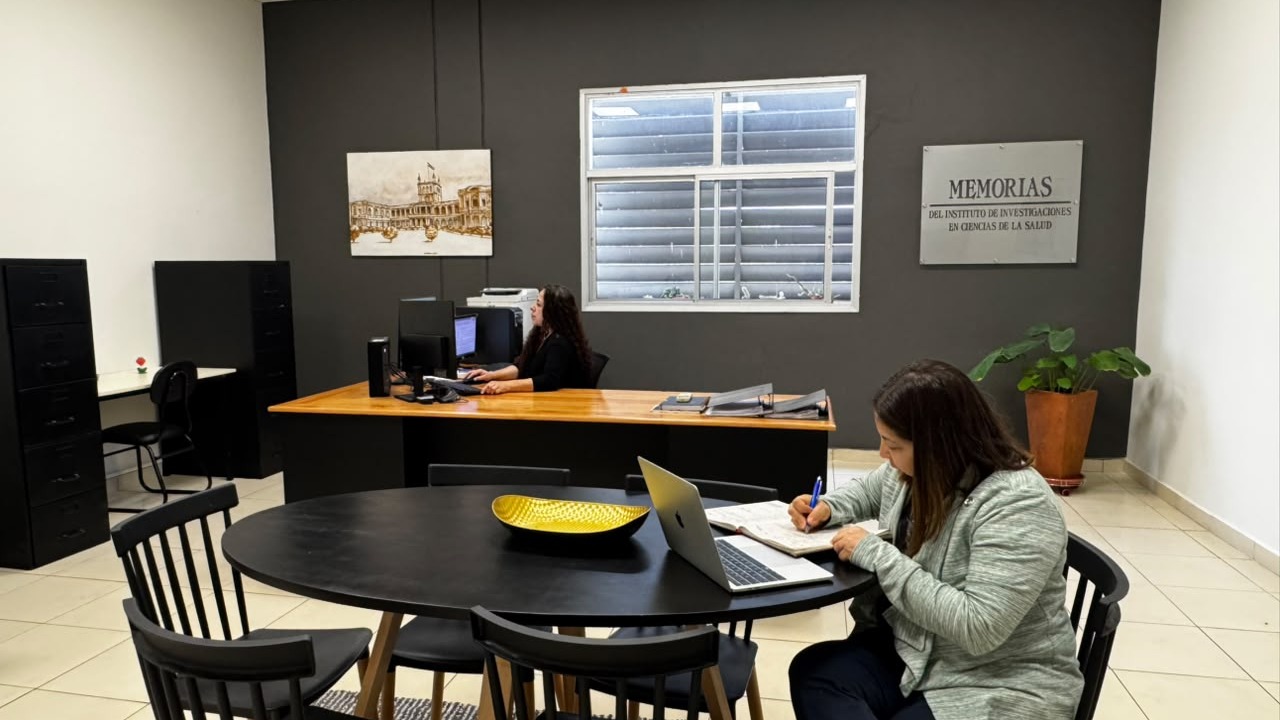
Our day-to-day at Memorias del IICS

A glimpse into our day-to-day at the Memorias del IICS office

Leer más

About

Memorias del Instituto de Investigaciones en Ciencias de la Salud (Mem. Inst. Investig. Cienc. Salud) is the official publication of the Institute of Research in Health Sciences (IICS) of the National University of Asunción (UNA), Paraguay. It publishes original scientific contributions in clinical medicine, biomedical research, microbiology, molecular biology, dentistry, nursing, nutrition, public health, health biotechnology, genetics, biochemistry, and related disciplines. Founded in 1983, the journal adopted its current name in 2002 and has been published exclusively online since 2015, incorporating XML article dissemination as of 2024. Since 2023, it operates under a continuous publication model. The journal accepts manuscripts in Spanish and English as original research articles, reviews, case studies, and brief communications. All content is available in open access, free of charge for authors and readers, under the Creative Commons Attribution 4.0 International License, in accordance with the Budapest Open Access Initiative (BOAI). It is indexed in BVS, SciELO Paraguay, HINARI, LILACS, DOAJ, Latindex, MIAR, Dialnet, CiteFactor, Google Scholar, LivRe, BASE, EBSCO, and Web of Science – SciELO Citation Index. The journal is funded by IICS-UNA, supports the OAI-PMH protocol for metadata harvesting, and uses the LOCKSS system for digital preservation of its contents.

 
Leer más

Peer Review Process

Manuscripts submitted to Memorias del Instituto de Investigaciones en Ciencias de la Salud undergo a double-blind peer review process, in which the identities of both authors and reviewers remain anonymous throughout the evaluation. Each manuscript is assessed by a minimum of two external reviewers with expertise in the relevant subject area, who are given a period of 30 days to submit their evaluation. Reviewers assess the originality, methodological rigor, scientific relevance, and clarity of presentation of each work. Based on the reviewers' reports, the Editorial Committee decides whether to accept, request revisions, or reject the manuscript, and communicates the decision to the authors as promptly as possible. This process ensures impartiality, transparency, and the scientific quality of published articles.

Leer más

Call for Papers

The Institute of Research in Health Sciences (IICS) of the National University of Asunción (UNA) invites researchers, academics, and health professionals to submit their manuscripts for consideration in the 2026 Volume of Memorias del Instituto de Investigaciones en Ciencias de la Salud (Mem. Inst. Investig. Cienc. Salud). The journal accepts original and unpublished contributions in Spanish as original research articles, review articles, case studies, and brief communications, in the areas of clinical medicine, biomedical research, microbiology, molecular biology, dentistry, nursing, nutrition, public health, health biotechnology, genetics, biochemistry, and related disciplines. The call for submissions is open and ongoing, and manuscripts may be submitted at any time of the year through the journal's online submission system. All received manuscripts undergo double-blind peer review. The journal is open access, with no charges for authors or readers. For further information on submission guidelines, please refer to the author instructions available on the journal's website.

Leer más

Concordancia de antígenos de dengue en el ELISA de captura de IgM (MAC ELISA) en el IICS-UNA

Authors

  • Laura Aria Instituto de Investigaciones en Ciencias de la Salud. Universidad Nacional de Asunción (UNA)
  • Yvalena Guillén Instituto de Investigaciones en Ciencias de la Salud. Universidad Nacional de Asunción (UNA), Author
  • Alejandra Rojas Instituto de Investigaciones en Ciencias de la Salud. Universidad Nacional de Asunción (UNA), Author
  • María Eugenia Acosta Instituto de Investigaciones en Ciencias de la Salud. Universidad Nacional de Asunción (UNA) Author
  • Carmen Roig Instituto de Investigaciones en Ciencias de la Salud, Universidad Nacional de Asunción (UNA) Author
  • Teresa Meza Instituto de Investigaciones en Ciencias de la Salud, Universidad Nacional de Asunción (UNA) Author
  • M Carpinelli Instituto de Investigaciones en Ciencias de la Salud, Universidad Nacional de Asunción (UNA) Author
  • Lorena Ferreira Instituto de Investigaciones en Ciencias de la Salud, Universidad Nacional de Asunción (UNA) Author

Keywords:

dengue, MAC ELISA, antígeno

Abstract

El dengue es una enfermedad aguda grave considerada actualmente como infección reemergente, cuyo vector principal es el Aedes aegypti. En Paraguay en el 2007 fueron reportados 28.181 casos, 55 se clasificaron como fiebre hemorrágica del dengue de los cuales 7 fallecieron. El 90% de los casos fueron de Asunción y del Departamento Central, 10% del resto del país. En los últimos años se han desarrollado diferentes sistemas inmunoenzimáticos para el diagnóstico del dengue, entre ellos el ELISA de captura de IgM (MAC ELISA). El objetivo de este estudio observacional analítico de corte transverso fue comparar la prueba del MAC ELISA desarrollada en el Instituto de Investigaciones en Ciencias de la Salud (IICS) utilizando antígenos suministrados por el Instituto Pedro Kouri (IPK) de Cuba y el Evandro Chagas de Brasil, con el kit comercial ELISA IgM por captura para virus del dengue (Focus Diagnostics Inc. Cypress, CA, USA). Fueron seleccionados al azar 92 sueros de pacientes codificados que concurrieron al IICS con sospecha de
dengue, respetándose la confidencialidad de los mismos. La concordancia obtenida fue del 94.6% (Índice Kappa: 0.891) utilizando el antígeno del IPK y 96.7% (Índice Kappa: 0.9350) con el antígeno del Evandro Chagas, mostrándose alta significancia estadística (p<0.00001) en ambos casos. La excelente concordancia obtenida con los dos antígenos indica que los mismos pueden ser utilizados indistintamente en la prueba del MAC ELISA desarrollada en el IICS, a fin de apoyar el diagnóstico del dengue a menor costo y que sería de producción local.

Downloads

Download data is not yet available.

References

Guzmán M, Vázquez S. Apuntes sobre el diagnóstico de laboratorio del virus dengue. Rev Cubana Med Trop 2002; 54(3):180-8.

Jacobs M. Dengue: Emergence as a global health problem and prospects for control. Trans Royal Soc Trop Med Hyg 2000; 94:7-8.

Guzmán M, Kourí G, Bravo J. La emergencia de la fiebre hemorrágica del dengue en las Américas. Reemergencia del dengue. Rev Cubana Med Trop 1999; 51:5-13.

Guzmán M, Kourí G. Dengue-an update. The Lancet Infectious Dis 2002;2:33-42.

Gubler D. Dengue and dengue hemorrhagic fever. Clin Microbiol Rev 1998;11:480-96.

Matheus S, Deparis X, Labeau B, Lelarge J, Morvan J, Dussart P. Use of Four Dengue Virus Antigens for Determination of Dengue Immune Status by Enzyme-Linked Immunosorbent Assay of Immunoglobulin G Avidity. J Clin Microbiol 2005 Nov; 43(11):5784-6.

Ministerio de Salud Pública y Bienestar Social. Antecedentes de Dengue en Paraguay. Boletín epidemiológico semanal 2007; 6(5): 1.

Paraguay. Ministerio de Salud Pública y Bienestar Social. Actualización de datos de Dengue. Boletín epidemiológico semanal. 2007; 25(5): 2.

Paraguay. Ministerio de Salud Pública y Bienestar Social. Situación epidemiológica del Dengue en Paraguay. Boletín epidemiológico semanal. 2008; 52(5): 1.

World Health Organization. Dengue haemorrhagic fever: diagnosis, treatment, prevention and control. 2da ed. Geneva: World Health Organization 1997.

Rossi C, Drabick J, Gambel J, Sun W, Lewis T, Henchal E. Laboratory diagnosis of acute dengue fever during the United Nations mission in Haiti, 1995–1996. Am J Trop Med Hyg 1998; 59(2):275-8.

Vorndam V, Kuno G. Laboratory diagnosis of dengue virus infections. In: Gubler D, Kuno G, editors. Dengue and dengue hemorragic fever. Londres: CAB International 1997: 313-33.

Pozzoli L, Guillén Y, Velázquez G, Velázquez G, Russomando G, Franco L, et al. ELISA de captura de IgM (MAC-ELISA) para detección de IgM del virus Dengue. Informe preliminar. Asunción: 3er Congreso Paraguaya de Alergia e Inmunología, 2000.

Catty D. Practical Approach Series. En: Catty D, editor. Antibodies. New York: Oxford University 1996.

Kuno G, Gomez D, Gubler D. Na ELISA procedure for the diagnosis of dengue infections. J Virol Methods 1991; 33: 101.

Ruíz A, Morillo L. Estudios de concordancia. In: Editorial Médica Panamericana, editor. Epidemiología Clínica. Investigación clínica aplicada. 1ra ed. Bogotá: Médica Panamericana 2004.

Ocazionez Raquel E, Cortés F, Villar L. Vigilancia del dengue basado en el laboratorio: diferencias en el número de casos virus aislados según la recolección del suero y la prueba

serológica. Colomb Med 2005; 36 (2): 65-72.

Wu S, Paxton H, Hanson B. Comparison of Two Rapid Diagnostic Assays for Detection of Immunoglobulin M Antibodies to Dengue Virus. Clinical and Diagnostic Laboratory Immunology

; 7(1):106-10.

Matheus S, Deparis X, Labeau B, Lelarge J, Morvan J, Dussart P. Use of Four Dengue Virus Antigens for Determination of Dengue Immune Status by Enzyme-Linked Immunosorbent Assay of Immunoglobulin G Avidity. J Clin Microbiol 2005; 43(11):5784-6.

Downloads

Published

2010-12-01

Issue

Section

Short communications

How to Cite

Aria, L. ., Guillén , Y. ., Rojas, A., Acosta, M. E., Roig, C., Meza, T., Carpinelli, M., & Ferreira, L. (2010). Concordancia de antígenos de dengue en el ELISA de captura de IgM (MAC ELISA) en el IICS-UNA. Memorias Del Instituto De Investigaciones En Ciencias De La Salud, 8(2), 34-38. https://revistascientificas.una.py/index.php/RIIC/article/view/1671