Antioxidant and antimicrobial potential of wildflower extracts from northern Sinaloa, Mexico.
DOI:
https://doi.org/10.56152/StevianaFacenV18N1A3_2026Keywords:
ethnobotany , phenolic compounds, secondary metabolitesAbstract
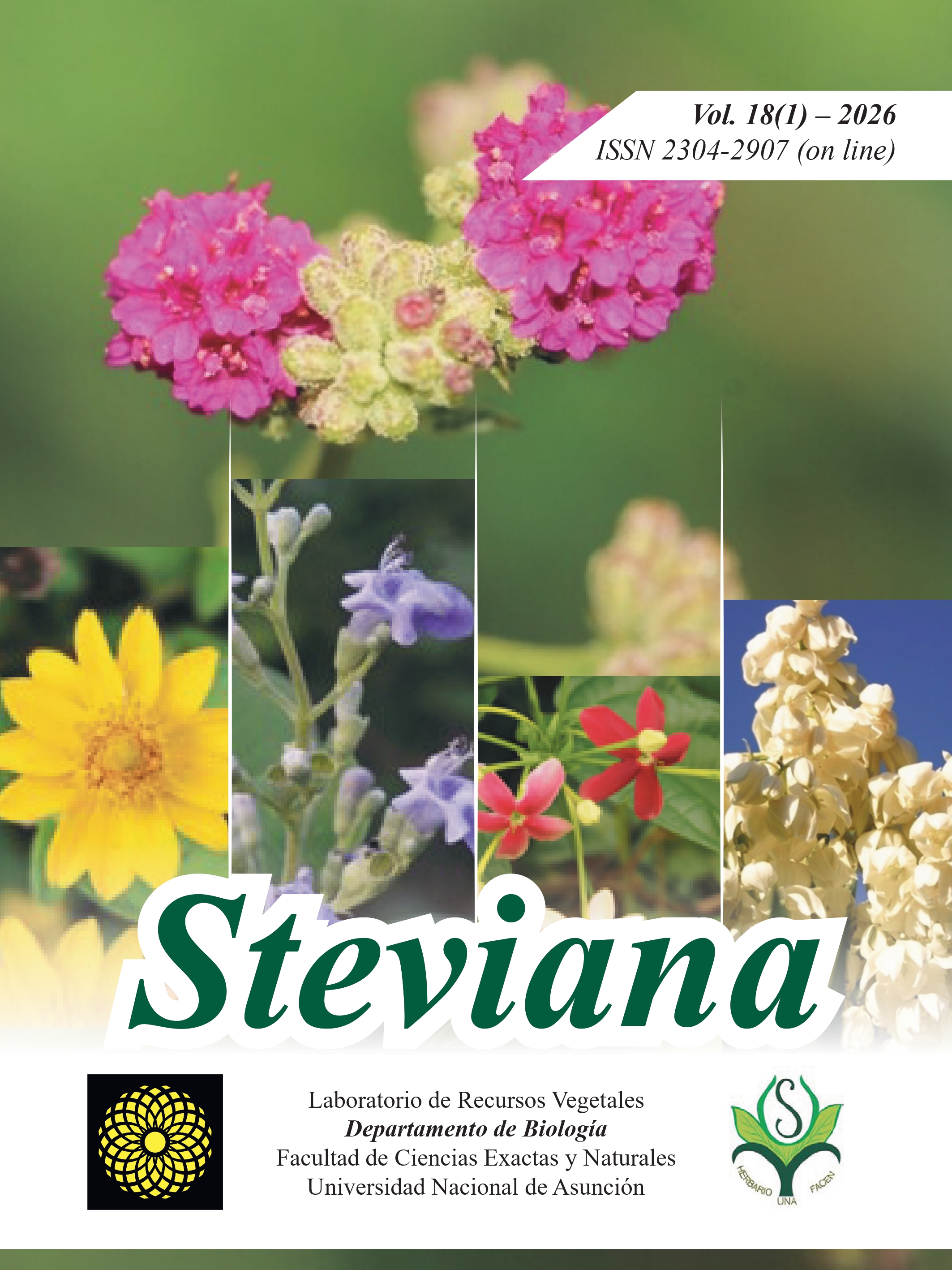
Northern Sinaloa, Mexico, harbors a rich diversity of wild floral species whose phytochemical potential has not been previously explored. This study presents a comprehensive evaluation of the antioxidant and antimicrobial activities of methanolic and ethyl acetate extracts obtained from wild flower species, including Albizia lebbeck, Boerhavia coccinea, Combretum indicum, Hylocereus undatus, Melampodium divaricatum, Vitex trifoliaand Yucca schidigera. The extracts were prepared using ultrasound-assisted solid–liquid extraction. Antioxidant activity was assessed using DPPH and ABTS assays, as well as total phenolic content determination by the Folin–Ciocalteu method. The results showed that the methanolic extract of B. coccinea exhibited the highest antioxidant activity (DPPH IC₅₀ = 16.4 µg/mL; ABTS IC₅₀ = 75.1 µg/mL) and the highest phenolic content (326.6 ± 1.67 mg GAE/g extract). The methanolic extract of C. indicum also displayed notable antioxidant activity (DPPH IC₅₀ = 63.1 µg/mL; ABTS IC₅₀ = 92.86 µg/mL; 208.5 ± 9.1 mg GAE/g extract). Antimicrobial activity was evaluated using the disk diffusion method against Staphylococcus aureus ATCC, Staphylococcus aureus MRSA, Salmonella Typhimurium, Escherichia coli ATCC, and Escherichia coli EAEC, revealing significant inhibition zones for several extracts. In addition, the extracts demonstrated protective activity against AAPH-induced hemolysis. These findings indicate that wild flowers from northern Sinaloa represent a promising source of secondary metabolites with multiple bioactivities, highlighting B. coccinea and C. indicum as strong candidates for further phytochemical studies and the development of natural bioactive products.
Downloads
References
Abalkhail, T., Alkubaisi, N. A., Aziz, I. M., Alsayed, M. F., Alodaini, H. A., AL‐Shenifi, A. S., & Farrag, M. A. (2025). Evaluation of the Antioxidant, Anticancer, and Antibacterial Activities of Flower and Leaf Extracts of Chrysanthemum indicum. ChemistryOpen, 14(10).https://doi.org/10.1002/open.202500252
Akman, T. Ç., Şimşek, S., Akşit, Z., Aydın, A., & Yılmaz, M. A. (2024). Exploring the Potential of Psephellus huber-Marathi (Wagenitz) Wagenitz: A Comprehensive UHPLC-MS/MS Analysis of Phytochemical Composition and Evaluation of Antioxidant, Antimicrobial, and Antiproliferative Activities. Kahramanmaraş Sütçü İmam Üniversitesi Tarım ve Doğa Dergisi, 27(4), 782–792. https://doi.org/10.18016/ksutarimdoga.vi.1339345
Apak, R., Özyürek, M., Güçlü, K., & Çapanoğlu, E. (2016). Antioxidant Activity/Capacity Measurement. 1. Classification, Physicochemical Principles, Mechanisms, and Electron Transfer (ET)-Based Assays. Journal of Agricultural and Food Chemistry, 64(5), 997–1027. https://doi.org/10.1021/acs.jafc.5b04739
Atanasov, A. G., Zotchev, S. B., Dirsch, V. M., Orhan, I. E., Banach, M., Rollinger, J. M., Barreca, D., Weckwerth, W., Bauer, R., Bayer, E. A., Majeed, M., Bishayee, A., Bochkov, V., Bonn, G. K., Braidy, N., Bucar, F., Cifuentes, A., D’Onofrio, G., Bodkin, M., … Supuran, C. T. (2021). Natural products in drug discovery: advances and opportunities. Nature Reviews Drug Discovery, 20(3), 200–216. https://doi.org/10.1038/s41573-020-00114-z
Balouiri, M., Sadiki, M., & Ibnsouda, S. K. (2016). Methods for in vitro evaluating antimicrobial activity: A review. Journal of Pharmaceutical Analysis, 6(2), 71–79. https://doi.org/10.1016/j.jpha.2015.11.005
Breda, C., Nascimento, A., Meghwar, P., Lisboa, H., Aires, A., Rosa, E., Ferreira, L., & Barros, A. N. (2025). Phenolic Composition and Antioxidant Activity of Edible Flowers: Insights from Synergistic Effects and Multivariate Analysis. Antioxidants, 14(3), 282. https://doi.org/10.3390/antiox14030282
Briones, E. R., Hernández, B. C. R., & Martínez, P. B. G. (2025). Bioeconomía desde la etnobotánica: plantas ancestrales moléculas actuales. In Bioeconomía en Latinoamérica: desafíos para la sostenibilidad y el desarrollo. (Vol. 3, pp. 108–134). Universidad de Guadalajara.
Chen, X., Lan, W., & Xie, J. (2024). Natural phenolic compounds: Antimicrobial properties, antimicrobial mechanisms, and potential utilization in the preservation of aquatic products. Food Chemistry, 440, 138198. https://doi.org/10.1016/j.foodchem.2023.138198
China, R., Mukherjee, S., Sen, S., Bose, S., Datta, S., Koley, H., Ghosh, S., & Dhar, P. (2012). Antimicrobial activity of Sesbania grandiflora flower polyphenol extracts on some pathogenic bacteria and growth stimulatory effect on the probiotic organism Lactobacillus acidophilus. Microbiological Research, 167(8), 500–506. https://doi.org/10.1016/j.micres.2012.04.003
Coyago-Cruz, E., Alarcón, A., Guachamin, A., Méndez, G., Osorio, E., Heredia-Moya, J., Zuñiga-Miranda, J., Beltrán-Sinchiguano, E., & Vera, E. (2024). Functional, Antioxidant, Antibacterial, and Antifungal Activity of Edible Flowers. Antioxidants, 13(11), 1297. https://doi.org/10.3390/antiox13111297
Duarte-Moreira, R. R., Zimmermann-Martins, G., Teixeira-Botelho, V., dos Santos, L. E., Cavaleiro, C., Salgueiro, L., Andrade, G., & Martins, C. H. G. (2014). Composition and Activity against Oral Pathogens of the Essential Oil of Melampodium divaricatum DC. Chemistry & Biodiversity, 11(3), 438–444. https://doi.org/10.1002/cbdv.201300322
Eghbaliferiz, S., & Iranshahi, M. (2016). Prooxidant Activity of Polyphenols, Flavonoids, Anthocyanins and Carotenoids: Updated Review of Mechanisms and Catalyzing Metals. Phytotherapy Research, 30(9), 1379–1391. https://doi.org/10.1002/ptr.5643
El Mihyaoui, A., Esteves da Silva, J. C. G., Charfi, S., Candela Castillo, M. E., Lamarti, A., & Arnao, M. B. (2022). Chamomile (Matricaria chamomilla L.): A Review of Ethnomedicinal Use, Phytochemistry and Pharmacological Uses. Life. 12(4), 479. https://doi.org/10.3390/life12040479
González-Elizondo, M. S., González-Elizondo, M., Tena-Flores, J. A., Ruacho-González, L., & López-Enríquez, I. L. (2022). Vegetación de la Sierra Madre Occidental, México: una síntesis. Acta Botánica Mexicana, (100), 351–403. https://doi.org/10.21829/abm100.2012.40
Gonçalves, F., Gonçalves, J. C., Ferrão, A. C., Correia, P., & Guiné, R. P. F. (2020). Evaluation of phenolic compounds and antioxidant activity in some edible flowers. Open Agriculture, 5(1), 857–870. https://doi.org/10.1515/opag-2020-0087
Hajlaoui, H., Arraouadi, S., Mighri, H., Ghannay, S., Aouadi, K., Adnan, M., Elasbali, A. M., Noumi, E., Snoussi, M., & Kadri, A. (2022). HPLC-MS Profiling, Antioxidant, Antimicrobial, Antidiabetic, and Cytotoxicity Activities of Arthrocnemum indicum (Willd.) Moq. Extracts. Plants, 11(2), 232. https://doi.org/10.3390/plants11020232
Hemeg, H. A., Moussa, I. M., Ibrahim, S., Dawoud, T. M., Alhaji, J. H., Mubarak, A. S., Kabli, S. A., Alsubki, R. A., Tawfik, A. M., & Marouf, S. A. (2020). Antimicrobial effect of different herbal plant extracts against different microbial population. Saudi Journal of Biological Sciences, 27(12), 3221–3227. https://doi.org/10.1016/j.sjbs.2020.08.015
Himri, C., Belkhiri, C., Azizi, S. E., Loukili, E. H., Rahhou, I., Legssyer, M., & Legssyer, B. (2025). A Comparative Study of Phenolic Compounds, and the Antioxidant Properties of Arabica Coffee Beans (Coffea arabica) and Robusta Coffee Beans (Coffea canephora) and Their By-Products. Tropical Journal of Natural Product Research, 9(8), 3568–3580. https://doi.org/10.26538/tjnpr/v9i8.17
Hulankova, R. (2024). Methods for Determination of Antimicrobial Activity of Essential Oils In Vitro - A Review. Plants, 13(19), 2784. https://doi.org/10.3390/plants13192784
Jadhavar, P., & Deshpande, S. (2022). Recent Updates On Medicinal Potentiality of Fabaceae Family: Critical Review. International Journal of Pharma and Bio Sciences, 13(3). https://doi.org/10.22376/Ijpbs.2022.13.3.b32-41
Karageçili, H., & G. İ. (2025). The Lamiaceae family plants ethnobotanical properties, ethnopharmacological uses, phytochemical studies and their utilization in public or current clinical practices: A review. Records of Natural Products, 19(Special issue), 307–307. https://doi.org/10.25135/rnp.540.2506.3573
Kobayashi, T., Ikeda, M., Okada, Y., Higurashi, Y., Okugawa, S., & Moriya, K. (2021). Clinical and Microbiological Characteristics of Recurrent Escherichia coli Bacteremia. Microbiology Spectrum, 9(3). https://doi.org/10.1128/Spectrum.01399-21
Kumar, M. (2015). Antibacterial activity of combretum indicum (l.) Defilipps flower extracts against gram-positive and gram-negative human pathogenic bacteria. In 1288 world journal of pharmacy and pharmaceutical sciences SJIF Impact Factor 5 (Vol. 4, Number 10). www.wjpps.com
Liu, Y., Zhang, H., & Wei, S. (2015). Ultrasonic-assisted extraction of pigments from Hylocereus undatus flowers: optimization, antioxidant activity, and HPLC analysis. RSC Advances, 5(58), 46598–46607. https://doi.org/10.1039/C5RA04089B
Mohanasundaram, P., & Saral, A. M. (2023). Phytochemical Screening, Antibacterial, Antifungal, Anti‐Biofilm and Antioxidant Activity of Azadiracta Indica A. Juss. Flowers. Chemistry & Biodiversity, 20(3). https://doi.org/10.1002/cbdv.202201049
Monroy-García, I. N., Carranza-Torres, I. E., Carranza-Rosales, P., Oyón-Ardoiz, M., García-Estévez, I., Ayala-Zavala, J. F., Morán-Martínez, J., & Viveros-Valdez, E. (2021). Phenolic Profiles and Biological Activities of Extracts from Edible Wild Fruits Ehretia tinifolia and Sideroxylon lanuginosum. Foods, 10(11), 2710. https://doi.org/10.3390/foods10112710
Morales-Figueroa, G.-G., Pereo-Vega, G. D., Reyna-Murrieta, M. E., Pérez-Morales, R., López-Mata, M. A., Sánchez-Escalante, J. J., Tapia-Rodriguez, M. R., Ayala-Zavala, J. F., Juárez, J., & Quihui-Cota, L. (2022). Antibacterial and Antioxidant Properties of Extracts of Yucca baccata, a Plant of Northwestern Mexico, against Pathogenic Bacteria. BioMed Research International, 2022(1). https://doi.org/10.1155/2022/9158836
Mottaghipisheh, J., Kamali, M., Doustimotlagh, A. H., Nowroozzadeh, M. H., Rasekh, F., Hashempur, M. H., & Iraji, A. (2024). A comprehensive review of ethnomedicinal approaches, phytochemical analysis, and pharmacological potential of Vitex trifolia L. Frontiers in Pharmacology, 15. https://doi.org/10.3389/fphar.2024.1322083
Nancy, R. M. I., Meenashree, B., & Vasanthi, V. J. (2014). Screening of Antibacterial Activity and Qualitative and Quantitative analysis of Phytochemicals in vitex trifolia. In Int.J.Curr.Microbiol.App.Sci (Vol. 3, Number 5). http://www.ijcmas.com
Navarro-Hoyos, M., Bisoyi, R., KC, P., Lutz, N., & Ruxsarash, M. (2026). Key Dietary Flavonoids: Insights into Their Structural Characteristics, Antioxidant and Anti-Inflammatory Activities, and Potential as Neuroprotective Agents. Molecules, 31(1), 154. https://doi.org/10.3390/molecules31010154
Osuna, L., Tapia-Pérez, M. E., Jiménez-Ferrer, J. E., Carrillo-Quiróz, B. A., & Silva-Sánchez, J. (2005). Screening of Alternanthera repens., Boerhavia coccinea., Flaveria trinervia., Tournefortia densiflora., and Vitex mollis. Extracts to Evaluate their Antibacterial Activity and Effect on Smooth Muscle. I. Pharmaceutical Biology, 43(9), 749–753. https://doi.org/10.1080/13880200500406412
Patel, S. (2012). Yucca: A medicinally significant genus with manifold therapeutic attributes. Natural Products and Bioprospecting, 2(6), 231–234. https://doi.org/10.1007/s13659-012-0090-4
Perez-Sepulveda, B. M., & Hinton, J. C. D. (2025). Microbe Profile: Salmonella Typhimurium: the master of the art of adaptation. Microbiology, 171(1). https://doi.org/10.1099/mic.0.001521
Piegang, B. N., Ndjateu, F. S. T., Tene, M., Bomba, F. D. T., Tseuguem, P. P., & Nguelefack, T. B. (2021). Antinociceptive, anti-inflammatory and antioxidant effects of Boerhavia coccinea extracts and fractions on acute and persistent inflammatory pain models. Journal of Basic and Clinical Physiology and Pharmacology, 32(1). https://doi.org/10.1515/jbcpp-2020-0118
Rahul, C., Pankaj, P., Sarwan, S. K., & Mahesh, J. K. (2010). Phytochemical screening and antimicrobial activity of Albizzia lebbeck. J. Chem. Pharm. Res, 2(5), 476–484.
Rassem, H. H., Khamidun, M. H. B., A. U. F. M., Hadibarata, T., & Alrabie, N. A. (2024). Comprehensive analysis of antioxidant and antibacterial activities of water and methanol extracts of Hibiscus flower. Journal of King Saud University - Science, 36(11), 103506. https://doi.org/10.1016/j.jksus.2024.103506
Ray, R., & Ray, A. (2020). Medicinal practices of sacred natural site: a socio-religious approach for successful implementation of primary healthcare services. Ethnobotany Research and Applications, 20, 1–46.
Rolnik, A., & Olas, B. (2021). The Plants of the Asteraceae Family as Agents in the Protection of Human Health. International Journal of Molecular Sciences, 22(6), 3009. https://doi.org/10.3390/ijms22063009
Sait Ertuğrul, M., Balpınar, Ö., Can Aytar, E., Aydın, B., Incilay Torunoglu, E., Durmaz, A., & Rossato Viana, A. (2025). Antioxidant, Antimicrobial, Anticancer, and Molecular Docking Insights into Pancratium maritimum Seeds and Flowers: A Phytochemical Approach. ChemistryOpen, 14(2). https://doi.org/10.1002/open.202400407
Šamec, D., Karalija, E., Šola, I., Vujčić Bok, V., & Salopek-Sondi, B. (2021). The Role of Polyphenols in Abiotic Stress Response: The Influence of Molecular Structure. Plants (Basel, Switzerland), 10(1). https://doi.org/10.3390/plants10010118
Shahane, K., Kshirsagar, M., Tambe, S., Jain, D., Rout, S., Ferreira, M. K. M., Mali, S., Amin, P., Srivastav, P. P., Cruz, J., & Lima, R. R. (2023). An Updated Review on the Multifaceted Therapeutic Potential of Calendula officinalis L Pharmaceuticals, 16(4), 611. https://doi.org/10.3390/ph16040611
Shahidi, F., &Ambigaipalan, P. (2015). Phenolics and polyphenolics in foods, beverages and spices: Antioxidant activity and health effects – A review. Journal of Functional Foods, 18, 820–897. https://doi.org/10.1016/j.jff.2015.06.018
Sobia, M. Z., Rasool, N., Mansha, A., Anjum, F., Iqbal, M., Mushtaq, M., & Shahid, M. (2013). Antioxidant, antibacterial, antifungal activities and phytochemical analysis of dagger (Yucca aloifolia) leaves extracts. Journal of Medicinal Plants Research, 7(6), 243–249.
Sreepian, P. M., Rattanasinganchan, P., & Sreepian, A. (2023). Antibacterial efficacy of Citrus hystrix (makrut lime) essential oil against clinical multidrug-resistant methicillin-resistant and methicillin-susceptible Staphylococcus aureus isolates. Saudi Pharmaceutical Journal, 31(6), 1094–1103. https://doi.org/10.1016/j.jsps.2023.03.020
Stachelska, M. A., Karpiński, P., & Kruszewski, B. (2025). A Comprehensive Review of Biological Properties of Flavonoids and Their Role in the Prevention of Metabolic, Cancer and Neurodegenerative Diseases. Applied Sciences, 15(19), 10840. https://doi.org/10.3390/app151910840
Tang, S., Wang, B., Liu, X., Xi, W., Yue, Y., Tan, X., Bai, J., & Huang, L. (2025). Structural insights and biological activities of flavonoids: Implications for novel applications. Food Frontiers, 6(1), 218–247. https://doi.org/10.1002/fft2.494
Tenore, G. C., Novellino, E., & Basile, A. (2012). Nutraceutical potential and antioxidant benefits of red pitaya (Hylocereus polyrhizus) extracts. Journal of Functional Foods, 4(1), 129–136. https://doi.org/10.1016/j.jff.2011.09.003
Tong, S. Y. C., Fowler, V. G., Skalla, L., & Holland, T. L. (2025). Management of Staphylococcus aureus Bacteremia: A Review. JAMA, 334(9), 798. https://doi.org/10.1001/jama.2025.4288
Torres-Bojórquez, A. E., García-Rubio, O. R., Miranda-López, R., & Cardador-Martínez, A. (2017). Evaluación de la capacidad antioxidante, características fisicoquímicas y perfil sensorial de Opuntia robusta y O. ficus-indica. Archivos Latinoamericanos de Nutrición, Volumen 67(Número 4). https://doi.org/10.37527/2017.67.4.006
Travis, C. R., McMaster, J., & Rivas, F. (2026). Advances in Natural Product Extraction: Established and Emerging Technologies. Molecules, 31(7), 1136. https://doi.org/10.3390/molecules31071136
Villaseñor, J. L. (2016). Checklist of the native vascular plants of México. Revista Mexicana de Biodiversidad, 87(3). https://doi.org/10.1016/j.rmb.2016.06.017
Viveros-Valdez, E., Jaramillo-Mora, C., Oranday-Cardenas, A., Mordn-Martinez, J., & Carranza-Rosales, P. (2016). Antioxidant, cytotoxic and alpha-glucosidase inhibition activities from the Mexican berry “Anacahuita” (Cordia boissieri). Archivos Latinoamericanos de Nutricion, 66(3), 211–218.
Wang, J., Li, H., She, Y., Xu, C., Peng, K., & Ding, W. (2026). Research progress on the damage of lipid peroxidation to the body and its correlation with metabolic diseases. Frontiers in Molecular Biosciences, 13. https://doi.org/10.3389/fmolb.2026.1793466
Wojtunik-Kulesza, K., Oniszczuk, A., Oniszczuk, T., Combrzyński, M., Nowakowska, D., & Matwijczuk, A. (2020). Influence of In Vitro Digestion on Composition, Bioaccessibility and Antioxidant Activity of Food Polyphenols—A Non-Systematic Review. Nutrients, 12(5), 1401. https://doi.org/10.3390/nu12051401
Wybraniec, S., & Mizrahi, Y. (2002). Fruit Flesh Betacyanin Pigments in Hylocereus Cacti. Journal of Agricultural and Food Chemistry, 50(21), 6086–6089. https://doi.org/10.1021/jf020145k
Xie, Y., Lu, H., Liu, Y., Hu, G., Lian, S., Liu, J., Pang, S., Zhu, G., & Ding, X. (2025). Unveiling the Mechanisms of Bacterial Resistance and Countermeasures. Pathogens, 14(11), 1085. https://doi.org/10.3390/pathogens14111085
Zaki, F. L. M., & Wan Salleh, W. M. N. H. (2020). Essential Oils and Biological Activities of the Genus Vitex (Lamiaceae) – A Review. Natural Volatiles and Essential Oils, 7(2), 1–9. https://doi.org/10.37929/nveo.743784
Zheng, C.-J., Li, H.-Q., Ren, S.-C., Xu, C.-L., Rahman, K., Qin, L.-P., & Sun, Y.-H. (2015). Phytochemical and Pharmacological Profile of Vitex egundo. Phytotherapy Research, 29(5), 633–647. https://doi.org/10.1002/ptr.5303
Zulkifli, L., Basri, M. H., & Syukur, A. (2021). Antibacterial activity of Vitex trifolia methanol extract against pathogenic bacteria. Journal of Physics: Conference Series, 1869(1), 012060. https://doi.org/10.1088/1742-6596/1869/1/012060
Downloads
Published
Issue
Section
License
Copyright (c) 2026 Monroy-García, Imelda Noehmi; Torres-Romero, Suleyka; Denise Castro-Ochoa, Lelie; Martínez-Cárdenas, Anahí

This work is licensed under a Creative Commons Attribution 4.0 International License.