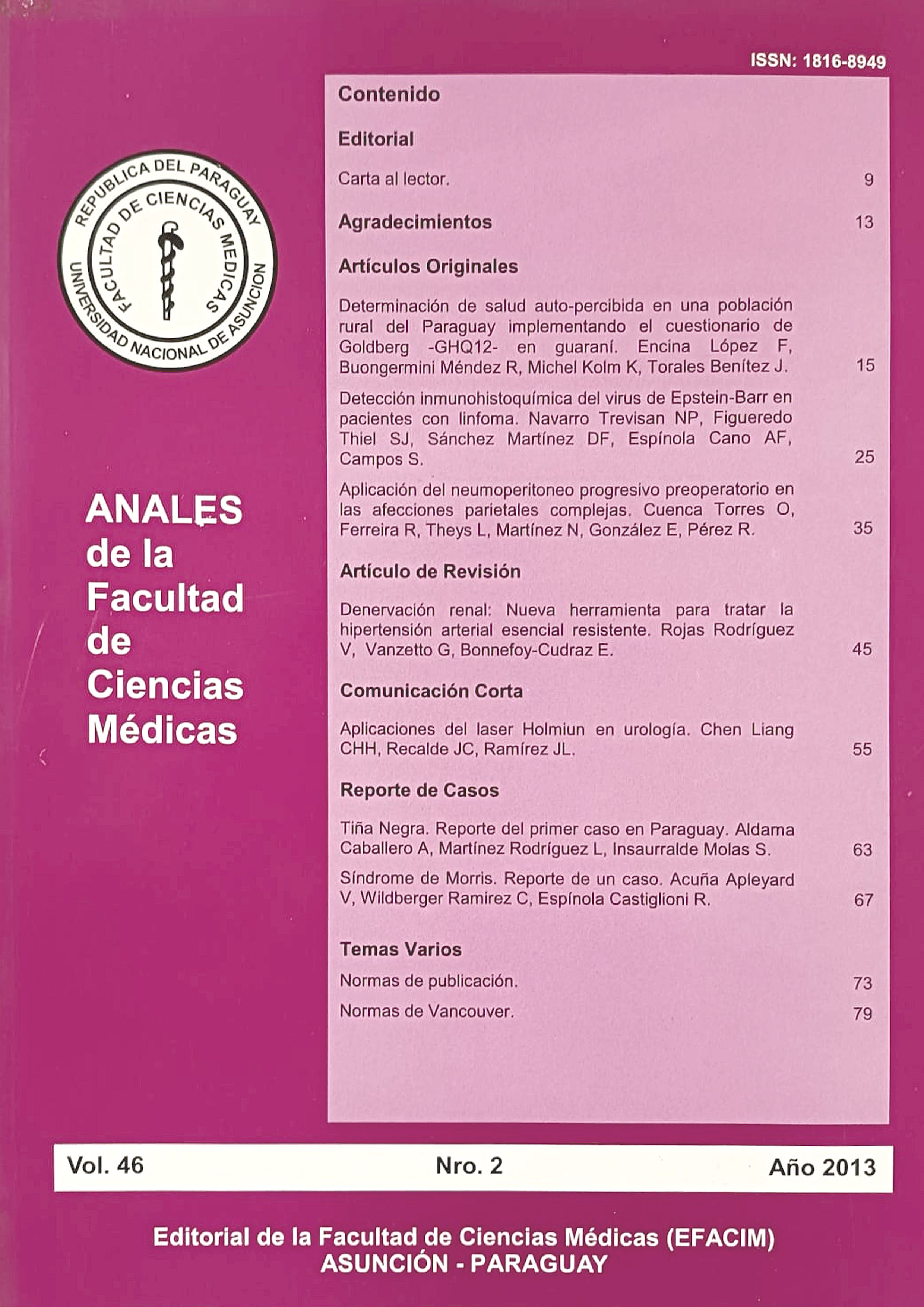
Renal denervation: A new tool to treat resistant essential hypertension.
DOI:
https://doi.org/10.18004/Keywords:
Arterial hypertension, renal denervation, Sympathetic activity, ParaguayAbstract
Arterial hypertension is one of major public health problem that affects between 30% and 40% of the adult population in industrialized countries. Despite the availability of many pharmacological treatments, hypertension often remains uncontrolled. A significant percentage of patients with hypertension remain resistant to the combination of drugs, which puts them at increased risk of cardiovascular events. Renal denervation using radiofrequency with low energy by endovascular catheter, decreasing the afferent innervation and reducing blood pressure in these patients. The patients who can benefit from this technique are the ones with an uncontrolled essential hypertension despite treatment with at least a combination of antihypertensive therapy with a diuretic, and have a glomerular filtration rate greater than or equal to 45mL/min. A first study in the form of registry showed that renal denervation ablation was a simple and safe procedure, and allowed a significant and sustained reduction in blood pressure. Then, a randomized trial (the Symplicity HTN-2) showed that blood pressure in the group receiving the intervention decreased an average of 32/12mmHg, while no change was found in the control group. This decrease in blood pressure persisted at 24 months follow-up. No complications associated with the procedure, no renal artery stenosis or aneurysmal dilatation has been identified during the follow-up. No alteration or worsening renal function has been observed. This technique seems to be a real hope for these severely ill patients. We present at the end of this review the protocol of the French Society of Cardiology for management and performance of this novel procedure.
References
1. Benamer H. et al. / Annales de Cardiologie et d’Angeiologie 2011 ; 60 ; 354-360
2. Krum H, Schlaich M, Sobotka P, Scheffers I, Kroonn AA, de Leeuw PW. Novel procedure and device based strategies in the management of systemic hypertension. Eur Heart J 2011; 32 (5): 537-44.
3. Mann SJ. Drug therapy for resistant hypertension: simplifying the approach.
4. J Clin Hypertens (Greenwich) 2011; 13 (2): 120-30.
5. Doummas M, Papademetriou V, Douma S, Faselis C, Tsioufis K, Gkaliagkousi E, et al. Benefits from treatment and control f patients with resistant hypertension. Int J Hypertens 2011; 2011: 1-8.
6. Esler M, Heart and mind: psychogenic cardiovascular disease. J Hypertens 2009;27(4): 692-5.
7. Guyton AC, Coleman TG, Granger HJ. Circulation: overall regulation. Annu Rev Physiol 1972; 43; 13-36.
8. Campese VM, Kgosow E. Renal afferent denervation prevents hypertension in rats with chronic renal failure. Hypertension 1995; 25(42): 878-72.
9. Cicone CD, Zambraski EJ, Effects of acute renal denervation on kidney function in deoxycorticosterone acetate-hypertensive swine. Hypertension 1986;8(10):925-31.
10. Schlaich MP, Sobotka PA, Krum H, Lambert E, Esler MD, Renal sympathetic-nerve ablation for uncontrolled hypertension. N Engl J Med 2009;361(9):932-4.
11. Esler MD, Krum H, Sobotka PA, Schalaich MP, Schmieder RE, Bohm M. Renal sympathetic deneervation in patients with treatment-resistant hypertension (The Symplicity HTN-2 Trial): a randomized controlled trial. Lancet 2010;376(9756):1903-9.
12. Krum H, Schalaich M, Whitbourn R, Sobotka PA, Sadowski J, Bartus K, et al. Catheter-based renal sympathetic denervation for resistant hypertension: a multicentre safety and proof-of-principle cohort study. Lancet 2009;373 (9671):1275-81.
13. Catheter-Based Renal Sympathetic Denervation for Resistant Hypertension : Durability of Blood Pressure Reduction Out to 24 Months Symplicity HTN-1 Investigators. Hypertension. 2011;57:911-917
14. Faselis C, Doumas M, Papademetriou V, Common secondary cuases of resistant hypertension and rational for treatment. In J Hypertens 2011; 2011: 236-239.
15. Turner MJ, van Schalkwyk JM. Is it ethical to perform irreversible renal denervation before a trial of low sodium intake for treatment-resitant hypertension? Hypertension 2011;58(2):e9.
16. Atul P, Girerd X, Aziz Mi, Benamer H, Halim JM, LantelmeP, Lefevre T,Sapova Ml.Société Française d’Hypertension Artérielle,de la Société Française de Cardiologie, du Groupe Athérome, Coronaire et Interventionnel et de la Société Française de Radiologie. Avril 2012.
17. Bisognano JD, Bakris G, Nadim MK, et al. Baroreflex. Activation therapy lowers blood pressure in patients with resistant hypertension: results from the double-blind,randomized, placebo-controlled rheos pivotal trial. J Am Coll Cardiol. 2011 Aug 9;58(7):765-73.
18. DiBona GF, Esler M. Translational medicine: the antihypertensive effect of renal denervation. Am J Physiol Regul Integr Comp Physiol 2010; 298(2):R245-53.
19. DiBona GF. Neural Control of the Kidney. Hypertension 2003;41(3):621-4.
20. Murray D. Esler, Henry Krum, Markus Schlaich, Roland E. Schmieder, Michael Böhm and Paul A. Sobotka. Symplicity HTN-2 Investigators. Circulation. 2012;126:2976-2982