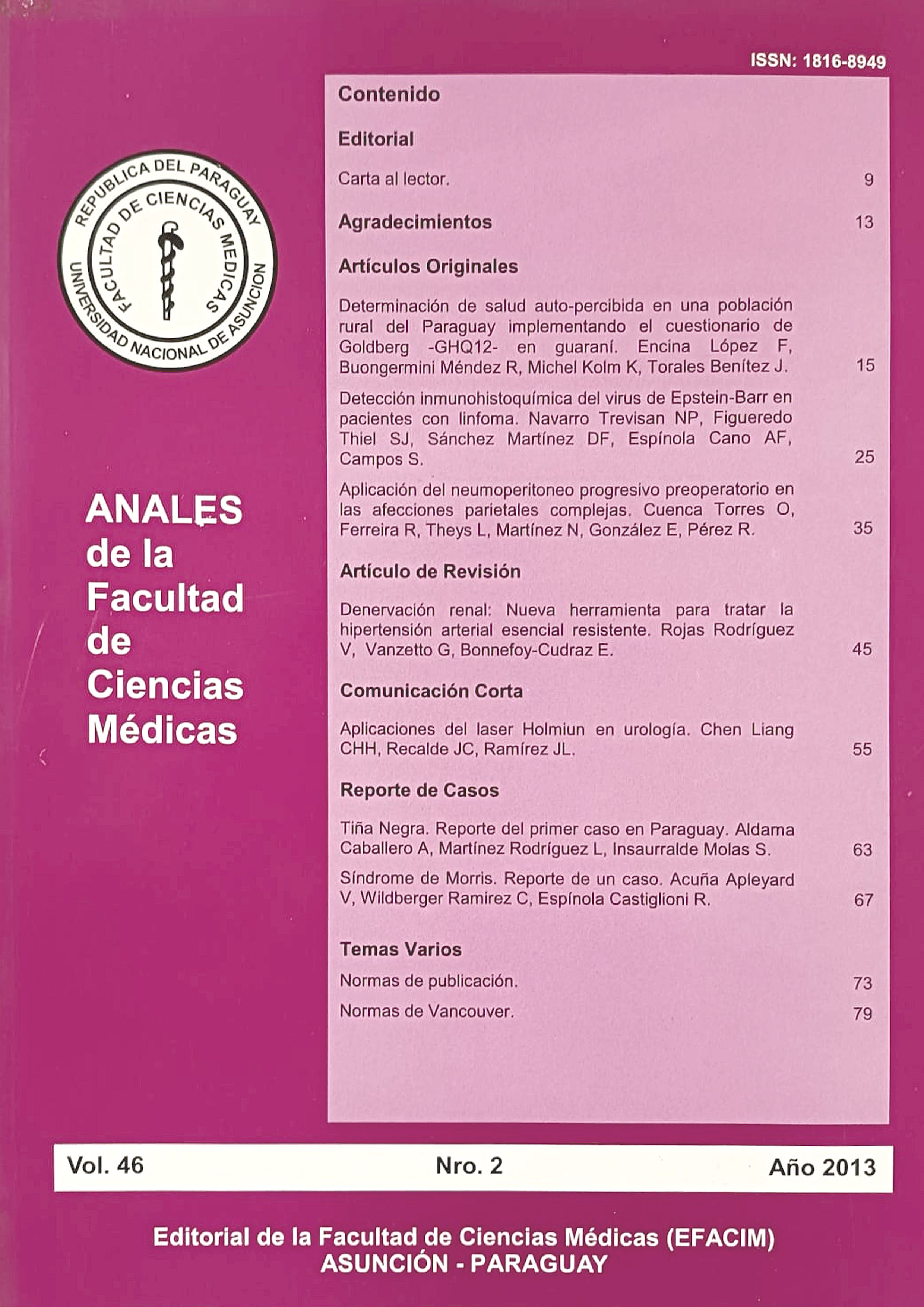
Determination of self-perceived health in a rural population of Paraguay implementing the Goldberg questionnaire -GHQ12- in guarani
DOI:
https://doi.org/10.18004/Keywords:
self-perceived health, GHQ, rural population, ParaguayAbstract
Introduction: The Goldberg self-perceived health questionnaire is an evaluation of the personal perception of the health of the individuals. As there is no evidence of the application of the GHQ in rural populations of Paraguay, the objective of the study was its implementation in said sector as a mean of determining the level of self-perceived health. Also, the translation of the questionnaire of Goldberg-GHQ12- into Guarani language was done, in order to make this instrument more suited to the rural population of Paraguay. Materials and Methods: The questionnaire is composed of 12 questions that express specific attitudes or symptoms. A positive result indicated risk of mental disorder. It was applied in the settlement San Antonio, San Pedro’s province, in May and June of 2013. Results: A total of 74 people were included, with an average age of 39±15.4 years. The average score was of 4.13±1.98. The 27% of subjects presented risk of emotional disorder. No significant differences were found between sexes, or correlation between age and score. Conclusion: The percentage of people at risk is consistent with the values found in the general population. It was noted that age and sex did not have a large influence on scores, corroborating results found in previous studies, even though the bibliography was divided. Despite the percentage being coherent with the rest of the population, the limited access to health professionals makes diagnosis and treatment of mental disorders difficult in this demographic sector.
References
1. Salud Mental [Internet]. Washington: Organización Mundial de la Salud. c2012 [cited 2013 Jun 07]. Available from: http://www.who.int/topics/mental_health/es/
2. Salud Mental: definición [Internet]. Washington: Organización Mundial de la Salud. c2012 [cited 2013 Jun 09]. Available from http://www.who.int/features/qa/62/es/index.html
3. La salud mental en América Latina y el Caribe [Internet]. Washington: Organización Mundial de la Salud. c2012 [cited 2013 Jun 09]. Available from http://www1.paho.org/Spanish/DD/PIN/saludmental_004.htm
4. García Viniegras C. Manual para la utilización del cuestionario de salud general de Goldberg. Adaptación cubana. Rev Cubana Med Gen Integr 1999; 15(1): 88-97.
5. Apostolo JLA, Figueiredo MH, Mendes AC, Rodrigues MA. Depression, anxiety and stress in primary care users. Rev. Latino-Am. Enfermagem 2011; 9(2): 348-53.
6. World Health Report 2001: Mental Health: new understanding, new hope [Internet]. Geneva: World Health Organization. c2001 [cited 2013 Jun 09]. Available from http://www.who.int/whr/2001/en/
7. World Health Report 2001: Primary health care – now more than ever [Internet]. Geneva: World Health Organization. c2008 [cited 2013 Jun 09]. Available from http://www.who.int/whr/2008/en/
8. Hulley S, Cunnings S, editores. Diseño de la investigación clínica. Un enfoque epidemiológico. 1ª ed. Barcelona: Doyma; 2008. p. 34-45.
9. Fullerton C, Acuña J, Florenzano R, Cruz C, Weil K. Psicopatología en pacientes hospitalizados en un hospital general. Revista chilena de neuro-psiquiatría 2003; 41(2): 103-9.
10. Rocha KB, Pérez K, Rodríguez-Sanz M, Borrell C, Llandrich JO. Propiedades psicométricas y valores normativos del General Health Questionnaire (GHQ-12) en población general española. International journal of clinical and health psychology 2011; 11(1): 125-39.
11. Susser M. Causal thinking in the health sciences: concepts and strategies of epidemiology. New York: Oxford University Press, 1973.
12. Nuñez Irene Y, Almeida Sergio, Czernik Gabriela E, Almirón Lila M. Determinación de salud auto-percibida en un Servicio Hospitalario de Emergencias. Alcmeon, Revista Argentina de Clínica Neuropsiquiátrica; 2007; 13(4).
13. Retolaza A, Mostajo A, De la Rica J R, Oiaz A, Pérez de Loza J, Arramberri, Márquez. Validación del Cuestionario de Salud General de Goldberg (versión 28 ítems) en consultas de Atención Primaria. Rev. Asoc. Esp. Neuropsiq 1993; 13 (1): 187-194.
14. Santander J, Romero M I, Hitschfeld M, Zamora V. Prevalencia de ansiedad y depresión entre los estudiantes de medicina de la Pontificia Universidad Católica de Chile. Rev. chil. neuro-psiquiatr 2011 ; 49 (1): 47-55
15. Gove, W. y Tudor, J. (1973). “Adult sex roles and mental illness”, American Journal of Sociology, vol. 78, pp. 812-835.
16. Rosenfield, S. (1980). “Sex differences in depression: Do women always have higher rates?” Journal of Health and Social Behavior, vol. 21, pp. 33-42.
17. Gore, S. y Mangione, T. W. (1983). “Social roles, sex roles and psychological distress: Additive and interactive models of sex differences”, Journal of Health and Social Behavior, vol. 24, pp. 300-312.
18. Annanale, E. y Hunt, K. (1990). “Masculinity, feminity and sex: An exploration of their relative contribution to explaining gender differences in health”, Sociology of Health and Illness, vol. 12, nº 1, pp. 24-46.
19. Aneshensel, C. S., Frerichs, R. R. y Clark, V. A. (1981). “Family roles and sex differences in depression”, Journal of Health and Social Behavior, vol. 22, pp. 379-393.
20. Marmot, M.G., Davey-Smith, G., Stansfeld, S., Patel, C., North, F., Head, J., White, I., Brunner, E. y Feeney, A. (1991). “Health inequalities among British civil servants: the Whitehall 2 study”, The Lancet, vol. 337, pp. 1387-1393.
21. Messing, K. y Stellman, J. M. (2006). “Sex, gender and women’s occupational health: The importance of considering mechanism”, Environmental Research, vol. 101, pp. 149-162.
22. Lobo A, Muñoz P. Cuestionario de salud general. Guía para el usuario de las distintas versiones. Versiones en lengua española validadas; Barcelona; 1996.