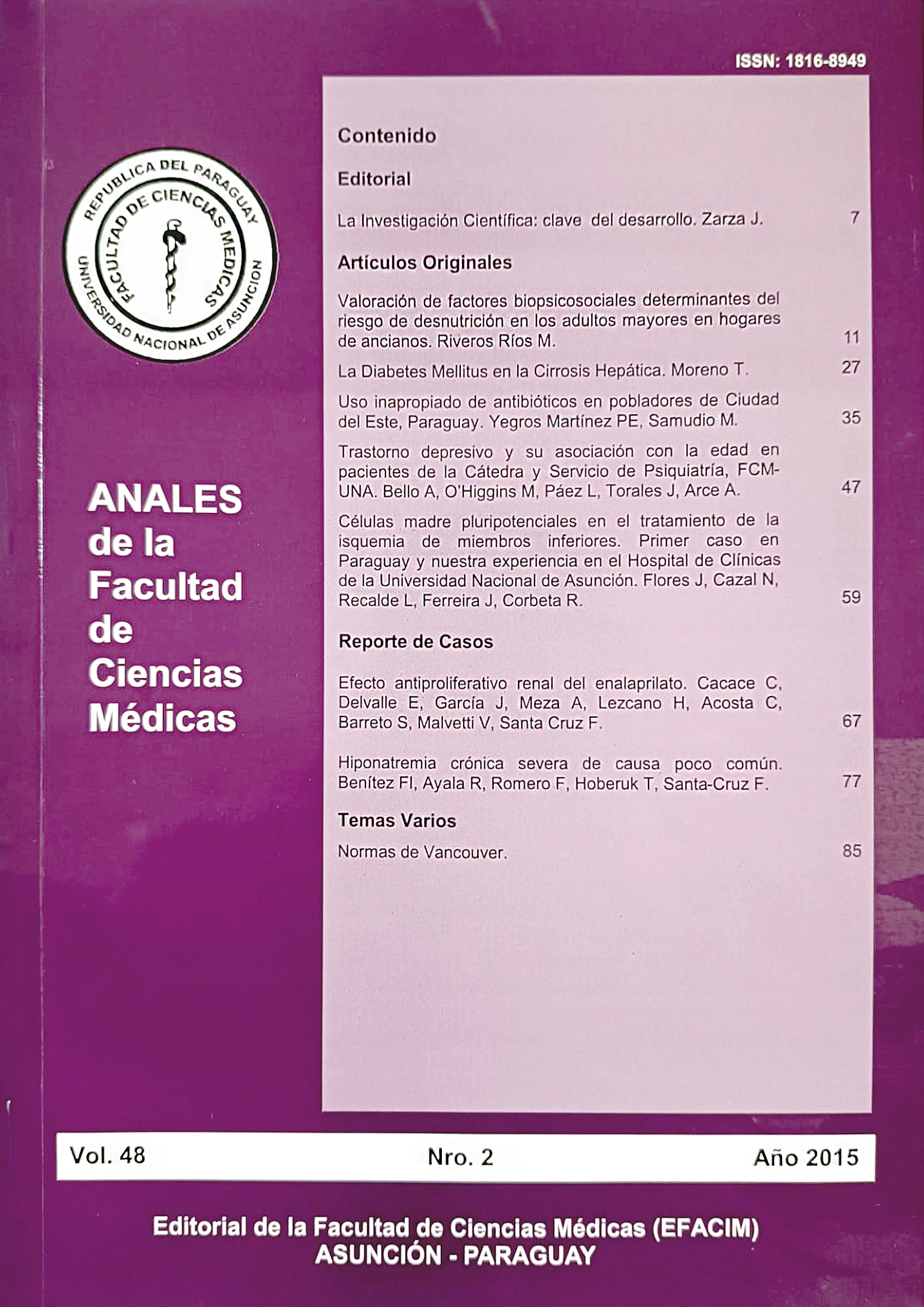
Renal antiproliferative effect of enalapril
DOI:
https://doi.org/10.18004/An.fcm/1816-8949.048.02.073-081Keywords:
Hyperfiltration, renal glomerulosclerosis, ACE inhibitors, enalapril, ParaguayAbstract
Introduction: Enalapril is known for its antiproliferative effect by inhibiting Angiotensin Converting Enzyme (ACEi). Reverses renal effects of angiotensin II including glomerular hyperfiltration can prevent sclerosis. Objective: To analyze antiproliferative effect of enalaprilat in renal sclerosis model in unilateral nephrectomized wistar rats. Material. Methods: 20 Wistar rats were divided into 4 groups of 5. Group 1: treatment with enalaprilat after nephrectomy. Group 2: enalaprilat prior to nephrectomy. Group 3: nephrectomy without treatment. Group 4: enalaprilat without nephrectomy. Dose was 60 mg / kg / per day by orogastric cannula for 1 month. Rats were sacrificed and kidney tissue samples were taken. Were evaluated size and kidney weight and glomerular injury staging by frequency and percentage. Results: 87 % of the rats survived nephrectomy. The renal size average was 20x10 mm and kidney weight of G1: 1.6 ± 0.1g; G2: 1.7 ± 0.5g; G3: 2.0 ± 0.2 g and G4 1.7 ± 0.1 g. The maximum degree of glomerulosclerosis was grade 1 (mensagial expansion / thickening of the basement membrane and / or irregularities lights capillaries); G1 showed 50 % involvement, 25 % presented G2, G3 and G4 showed 60 % without glomerular involvement. Conclusion: enalaprilat prevents glomerulosclerosis in G2 demonstrating administered before nephrectomy sclerosis developments decreases relative to the G1 and G3and this can prove antiproliferative effect of ACE inhibitors.
References
1. Santeliz Contra H, Romano Estrada L, González Chávez A, Hernández Hernández H. El sistema renina-angiotensina-aldosterona y su papel funcional más allá del control de la presión arterial. Rev Mex Cardiol. 2008;19:21-29.
2. Batlle D, Soler M, Wysocki, J. New aspects of the renin-angiotensin system: angiotensin-converting enzyme 2-a potential target for treatment of hypertension and diabetic nephropathy. Curr Opin Nephrol Hypertens 2008;17:250-257.
3. Flores O, Arévalo M, Gallego B, Hidalgo F, Vidal S, López-Novoa JM Beneficial effect of the long-term treatment with the combination of an ACE inhibitor and a calcium channel blocker on renal injury in rats with 5/6 nephrectomy. Exp Nephrol. 1998;6:39-49.
4. Fernández Andrade C. Renina: descubierta en 1898, inhibida en 2008. Historia de su investigación. Evolución y desarrollo de sus inhibidores. Rev Esp Cardiol. 2009;9(Supl A):1-23
5. Guyton AC, Coleman TG, Cowley AV Jr, Scheel KW, Manning RD Jr, Norman RA Jr. Arterial pressure regulation. Overriding dominance of the kidneys in long-term regulation and in hypertension. Am J Med. 1972;52(5):584-94
6. Couser WG. Basic and Translational Concepts of Immune-Mediated Glomerular Diseases. J Am Soc Nephrol 2012;23:381–399
7. Rosenberg HG. Primary glomerular diseases (primary glomerulopathies). Pathol Res Pract. 1986;181:489-523.
8. Marín R, Álvarez-Navascués R, Fernández-Vega F. Bloqueo del sistema renina-angiotensina-aldosterona en hipertensión arterial, diabetes y nefropatía. Rev Esp Cardiol Supl. 2008;8:30E-8E.
9. Adamczak M, Gross M, Krtil J, Koch A, . Tyralla K, et al. Reversal of glomerulosclerosis after high-dose enalapril treatment in subtotally nephrectomized rats. J Am Soc Nephrol. 2003;14:2833–2842.
10. Liern M, Maldonado L, Jordán P, Vallejo G. Efficacy of Enalapril in patients with single kidney and with or without normoprotein diet. Arch Argent Pediatr. 2008;106:416-21
11. Gossmann J, Wilhelm A, Kachel HG, Jordan J, Sann U, Geiger H, Kramer W, Scheuermann EH. Long-term consequences of live kidney donation follow-up in 93% of living kidney donors in a single transplant center. Am J Transplant. 2005;5:2417-24.
12. Ibrahim H, Foley R, LiPing T, Long-Term Consequences of Kidney Donation. N Engl J Med. 2009;360: 459–469