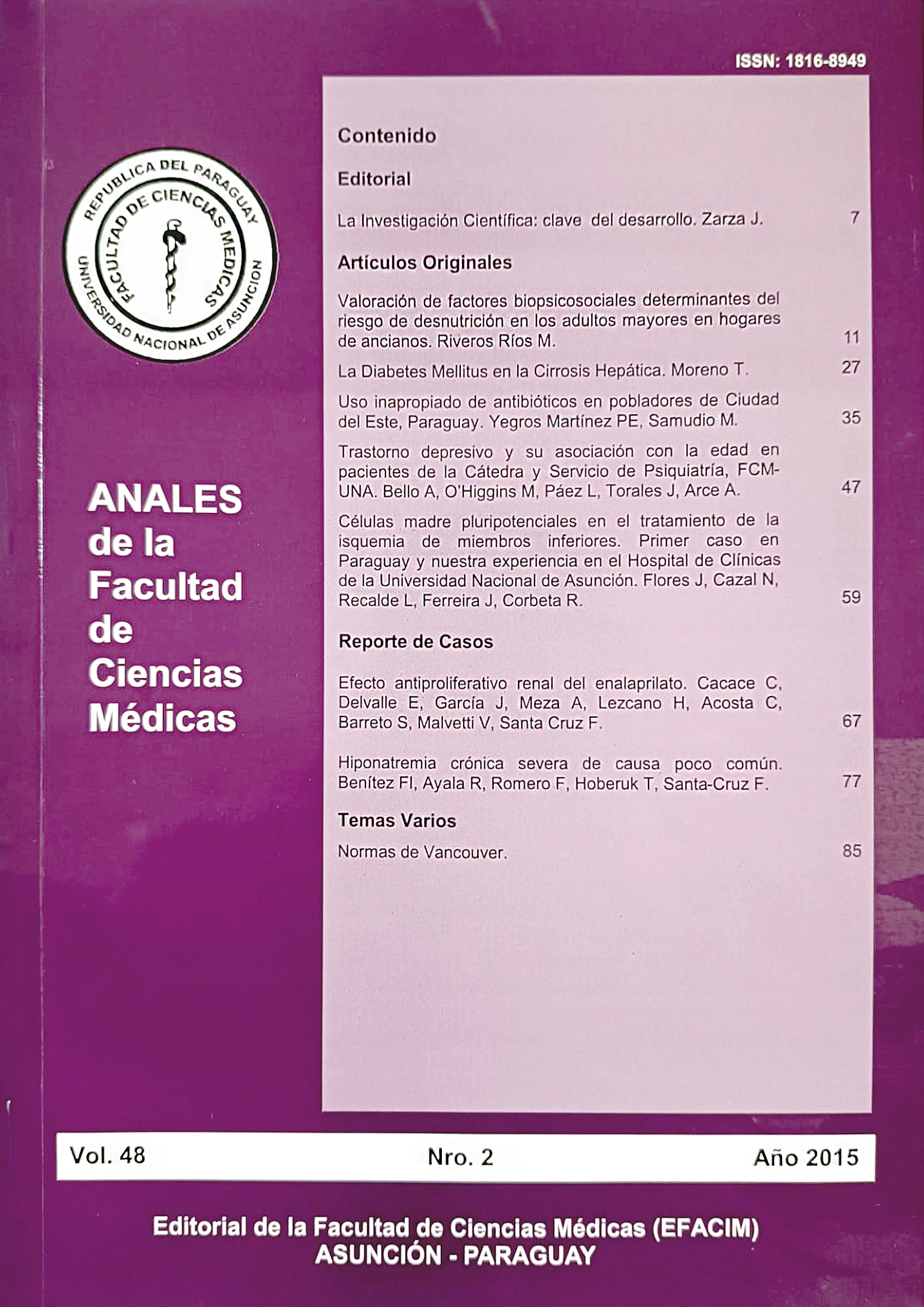
Depressive disorder and its association with age in patients of the Department of Psychiatry, FCM- UNA
DOI:
https://doi.org/10.18004/An.fcm/1816-8949.048.02.053-063Keywords:
Depression, age, gender, ParaguayAbstract
Introduction: According to the World Health Organization in the world there are over 350 million people with depression. 5% of the adult population suffers from depression. Severe mental disorders affect 1.5% of the total Paraguayan population. The aim of this study was to establish the association between the presentation of depressive disorder and the patient's age (over or under 45 years of age). Materials and Methods: An observational, analytical cohort study was conducted with consecutive non-probabilistic sampling of cases of patients treated at the Department of Psychiatry of the Faculty of Medical Sciences of the National University of Asuncion, in whom presented or not a depressive disorder, between the periods 2011 and 2012. The independent variables were age, sex and place of birth and the dependent variable was the presence or absence of a depressive disorder. The study included patients over 18 years, excluding those with incomplete medical histories. Results: The null hypothesis, indicating that patients with ages equal to or greater than 45 years did not have a higher prevalence of depressive disorder, was rejected with the chi-square value was of 31, 9356 (p <0.05). An odds ratio (OR) of 2.10 indicates that the estimated probability of a depressive disorder is double for those 45 and older than for those under 45 years. The relative risk (RR) indicates that those who have 45 or more years of age are 1.43 times more likely than those less than 45 years to present a depressive disorder. A stratified analysis was conducted demonstrating that sex is not a confounder, it interacts with age, making female patients more likely to suffer from a depressive disorders. Discussion: There is an association between depressive disorder and the patient's age, specifically ages higher or lower than 45 years. This could guide the psychiatrist to diagnose and to possible causes of the disorders, helping in prevention through relevant techniques according to that age group.
References
1. Organización Mundial de la Salud [sede web] Ginebra: Centro de Prensa; 9 de octubre de 2012 [acceso 10 de abril de 2014] La depresión es una enfermedad frecuente y las personas que la padecen necesitan apoyo y tratamiento. Disponible en: http://www.who.int/mediacentre/news/notes/2012/mental_health_day_20121009/es/
2. Junta de Castilla y León. Estrategia Regional de salud mental y asistencia psiquiátrica en Castilla y León. Junta de Castilla y León. Consejería de Sanidad y Bienestar Social. Dirección General de Planificación Sociosanitaria. 2007.
3. Harrington R, Rutter M, Weissman M, Fudge H, Groothues C, Bredenkamp D et al. Psychiatric disorders in the relatives of depressed probands I. Comparison of prepubertal, adolescent and early adult onset cases. J Affect Disord 1997;42:9-22.
4. Shaffer D, Fisher P, Dulcan MK, Davies M, Piacentini J, Schwab-Stone ME et al. The NIMH Diagnostic Interview Schedule for Children Versión 2.3 (DISC.2.3): Description, acceptability, prevalence rates, and performance in the MECA Study. Methods for the Epidemiology of Child and Adolescent Mental Disorders Study. J Am Acad Child Adolesc Psychiatry 1996;35:865-877.
5. Secretaría de Salud de México Diagnostico Epidemiológico. Dirección general de los servicios de salud mental. Epidemiología en el ámbito internacional. 2013.
6. Urrego, Diana Z., and Juan C. Cocoma. "Por la salud mental." Rev. salud pública 1.1 (1999): 58-67.
7. Barrio Pedro I, Eraña I, Mañol L. Relación de la actividad física con la depresión y la satisfacción en la tercera edad. Revista de la psicología del Deporte. 2001. Vol. 10, núm. 2, pp. 239-246.
8. Organización de las Naciones Unidas [sede web] Ginebra: Centro de Noticias ONU, 9 de octubre de 2012 [acceso 10 de abril de 2014] OMS afirma que la depresión es el trastorno mental más frecuente. Disponible en: http://www.un.org/spanish/News/story.asp?NewsID=24705#.U1E7Z1V5Pl8
9. ABC COLOR [en línea]. Asunción: Servicios periodísticos y multimedia; 2008 [fecha de acceso 10 de mayo del 2012], URL disponible en: http://archivo.abc.com.py/suplementos/rural/articulos.php?pid=282840
10. Berndt ER, Koran LM, Finkelstein SN, Gelenberg AJ, Kornstein SG, Miller IM, et al. Lost human capital from early-onset chronic depression. Am J Psychiatry 2000; 157(6): 940-47.
11. Dirección General de Estadisticas, Encuestas y Censos. Paraguay, Proyección de la población nacional 2000-2050. Dirección de Prensa, Fernando de la Mora, Paraguay, diciembre 2005. Disponible en: http://www.dgeec.gov.py/Publicaciones/Biblioteca/NACIONAL/Proyeccion_Nacional.pdf
12. Benjet C, Borges G, Medina-Mora M, Fleiz-Bautista C, Zambrano-Ruiz J. La depresión con inicio temprano: prevalencia, curso natural y latencia para buscar tratamiento. Salud pública Méx [revista en la Internet]. 2004 Oct [citado 2014 Abr 17] ; 46( 5 ): 417-424. Disponible en: http://www.scielo.org.mx/scielo.php?script=sci_arttext&pid=S0036-36342004000500007&lng=es.
13. Haffer D, Fisher P, Dulcan MK, Davies M, Piacentini J, Schwab-Stone ME et al. The NIMH Diagnostic Interview Schedule for Children Versión 2.3 (DISC.2.3): Description, acceptability, prevalence rates, and performance in the MECA Study. Methods for the Epidemiology of Child and Adolescent Mental Disorders Study. J Am Acad Child Adolesc Psychiatry 1996;35:865-877.
14. Medina-Mora ME, Rascón ML, Tapia R, Mariño M, Juárez F, Villatoro J et al. Trastornos emocionales en población urbana mexicana: resultados de un estudio nacional. An Inst Mex Psiquiatr 1992; 3:48-55.
15. Schonhaut B L, Rojas N P, Kaempffer R A. Factores de riesgo asociados a déficit del desarrollo psicomotor en preescolares de nivel socioeconómico bajo: Comuna urbano rural, Región Metropolitana, 2003. Rev. chil. pediatr. [revista en la Internet]. 2005 Dic [citado 2014 Abr 17] ; 76( 6 ): 589-598. Disponible en: http://www.scielo.cl/scielo.php?script=sci_arttext&pid=S0370-41062005000600006&lng=es. http://dx.doi.org/10.4067/S0370-41062005000600006.
16. López H. "Uso de un índice de bienestar social para la planificación de la salud a nivel municipal." Salud Publica Mex 38 (1996): 257-267
17. Organización Mundial de la Salud. Estadísticas sanitarias mundiales 2013. Ginebra: OMS; 2013.
18. Páez L, O´Higgins M, Torales J. Pérdida económica acorde a años de vida perdidos por discapacidad en pacientes de la Cátedra y Servicio de Psiquiatría de la Facultad de Ciencias Médicas de la Universidad Nacional de Asunción, Paraguay, años 2011-2012. Revista Paraguaya de Psiquiatría 2013; 1 (2): 29-36
19. Couto Núñez D, Nápoles Méndez D. Síndrome climatérico en mujeres de edad mediana desde un enfoque médico social. MEDISAN [revista en la Internet]. 2012 Ago [citado 2014 Abr 18] ; 16(8): 1185-1194. Disponible en: http://scielo.sld.cu/scielo.php?script=sci_arttext&pid=S1029-30192012000800001&lng=es.
20. Torpy J, Burke A, Bass R. Depresión. JAMA, 19 de mayo de 2010—Vol 303, núm. 19
21. World Health Organization (sede web). Ginebra, octubre de 2012. (acceso 16 de junio de 2012) World suicide prevention day 2012. Disponible en: http://www.who.int/mediacentre/events/annual/world_suicide_prevention_day/en
22. Aragonès Benaiges, E., et al. "Prevalencia, expresión e impacto de los trastornos depresivos en atención primaria." Atención primaria 31.2 (2003): 120-125.
23. Aldana E, Gómez ME, Morales FA, Gaviño F. Síntomas psicológicos en un grupo de mujeres en etapa del climaterio, antes y después de un proceso psicoterapéutico. Ginecol Obstet Mex. 2007;75:268-76.
24. Rodríguez Miranda O, Apolinaire Pennini J, Alonso A. Prevalencia de alteraciones de la salud mental y factores de riesgo relevantes. Rev Cubana Med Gen Integr [revista en la Internet]. 2003 Ago [citado 2012 Jul 01] ;19(4): Disponible en: http://scielo.sld.cu/scielo.php?script=sci_arttext&pid=S0864-21252003000400007&lng=es.
25. Organización Mundial de la Salud. The Global Burden of Disease; 2004 update. WHO Geneva.