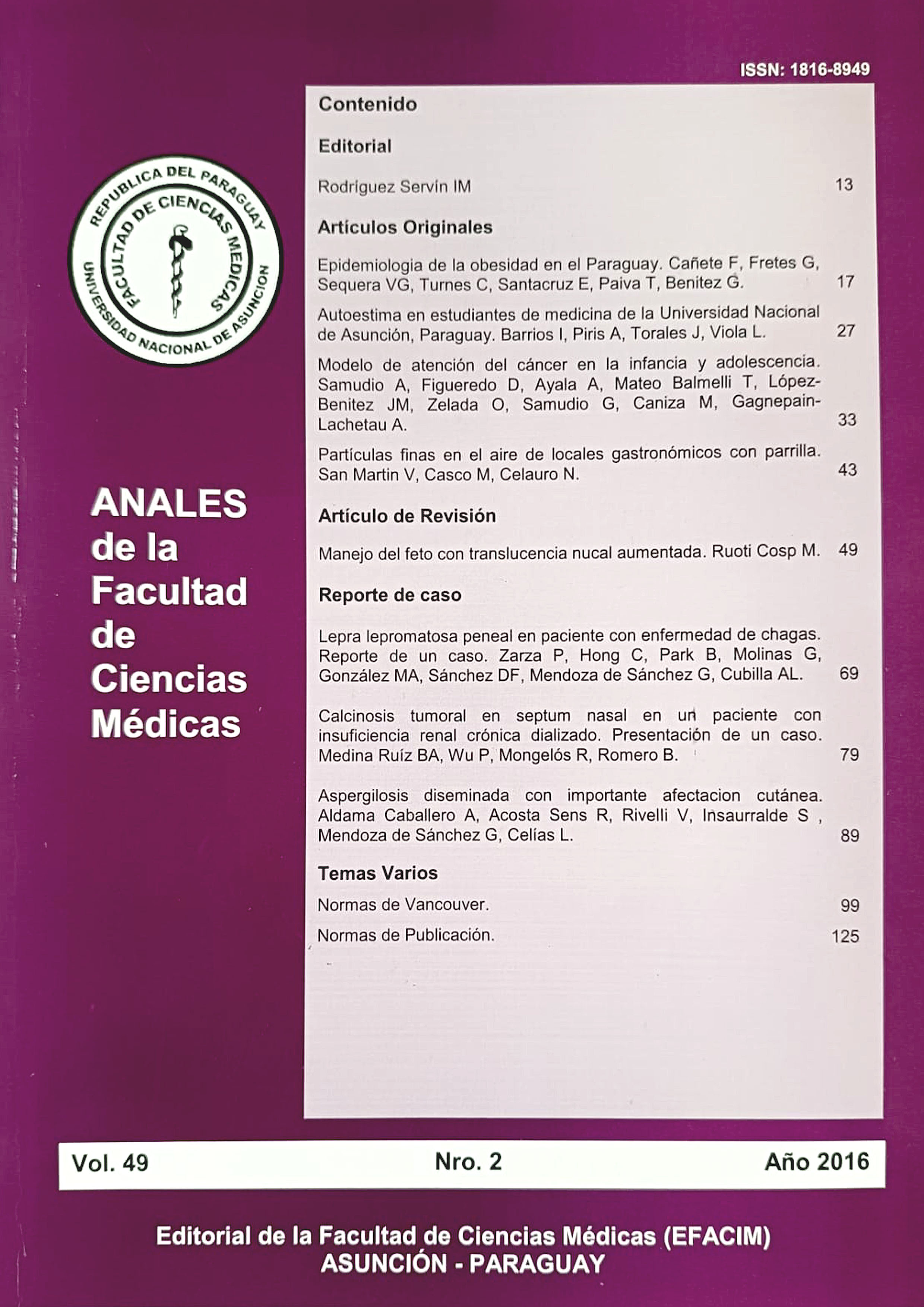
EPIDEMIOLOGY OF OBESITY IN PARAGUAY
DOI:
https://doi.org/10.18004/anales/2016.049(02)17-026Keywords:
obesity, lifestyle, determinants of health, ParaguayAbstract
Introduction: Paraguay has not escaped from the global epidemic of obesity. This study described the prevalence and socio-demographic, clinical and behavioral determinants associated to obesity. Methods: Cross-sectional study with a nationally representative survey, included people among 15 and 74 years old. The sampling was probabilistic, three-stage without replacement. STEPSwise was the methodology and survey applied during June-September 2011. Obesity was considered a body mass index (BMI) >=30 kg/m2. This value was distributed by sociodemographic, clinical, and behavioral variables. A logistic regression among obesity and variables was estimated for obtain odd ratios (OR) with confidence intervals of 95% (95% CI) of association. Results: 2501 participants were included. Were obese 23.5%, men and women were 20.2% and 26.0%, respectively. In addition to gender, showed significant differences: >35 years-old 3.17(2.11-4.76) than younger; men in urban residence 1.94(1.35-2.79) odds more than those in rural areas. No single men 2.52(1.80-3.53) odds more obese than single; civil servants 2.57(1.57-4.26) odds more than other jobs. Low physical activity 1.75(1.19-2.57) odds were more obese than a acceptable physical activity. In mans with the top income quintile showed 3.87(2.17-6.92) more obesity than the bottom quintile. In women, low educational level was 2.01(1.43-2.83) odds more than a higher. Conclusions: The observed pattern of obesity distribution in Paraguay described some behaviors and obesogenic environments. These results serve to take decisions and specific interventions in public health, beyond the population measures.
References
1. Finucane MM, Stevens GA, Cowan MJ, et al. and the Global Burden of Metabolic Risk Factors of Chronic Diseases Collaborating Group (Body Mass Index). National, regional and global trends in body-mass index since 1980: systematic analysis of health examination surveys and epidemiological studies with 960 countries-years and 9.1 million participants. Lancet 2011; 377:557-67.
2. WHO. Global health risks. Health Statistics and Informatics Department. Geneva: World Health Organization, 2004.
3. WHO. Global status report on non-communicable diseases 2010. Geneva: World Health Organization, 2011.
4. Lim SS, Vos T, Flaxman AD, et al. A comparative risk assessment of burden of disease and injury attributable to 67 risk factors and risk factor clusters in 21 regions, 1990-2010: a systematic analysis for the Global Burden of Disease Study 2010. Lancet 2012; 380:2224-60.
5. Moreno-Altamirano L, Hernández-Montoya D, Silberman M, Capraro S, García-García JJ, Soto-Estrada G, et al. La transición alimentaria y la doble carga de malnutrición: cambios en los patrones alimentarios de 1961 a 2009 en el contexto socioeconómico mexicano. ALAN 2014; 64(4):231-40.
6. Ministerio de Salud Pública y Bienestar Social. Paraguay. Primera Encuesta Nacional de Factores de Riesgo para Enfermedades No Transmisibles, 2011. Documento impreso.
7. Instituto Nacional de Alimentación y Nutrición, Ministerio de Salud Pública y Bienestar Social. Paraguay. Situación nutricional de escolares y adolescentes que asisten a escuelas públicas y privadas. Año 2007-2014. Disponible en: https://drive.google.com/file/d/0B0fO30Y7z_VPclFGTTVrbEs3MDA/view
8. Instituto Nacional de Alimentación y Nutrición, Ministerio de Salud Pública y Bienestar Social. Paraguay. Situación nutricional de mujeres embarazadas que asisten a servicios de salud pública. Año 2000-2014. Disponible en: https://drive.google.com/file/d/0B0fO30Y7z_VPM2h1UEVhQ0l4aEU/view
9. Prospective Studies Collaboration, Whitlock G, Lewington S, Sherliker P, Clarke R, Emberson J, et ál. Body-mass index and cause specific mortality in 900 000 adults: collaborative analyses of 57 prospective studies. Lancet 2009; Mar. 28; 373 (9669): 1083-96.
10. Kuntz B, Lampert T. Socioeconomic factors and obesity. Dtsch Arztebl Int 2010; 107(30):517-22.
11. Reidpath D, Burns C, Garrard J, Mahoney M, Townsend M. An ecological study of the relations¬hip between social and environmental determinants of obesity. Health Place 2002; 8:141-45.
12. WHO. Global Physical Activity Questionnaire / GPAQ. Surveillance and Population-Based Prevention Prevention of Noncommunicable Diseases. Switzerland. Disponible en: http://www.who.int/chp/steps/GPAQ/es/
13. Álvarez-Castaño LS, Goez-Rueda JD, Carreño-Aguirre C. Factores sociales y económicos asociados a la obesidad: los efectos de la inequidad y de la pobreza. Rev. Gerenc. Polit. Salud 2012;11(23):98-110.
14. Ortiz-Moncada R, Álverez-Dardet C, Miralles-Bueno JJ, Ruiz-Cantero M, Dal Re-Saavedra, Villar-Villalba C et al. Determinantes sociales de sobrepeso y obesidad en España 2006. Med Clin (Barc) 2011;137(15):678-84.
15. Álvarez-Dongo D, Sánchez-Abanto J, Gómez-Guizado G, Tarqui-Mamami C. Sobrepeso y obesidad: prevalencia y determinantes sociales del exceso de peso en la población peruana (2009-2010). Rev Peru Med Exp Salud Pública 2012;29(3):303-13.
16. McMurray RG, Harrell JS, Deng S, Bradley C, Cox LM, Bangdiwala SI. The influence of physical activity, socioeconomic status, and ethnicity on the weight status of adolescents. Obes Res. 2000; 8 (2): 130-139.
17. Pedraza D. Obesidad y Pobreza: marco conceptual para su análisis en latinoamérica. Saúde e Sociedade 2009;(18):103-17.
18. Jeffery RW, Forster JL, Folsom AR, Luepker RV, Jacobs DR Jr, Blackburn H. The relationship between social status and body mass index in the Minnesota Heart Health Program. Int J Obes. 1989; 13 (1): 59-67.
19. Martikainen PT, Marmot MG. Socioeconomic differences in weight gain and determinants and consequences of coronary risk factors. Am J Clin Nutr. 1999 Abr.; 69: 719-726.
20. McLaren L. Socioeconomic status and obesity. Epidemiol Rev 2007; 29:29-48.
21. Barquera S, Rivera J, Espinosa-Montero J, Safdie M, Campirano F, MOnterrubio EA. Energy and nutrient consumption in Mexican woman 12-49 years of age: Analysis of the National Nutrition Survey 1999. Salud Pública México 2003;45(Supl 4):S530-39.
22. Alimentos y bebidas ultraprocesados en América Latina: tendencias, efecto sobre la obesidad e implicaciones para las políticas públicas. Washington, DC: OPS, 2015.
23. Lake A, Townshend T. Obesogenic environments: exploring the built and food environments. JRSH 2006;126(6):262-67.
24. Reidpath D, Burns C, Garrard J, Mahoney M, Townsend M. An ecological study of the relations¬hip between social and environmental determinants of obesity. Health Place. 2002 Jun.; 8: 141-145.
25. Gutiérrez-Pisac JL, Royo-Bordonada MA, Rodríguez-Artalejo F. Riesgos asociados a la dieta occidental y al sedentarismo: la epidemia de obesidad. Gac Sanit 2006;20(Supl 1):48-54.
26. Martin AR, Nieto JM, Ruiz JP, Jiménez LE. Overweight and obesity: the role of education, employment and income in Spanish adults. Appetie 2008; 2008:51:266-72.
27. Boletin de Enfermedades Crónicas No Transmisibles 2015. Dirección de Vigilancia de Enfermedades No Transimisibles, Ministerio de Salud y Bienestar Social. Disponible en: http://www.mspbs.gov.py/dvent/