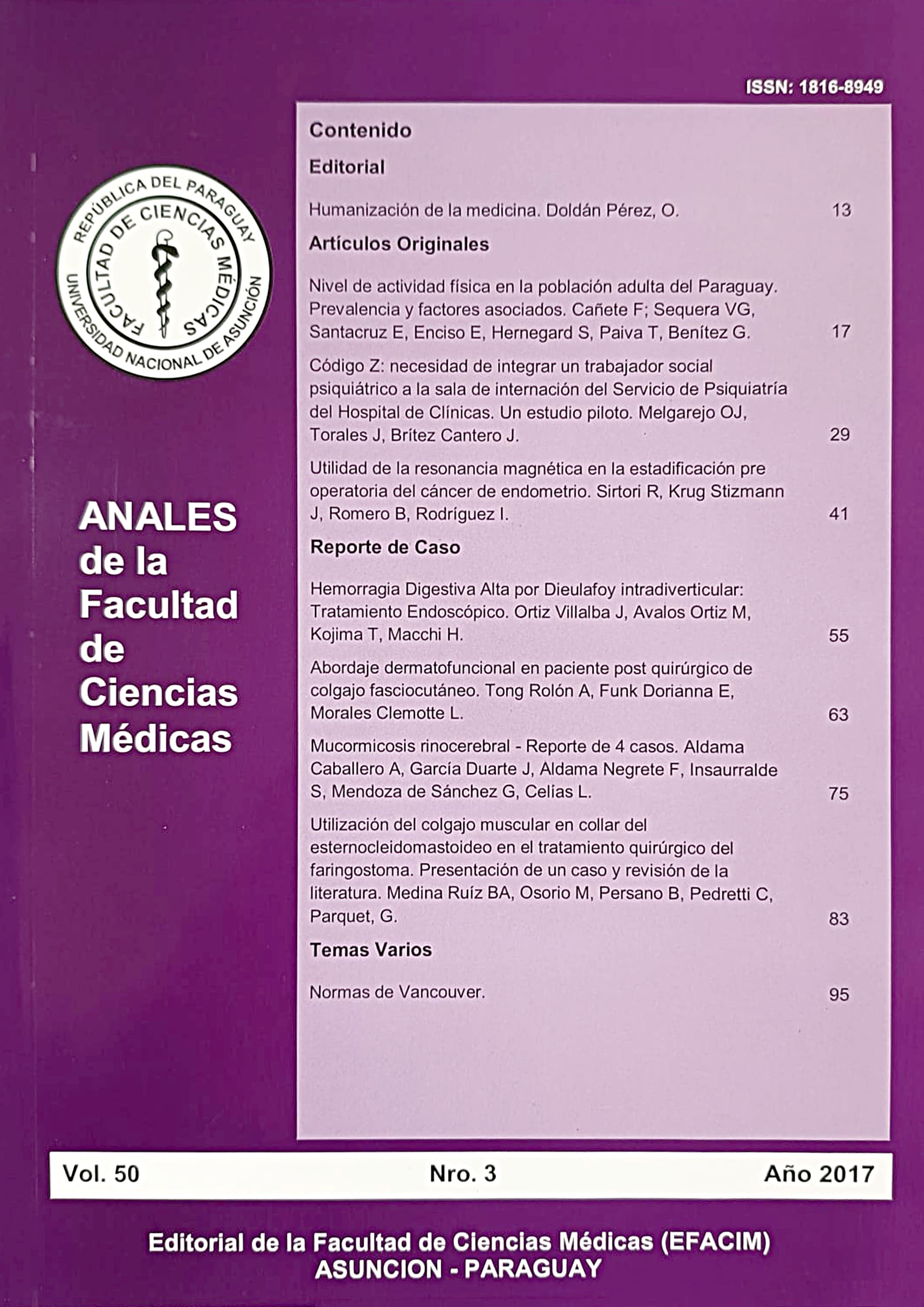
Use of the sternocleidomastoid muscle collar flap in the surgical treatment of the pharyngostoma. Case report and literature review
DOI:
https://doi.org/10.18004/anales/2017.050(03)83-094Keywords:
pharyngocutaneous fistula, pharyngostoma, closure, flap, sternocleidomastoid, ParaguayAbstract
Pharyngocutaneous fistula is defined as a dehiscence of the closing of the pharyngeal mucosa, which produces leakage of saliva and communication of pharyngeal light with the skin. It can be classified as a fistula proper, in which a fistulous tract communicates light from the digestive tract with the outside and in a pharyngostoma in which the pharyngeal lumen opens directly to the outside with significant loss of soft tissues. It is a frequent complication after open surgeries of the larynx, and may also appear after surgery of the pharynx, spinal column, mandibular reconstructions as well as surgeries of the floor of the mouth. Although they can close spontaneously or with conservative treatment, many of them, especially when there is a wide communication between the pharynx and the skin, require surgery. There are several surgical techniques to close these fistulas. We present a case in which the excresis of a tongue-based tumor was performed, due to uncontrollable bleeding, with a suprahyoid pharyngotomy as the approach, presenting as a postoperative complication a pharyngocutaneous fistula followed by the formation of a broad pharyngostoma. He was treated surgically with a synthesis of the defect and reinforcement with a muscular flap in a collar with the bilateral sternocleidomastoid sternal fascicle. The patient presented good evolution with closure of the fistula.
References
1. Palomar Asenjo, V.; Sarroca Capell, E.; Tobías Gómez, S.; Pérez Hernández, I.; Palomar García, V. Fístula faringocutánea tras laringectomía total. Estudio de casos y controles de los factores de riesgo implicados en su aparición. Acta Otorrinolaringol Esp. 2008; 59(10): 480-4.
2. Mattioli, F.; Bettini, M.; Molteni, G.; Piccinini, A.; Valoriani, F.; Gabriele, S.; Presutti, L. Analysis of risk factors for pharyngocutaneous fistula after total laryngectomy with particular focus on nutritional status.Acta Otorhinolaryngol Ital. 2015; 35: 243-8.
3. Toyama Aires, F.; Dedivitis, RA.; Ferrari de Castro, MA.; Araki Ribeiro, D.; Cernea, CR.; Garcia Brandão, L. Pharyngocutaneous fistula following total laryngectomy. Braz J Otorhinolaryngol. 2012; 78 (6): 94-8.
4. Paz Portinho, C.; Sbalchiero, JC.; Silva de Souza, TH.; Ohana, BM.; Moreira Cardoso,M.; de
Albuquerque Leal, PR. Manejo das fístulas salivares em reconstruções mandibulares microcirúrgicas. Rev Bras Cir Craniomaxilofac. 2010; 13(4): 236-40.
5. Al-Mourgi M. Sternocleidomastoid flap for repair of pharyngocutaneous fistula following anterior cervical spine surgery. Saudi J Health Sci. 2015; 4: 199-201.
6. Boltes Cecatto, S.; Monteiro Soares, M.; Henriques, T.; Monteiro, E.; Ferreira Pinto Moura, CI. Predictive factors for the postlaryngectomy pharyngocutaneous fistula development: systematic review. Braz J Otorhinolaryngol. 2014; 80(2): 167-77.
7. Bortucan Lenza, N de F.; da Silva, SL.; Megumi Sonobe, H.; Scatralhe Buetto, L.; Módolo Martins, L. Pharyngocutaneous Fistula in Cancer Patients: Implications for Nursing. Revista Brasileira de
Cancerologia 2013; 59(1): 87-94.
8. Saki, N.; Nikakhlagh, S.; Kazemi, M. Pharyngocutaneous fistula after laryngectomy: Incidence, predisposing factors, and outcome. Arch Iranian Med. 2008; 11 (3): 314-7.
9. Busoni, M.; Deganello, A.; Gallo, O. Pharyngocutaneous fistula following total laryngectomy: analysis of risk factors, prognosis and treatment modalities. Acta Otorhinolaryngol Ital. 2015; 35: 400-5.
10. Nagarkar, R.; Kokane, GS.; Wagh, A.; Vanjari, S.; Bansod, S. Pharyngocutaneous fistula repair: case report and review of management strategies. Int J Otorhinolaryngol Head Neck Surg. 2017; 3(4):1120-2.
11. Lin, Ch-H.; Lin,Ch-H.; Wu, Ch-W.; Liao, Ch-T. Sternocleidomastoid Muscle Flap: An option to seal off the esophageal leakage after free jejunal flap transfer. A case report. Chang Gung Med J. 2009; 32: 224-9.
12. Tan, Ö.; Atik, B.; Ergen, D. Repair of a large pharyngocutaneous fistula with the free dorsalis pedís flap. Eur J Gen Med. 2007; 4(1): 39-43.
13. Carrasco López, C.; López Ojeda, A.B.; Serra Payro, J.M.; Palacín Porte, J.A.; Viñals Viñals, J.M. Immediate microsurgical reonstruction after pharyngolaringhectomy: 10 years experience. Cir Plást Iberolatinoam. 2015; 41(1): 67-72.
14. Rizzi, M. Historia de la laringectomía total. Sus comienzos en Uruguay. Rev Med Uruguay. 2005; 21:4-14.
15. Zbar, RIS.; Funk, GF. Pharyngocutaneous fistula. In: Current therapy in otolaryngology. Head and neck Surgery. 6° Edition. Mosby, New York; 1998: 314-9.
16. Dedivitis, RA.; Ribeiro, KCB.; Castro, MAF.; Nascimento, PC. Pharyngocutaneous fistula following total laryngectomy. Acta Otorhinolaryngol Ital. 2007; 27: 2-5.
17. Horgan, EC.; Dedo, HH. Prevention of mayor and minor fistulae after larynguectomy. Laryngoscope. 1979; 89: 250-60.
18. Guha, G.; Saha, S.; Kundu, I. Surgical Repair of Postlaryngectomy Pharyngocutaneous Fistulas. Indian J Otolaryngol - Head Neck Surg. 2007; 59, 103-7.
19. Farias, TP.; Marques, A.; Días, FL.; Zolanowski, R.; Costa, AL.; Lopes, L.; Maia Filho, PC. Use of fibrin glue in prevention of pharyngocutaneous fistula in patients submitted to laryngectomies or oropharyngectomies. Ver Bras Cir Cabeça Pescoço. 2008; 37 (2): 100-3.
20. Singh, V.; Jain, R.; Gupta, SK. Sternocleidomastoid musculocutaneous flap: A viable option to seal off the post traumatic fistulas of neck. Indian Journal of Anatomy & Surgery of Head, Neck & Brain. 2017; 3(2): 30-2.
21. Qureshi, SS.; Ahmed, QG.; Yadav, PS. Successful reconstruction of large oropharyngeal defect with pectoralis major myocutaneous flap in a four-year-old boy with recurrent fibromatosis. World Journal of Surgical Oncology 2007, 5: 11.
22. Successful reconstruction of large oropharyngeal defect with pectoralis major myocutaneous flap in a four-year-old boy with recurrent fibromatosis. January 2007. doi: 10.1186/1477-7819-5-11. This article is available from: http://www.wjso.com/content/5/1/11
23. Iyoob, VA. Postoperative pharyngocutaneous fistula: treated by sternocleidomastoid flap repair and cricopharyngeus myotomy. Eur Spine J. 2013; 22: 107-12.
24. de Santana, ME.; Sawada, NO.Fístula faringocutánea posterior a la laringuectomía total: Revisión sistemática. Rer Latino-am Enfermagem. 2008; 16(4). This article is available from:
25. Qureshi, SS.; Chaturvedi, P.; Pai, PS.; Chaukar, DA.; Deshpande, MS.; Pathak, KA.; D´cruz, AK. A prospective study of pharyngocutaneous fistulas following total laryngectomy. J Cancer Res Ther. 2005; 1(1): 51-6.
26. Ferbeyre Binelfa, L.; Sánchez Acuña, G.; Hidalgo González, A.; Arteaga Gattorno, JL.; Cruz González, P. Cierre quirúrgico de la fístula faringocutánea postlaringectomía: nota técnica. An ORL Mex. 2006; 51(1): 26-32.
27. Dedivitis, RA.; Ribeiro, KCB.; Castro, MAF.; Nascimento, PC. Pharyngocutaneous fistula following total laryngectomy. Acta Otorhinolaryngol Ital, 2007; 27: 2-5.
28. Lebo, NL.; Caulley, L.; Alsaffar, H.; Corsten, MJ.; Johnson Obaseki, S. Peri-operative factors predisposing to pharyngocutaneous fistula after total laryngectomy: analysis of a large multiinstitutional patient cohort. Journal of Otolaryngology - Head and Neck Surgery. 2017; 46: 54.
29. Peri-operative factors predisposing to pharyngocutaneous fistula after total laryngectomy: analysis of a large multi-institutional patient cohort. Aug 2017.DOI 10.1186/s40463-017-0233-z. This article is available from: https://www.ncbi.nlm.nih.gov/pmc
30. Shah A K, Ingle M V, Shah K L. Some thoughts on prevention of post-operative salivary fistula. J Postgrad Med. 1985; 31(2): 95-7.
31. Some thoughts on prevention of post-operative salivary fistula. 1985. This article is available from: http://www.jpgmonline.com/text.asp?1985/31/2/95/5415
32. 29. Sumer, BD.; Larrison, D.; Miles, BA.; Truelson, JM.; Ahn, Ch.; Myers, LL.. Effect of perioperative hypothyroidism on pharyngocutaneous fistula formation following Total Laryngectomy. Otolaryngol 1:105. doi:10.4172/2161-119X.1000105 Otolaryngol. 2011; 1:105. This article is available from:
http://dx.doi.org/10.4172/2161-119X.1000105
33. Hassamo Ramos, N.; Nuno Barbosa, CA.; Antunes, L. Carotid blowout syndrome in patients with head and neck câncer. Rev Portuguesa ORL e Cirurgia Cérvico Facial 2015; 53 (1): 47-51.
34. Martín Villares, C.; Fernández Pello, ME.; San Román Carbajo, J.;Tapia Risueño, M.; Domínguez Calvo, J. Nutrición postoperatoria en pacientes con cáncer de cabeza y cuello. Nutr Hosp. 2003; 18 (5): 243-7.
35. Guntinas Lichius, O.; Eckel, HE. Temporary Reduction of Salivation in Laryngectomy Patients With Pharyngocutaneous Fistulas by Botulinum Toxin A Injection. The Laryngoscope. 2002; 112 (1): 187-9.
36. Naghibzadeh, M., Zojaji, R.; Mokhtari Amir Majdi, N.; Mazloum Farsi Baf, M. Using a sternocleidomastoid muscle flap to prevent postoperative pharyngocutaneous fistula after total laryngectomy: a study of 88 cases. Ear Nose Throat J. 2014; 93(8): 362-5.
37. Andrade Sousa, A.; de Oliveira Castro, SM.; Porcaro-Salles, JM.; Arantes Soares, JM.; Meyer de Moraes, G.; Rezende Carvalho, J.; Souza Silva, G. Laringectomia de resgate: utilização do retalho miocutâneo de peitoral maior na prevenção de fístula faringocutânea. Braz J Otorhinolaryngol. 2012; 78 (4): 103-7.
38. Boyce, SE.; Meyers, Ad. Oral feeding after total larynguectomy. Head Neck 1989; 11 (3): 269-73.
39. Loaeca, E.; Vaillant, PY.; Bonnea, L.; Marianowski, R. Negative-pressure wound therapy for the treatment of pharyngocutaneous fistula. European Annals of Otorhinolaryngology, Head and Neck diseases. 2014; 131: 351-5.
40. Negative-pressure wound therapy for the treatment of pharyngocutaneous fistula. December 2014. This article is available from: http://dx.doi.org/10.1016/j.anorl.2013.12.001
41. Bohannon, IA.; Carroll, WR.; Magnuson, JS.; Rosenthal, EL. Closure of post-laryngectomy
pharyngocutaneous fistulae. Bohannon et al. Head & Neck Oncology. 2011, 3: 29. This article is available from: http://www.headandneckoncology.org/content/3/1/29
42. Alcalde, JM.; Gimeno Vilar, C.; Montes Jovellar, L.; Manrique, R.; Sanhueza, I. Reconstruction of pharyngeal defects. Acta Otorrinolaringol Esp. 2009; 60(4): 283-290.
43. Rajan, R.; Sridhar Reddy, S.; Rajan, R. The pectoralis major myocutaneous flap in head and neck reconstruction. IJO & HNS. 1997; 49 (4): 368-73.
44. Dedivitis, RA.; Guimarães, AV. Pectoralis major musculocutaneous flap in head and neck cancer reconstruction. World J. Surg. 2002; 26 (1): 67–71.
45. Pfuetzenreiter Júnior, EG.; Alves de Andrade, CR.; Neutzling Lehn, C.; Dedivitis, RA. The pectoralis major musculocutaneous flap in head and neck cancer reconstruction. Arquivos Brasileiros de Ciências de Saúde. 2008; 33(3): 151-4
46. You, YS.;Chung, CH.; Chang, YJ.; Kim, KH.; Jung, SW.; Rho, YS. Analysis of 120 pectoralis major flaps for head and neck reconstruction. Archives of Plastic Surg. 2012; 39 (5): 522-7.
47. Keiner, AC.; Zelenka,I.; Gstoettner, W. The sternocleidomastoid flap-Its indications and limitations. Laryngoscope. 2001; 11 (12): 2201-4.
48. Raman, R.; Arumainathan, UD. Closure of a pharyngocutaneous fistula using a sternomastoid muscle flap. Can J Plast Surg. 2005; 13(1): 49.
49. Sinha, UK.; Chang, KE.; Shih, CW. R. Reconstruction of pharyngeal defects using AlloDerm and sternocleidomastoid muscle flap. Laryngoscope. 2001; 111(11): 1910-6.
50. Conley, J., Gullane, PJ. The sternocleidomastoid muscle flap. Head Neck Surg. 1980; 2(4): 308-11.
51. Ellabban, MA. The sternocleidomastoid muscle flap: A versatile local method for repair of external penetrating injuries of hypopharyngeal-cervical esophageal funnel. World J Surg. 2016;40(4): 870-80.
52. Albirmawy, OA. Prevention of postlaryngectomy pharyngocutaneous fistula using a sternocleidomastoid muscle collar flap. The Journal of Laryngology & Otology. 2007; 121 (3): 253-7.
53. Leonard, LG. Musculocutaneous flaps in head and neck reconstruction. Annals ofthe Royal College of Surgeons of England. 1989; 71: 159-68.
54. Ariyan S. Further experiences with the sternocleidomastoid myocutaneous flap: a clinical appraisal of 31 cases. Plast Reconstr Surg. 1997; 99: 61-9.
55. Ariyan S. One-stage reconstruction for defects of the mouth using a sternomastoid myocutaneous flap. Plast Reconstr Surg. 1979; 63: 618-25.
56. Testut, L.; Latarjet, A. Anatomía Humana. Tomo I. Ed. Salvat SA. 1984: 811-8.