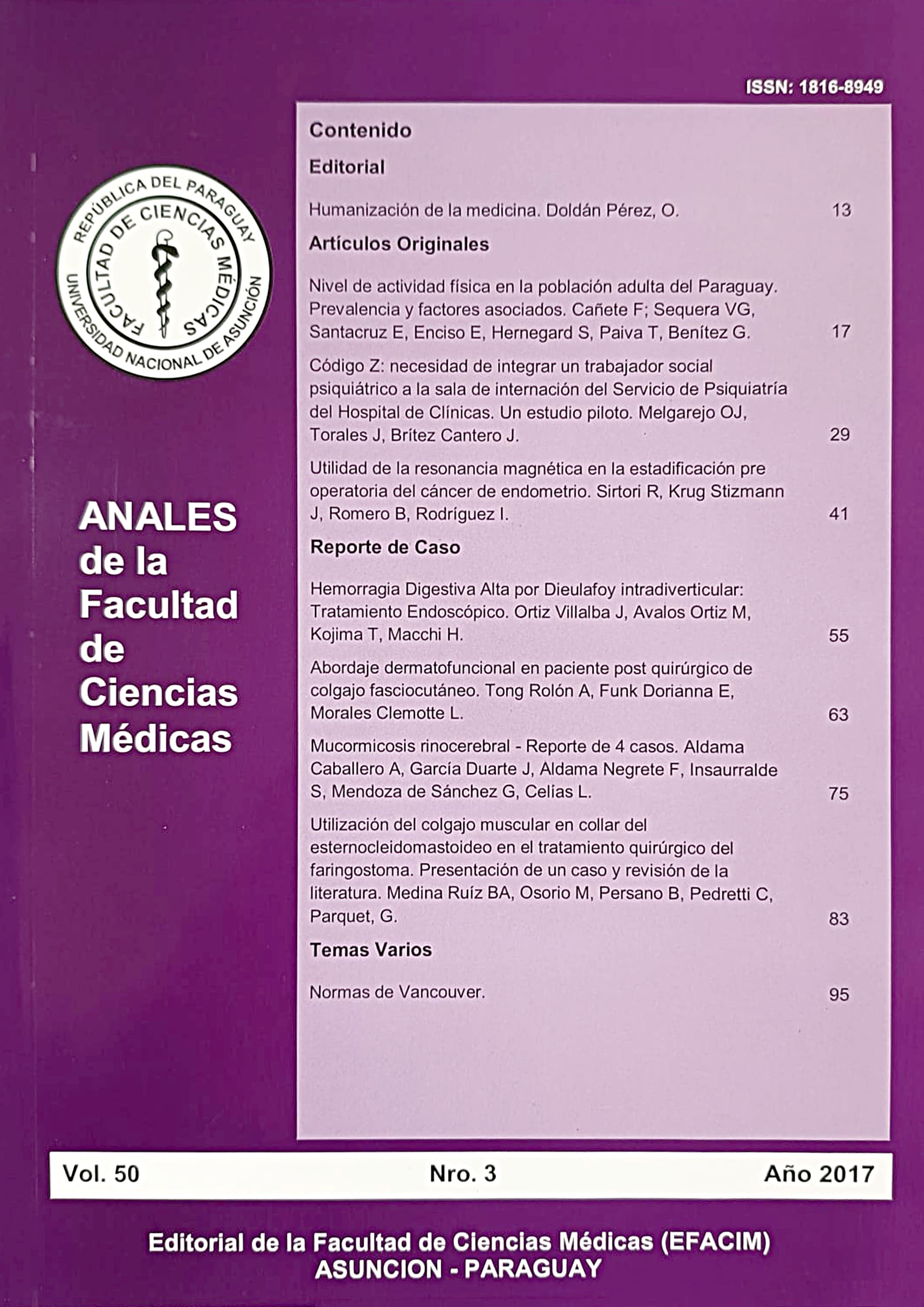
Dermato-functional approach of fasciocutaneous flap in post surgical patient
DOI:
https://doi.org/10.18004/anales/2017.050(03)63-074Keywords:
Dermatofunctional physiotherapy, Fasciocutaneo flap, Scars, ParaguayAbstract
Introduction: Many of the high impact injuries caused by traffic accidents produce compound fractures in the lower limbs, with soft tissue exposure. We are presenting the clinical case, diagnosed with chronic osteomyelitis of the left tibia, post-operated fasciocutaneous flap of the internal calf and skin graft in the calf. Case Description: A 27-year-old male patient is admitted to the Plastic Surgery Unit of the Hospital de Clínicas for 45 days, receives 16 sessions of kinesthetic treatment, from the pre, post-surgical and hospital discharge stage. In the pre-surgical evaluation, an open wound is observed in the area of the left leg covered by dressings and aspiration system and vacuum compaction, scars attached to the knee, limitation of ankle mobility and knee sequelae of previous injuries and interventions, is undergoing reconstructive surgery at the level of the leg. The kinesic objectives proposed were: educate the patient and his family about graft care and healing, improve joint mobility, flexibility, muscular strength and reduce muscle shortening, making the attached scars more flexible. Discussion: High-energy trauma in the lower limbs is often associated with soft-tissue defects and its reconstruction can be a challenging task. Physical rehabilitation from immediate postsurgical care to discharge has restored the patient's maximum functional independence in a short
period of time after a long period of hospitalization.
References
1. Alvarez Cambras R. Tratado de Ortopedia y Traumatología. Editorial Pueblo y Educación. La Habana;
1985.
2. Edmonson AS, Crenshaw AH. Campbell´s Operative Orthopeadics. 6ta ed. St. Louis Missouri: Mosby,
1980. p.1050-3.
3. Pérez R, Guerra R, González P. El colgajo muscular pediculado como variante de tratamiento en la
osteomielitis crónica. Revista Cubana de Ortopedia y Traumatología [serial on the Internet]. (2009,
June), [cited March 13, 2018]:23(1):1-17. Available from: MedicLatina.
4. Pancorbo EA, Martín JC, Navarro R, Díaz A, Pérez O, García G. Empleo de los
colgajos musculares pediculados en la solución de lesiones traumáticas y sus secuelas en miembro
inferior. Revista Cubana Ortopedia Traumatología; 2006:20(1). p.0-0. [serie en línea].
[revisado Agosto 2017]. Disponible en: http://scielo.sld.cu/scielo.php?script=sci_arttext&pid=S0864-
215X2006000100005&lng=es&nrm=iso
5. Fernández A, Santana P, Chiong M,Duconge D, Fernandez S. Empleo del colgajo muscular soleo,
como cobertura de los defectos cutáneos. Rev. Cub Med Mil. 2002:31(3)
6. Patzakis MJ, Zalavras CG. La osteomielitis crónica postraumática y la seudoartrosis infectada de tibia:
conceptos actuales de su tratamiento. J Am Acad Orthop Surg. (Ed Esp). 2005;4:487-97. [revisado
Agosto 20017].Disponible en: http://www.medigraphic.com/pdfs/ortope/or-2012/or124i.pdf
7. Román Salles G, Antuan Croas F. Rotación de colgajos musculares para cobertura
de defectos en fracturas abiertas de tibia producidas por armas de fuego. Rev
Cubana Ortop Traumatol2010:24(1) [revisado Agosto 20017]. Disponible en:
http://scielo.sld.cu/scielo.php?script=sci_arttext&pid=S0864-215X2010000100004
8. Ramírez M, Garces M, Jiménez J, García C. Colgajo de gemelo interno como
cobertura de defectos cutáneos en el tercio proximal de tibia. Hospintal Insular.
Las Palmas de gran Canaria. [revisado Agosto 20017]. Disponible en:
http://www.cirugia-osteoarticular.org/adaptingsystem/intercambio/revistas/articulos/1930_301-305.pdf
9. Wei JW, Ni JD, Dong ZG, Liu LH, Luo ZB, Zheng L.Distalmente perforador-plus fasciocutáneo sural
basado colgajo para la reconstrucción de los tejidos blandos de la parte inferior distal de la pierna , el
tobillo y pie: comparación entre pacientes pediátricos y adultos. Departamento de Ortopedia, el
Segundo Hospital Xiangya, Universidad Central del Sur, Changsha, República Popular de China.
[revisado Agosto 20017]. Disponible en: https://www.ncbi.nlm.nih.gov/pubmed/24590325
10. Yang C, Geng S, Fu C, Sun J, Bi Z .Un colgajo adipofascial sural inverso modificado mínimamente
invasivo para el tratamiento de la osteomielitis tibial y calcaneal postraumática distal. El primer hospital
afiliado de la Universidad Médica de Harbin, Harbin, China. [revisado Agosto 20017]. Disponible en:
https://www.ncbi.nlm.nih.gov/pubmed/24275754
11. Daniels y Worthingham. Técnicas de balance muscular. Editorial Elsevier. España. 9ª Edición 2014.
12. Revelo Jiron E. Reconstrucción tibial: transferencia sóleo-peroné ipsilateral. Tibialización peroneal.
Cir. plást. iberolatinoam. [Internet]. 2009 Dic [citado 2018 Feb 20]; 35( 4 ): 291-301. Disponible en:
http://scielo.isciii.es/scielo.php?script=sci_arttext&pid=S0376-78922009000400006&lng=es
13. Carabelli Guido, Barla Jorge D, Taype Danilo R, Sancineto Carlos F. Colgajo
fasciocutáneo sural para la cobertura del tercio distal de pierna y pie. Rev. Asoc. Argent.
Ortop. Traumatol. [Internet]. 2017 Jun [citado 2018 Feb 22]; 82 (2): 136-140. Disponible en:
http://www.scielo.org.ar/scielo.php?script=sci_arttext&pid=S1852-74342017000200010&lng=es.
14. Fernández J, Yanhez P, García F. Tape Neuro Muscular Aplicaciones Prácticas. TNM Argentina. 2016
15. Jhonson J. Masaje Profundo para liberación de tejidos blandos. Editorial Médica Panamericana. 2011
16. The physical and physiological effects of vacuum massage on the different skin layers: a current status
of the literature Peter Moortgat1*, Mieke Anthonissen1,2, Jill Meirte1,3, Ulrike Van Daele3 and Koen
Maertens1,4
17. González Montesinos, J.L.; Martínez González, J.; Mora Vicente, J.; Salto Chamorro, G. y Álvarez
Fernández, E. (2004). El dolor de espalda y los desequilibrios musculares. Revista Internacional de
Medicina y Ciencias de la Actividad Física y el Deporte vol. 4 (13) pp. 18-34