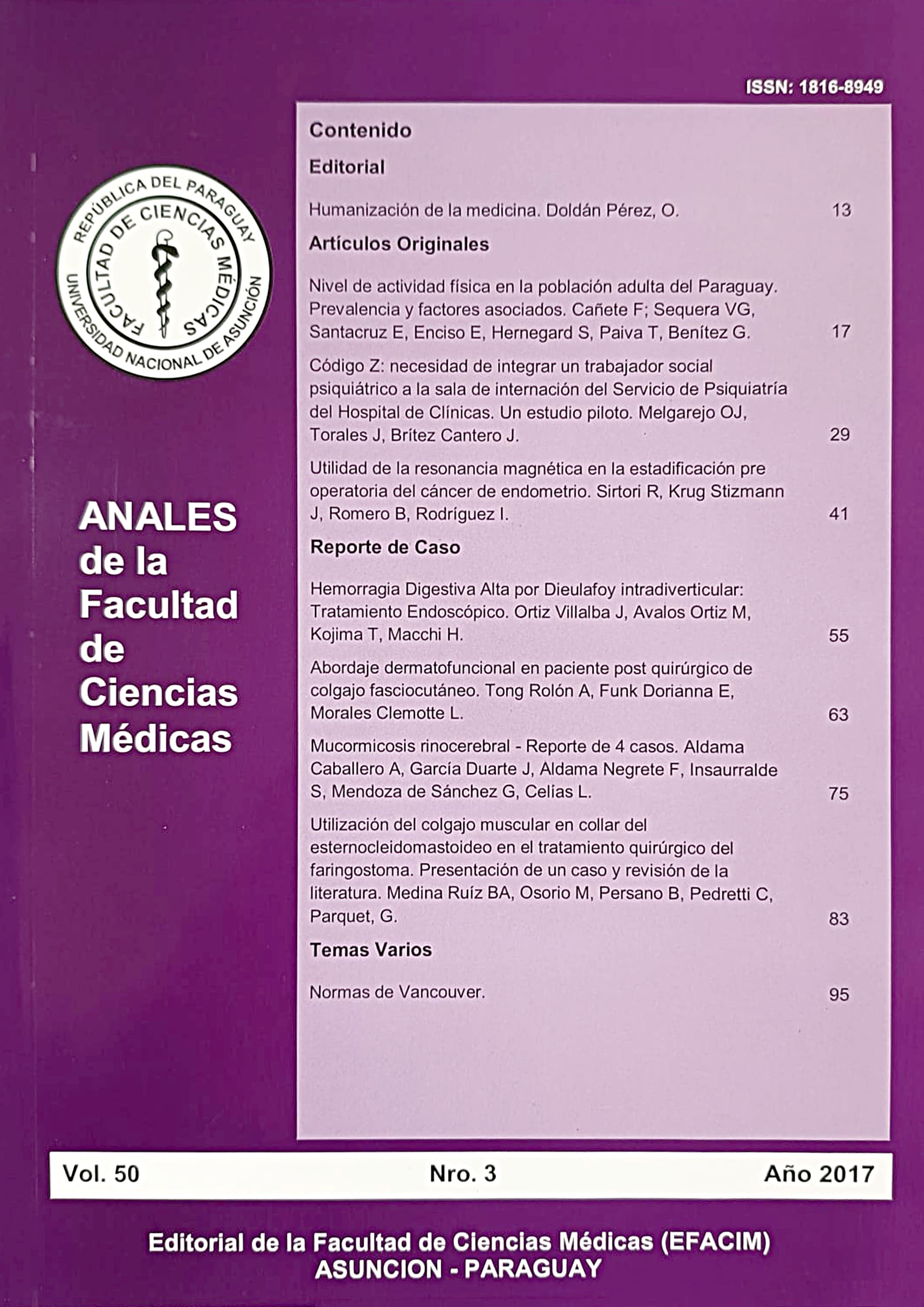
Code Z: The need to integrate a psychiatric social worker into the in-patient unit of the Psychiatry Service of the Hospital of Clínicas. A pilot study
DOI:
https://doi.org/10.18004/anales/2017.050(03)29-040Keywords:
Z codes, social worker, hospitalization, psychiatry, ParaguayAbstract
Introduction: The annex of the 10th edition of the International Classification of Diseases of the World Health Organization includes a chapter that deals with the factors that influence the state of health and the contact with health services, better known within the professional practice as "Z Codes", due to its prefix to code them. One way to intervene on these Z Codes is through the psychiatric social worker. Objective: The objectives of this study were to determine the need to integrate a psychiatric social worker into the in-patient unit of the Psychiatry Service of the Hospital of Clínicas (National University of Asunción, Paraguay) and to describe the sociodemographic and clinical profile and the presence of a Code Z within the in-patients clinical records. Methodology: This was an observational, descriptive, cross-sectional study, temporarily retrospective, with non-probabilistic sampling by convenience. We analyzed the medical records of patients 18 years of age or older, hospitalized in the in-patient unit of the Psychiatry Service of the Hospital or Clínicas. Sociodemographic and clinical variables were analyzed. Results: 284 clinical records were studied, of which 219 were included after meeting the inclusion criteria. 71% of the patients were female. The ages were between 18 and 78 years (mean=36±15). Major depressive disorder was the main diagnosis at admission of the studied patients, since 30.6% registered this disorder. Regarding the use of Code Z, it was observed that 77.6% registered this information in the clinical records and that 99% of the patients did not have a consultation from a psychiatric social worker. Regarding the diagnosis of discharge, personality disorders (24.2%) were the most frequent diagnoses, followed by major depressive disorder (20.5%) and psychotic disorders (20.1%). Discussion: Almost all of the patients admitted to the Psychiatry Service of the Hospital of Clínicas present Z Codes. The need to integrate a psychiatric social worker into the in-patient unit of the Psychiatry Service of the Hospital of Clínicas is reaffirmed, highlighting that the number of social workers should be the equivalent of one for every ten patients.
References
1. Organización Mundial de la Salud. Clasificación Estadística Internacional de Enfermedades y Problemas Relacionados con la Salud (CIE-10). 10ª edición. Ginebra: Organización Mundial de la Salud; 2003. URL.
2. American Psychiatric Association. Diagnostic and Statistical Manual of Mental Disorders. 5th ed. Arlington VA: APA Press; 2013.
3. Lozano Serrano C, Ortiz Lobo A, González Juárez C. Tratamiento y uso de recursos en salud mental de pacientes sin patología. Rev Asoc Esp Neuropsiq. 2014;34(122):267-281. https://doi.org/10.4321/S0211-57352014000200003
4. Méndez RR, Wraage DA, Costa MA. Trabajo Social en el campo de la salud mental. La discusión sobre el diagnóstico. Prospectiva. 2012;(17):407-435. https://doi.org/10.25100/prts.v0i17.1158
5. Ardila-Gómez S, Hartfiel M, Fernández MA, Ares Lavalle G, Borelli M, Stolkiner A. El desafío de la inclusión en salud mental: análisis de un centro comunitario y su trabajo sobre los vínculos sociales. Salud Colectiva. 2016;12(2):265-278. https://doi.org/10.18294/sc.2016.1000
6. Goldberg R, Rollins A, Lehman A. Social network correlates among people with psychiatric disabilities. Psychiatric Rehabilitation Journal 2003;26(4):393-402. URL.
7. Charlton BG, Mckenzie K. Treating unhappiness – society needs palliative psychopharmacology. Br J Psychiatry. 2004;185(3):194-195. https://doi.org/10.1192/bjp.185.3.194
8. Helmchen H, Linden M. Subthreshold disorders in psychiatry: Clinical reality, methodological artifact and the double-threshold problem. Compr Psychiatry 2000;41(2 Suppl 1):1-7. URL.
9. Ortiz Lobo A, Ibáñez Rojo I. Iatrogenia y prevención cuaternaria en salud mental. Rev Esp Salud Pública 2011;85(6):513-525. URL.
10. Arce A, Moreno M, Torales J, Rodríguez H, Bogado, A. Medina, A, et al. Normas generales para personas usuarias de salud mental, sus familiares y cuidadores. 3ª ed. EFACIM: Asunción; 2017.
11. Ministerio de Salud Pública y Bienestar Social. Política Nacional de Salud Mental 2011-2020. Asunción: Ministerio de Salud Pública y Bienestar Social; 2011. URL.
12. Leão A, Barros S. Inclusão e exclusão social: as representações sociais dos profissionais de saúde mental. Interface - Comunicação, Saúde, Educação. 2011;15(36):137-152. https://doi.org/10.1590/S1414-32832011000100011
13. Hernández Monsalve M. Rehabilitación psicosocial. Perspectiva actual y directrices en la Reforma Psiquiátrica. Estudos de Psicologia. 2011;16(3):295-303. https://doi.org/10.1590/S1413-294X2011000300013
14. Tenorio R, Hernández MN. Panorama de la investigación del trabajo social en el ámbito de la salud mental (1970-2000). Salud Mental. 2005;28(4):18-32. URL.
15. Allen R. The role of the social worker in adult mental health services. London: The College of Social Work; 2014. URL.
16. Barrios I, Domínguez K, Coluchi A, Arce A. Estudio piloto sobre el nivel de llenado de las historias clínicas de pacientes de consultorio externo de la Cátedra y Servicio de Psiquiatría de la Facultad de Ciencias Médicas de la Universidad Nacional de Asunción. Rev Par Psiq. 2013;1(2):36-38. URL.
17. Ministerio de Salud Pública y Bienestar Social. Guía de criterios de admisión y manejo de personas con trastornos mentales. Asunción: Ministerio de Salud Pública y Bienestar Social; 2013. URL.
18. Muñoz LF, Jaramillo LE. DSM-5: ¿Cambios significativos? Revista de la Asociación Española de Neuropsiquiatría. 2015;35(125):111-121 https://doi.org/10.4321/S0211-57352015000100008
19. Organización Mundial de la Salud. Manual de recursos de la OMS sobre la Salud Mental, derechos humanos y legislación. Ginebra: Organización Mundial de la Salud; 2006. URL.
20. Posada-Villa JA, Aguilar-Gaxiola SA, Magaña CG, Gómez LC. Prevalence of Mental Disorders and use of Services: Preliminary Results from of the National Study of Mental Health, Colombia, 2003. Rev Colomb Psiquiatr. 2004;33(3):241-262. URL.
21. Ziegenbein M, Anreis C, Brüggen B, Ohlmeier M, Kropp S. Possible criteria for inpatient psychiatric admissions: which patients are transferred from emergency services to inpatient psychiatric treatment? BMC Health Services Research. 2006;6:150. https://doi.org/10.1186/1472-6963-6-150
22. National Institute for Health Care Excellence. Adults with complex needs (including learning disabilities) and mental health needs: social work interventions. In development. London: National Institute for Health and Care Excellence; 2017.URL.
23. Taborda Zapata EM, Montoya González LE, Gómez Sierra NM, Arteaga Morales LM, Correa Rico OA. Intervención de la esquizofrenia desde el modelo comunitario. Rev. Colomb. Psiquiatr. 2016;45(1):46-50. https://doi.org/10.1016/j.rcp.2015.09.001
24. Organización Mundial de la Salud. Conjunto de Guías sobre Servicios y Políticas de Salud Mental. El Contexto de la Salud Mental. Ginebra: Organización Mundial de la Salud; 2005. URL.
25. Organización Panamericana de la Salud – Organización Mundial de la Salud. Informe WHO-AIMS sobre el Sistema de Salud Mental en Paraguay. Washington: Organización Panamericana de la Salud; 2006. URL.
26. Kessler RC, Berglund P, Demler O, Jin R, Merikangas KR, Walters EE. Lifetime prevalence and age-of-onset distributions of DSM-IV disorders in the National Comorbidity Survey Replication. Arch Gen Psychiatry. 2005;62(6):593-602 https://doi.org/10.1001/archpsyc.62.6.593
27. Alonso J, Angermeyer MC, Bernert S, Bruffaerts R, Brugha TS, Bryson H et al. Prevalence of mental disorders in Europe: results from the European Study of the Epidemiology of Mental Disorders (ESEMeD) project. Acta Psychiatr Scand Suppl. 2004;(420):21-27. https://doi.org/10.1111/j.1600-0047.2004.00327.x
28. Campo-Arias A, Miranda C, Arturo C. Trastornos mentales más frecuentes: prevalencia y algunos factores sociodemográficos asociados. Rev Colomb Psiquiatr. 2008;37(4):598-613. URL.
29. Wakefield J, First M. The Importance and Limits of Harm in Identifying Mental Disorder. Can J Psychiatry. 2013;58(11):618-621. https://doi.org/10.1177/070674371305801107
30. Organización Mundial de la Salud. Plan de acción sobre salud mental 2013-2020. Ginebra: Organización Mundial de la Salud; 2013. URL.
31. Garcés Trullenque E. El Trabajo Social en salud mental. Cuadernos de trabajo social. 2010;23:333-352. URL.
32. Torales J, Villalba-Arias J, Ruiz-Díaz C, Chávez E, Riego V. The right to health in Paraguay. International Review of Psychiatry 2014;26(4):524-529. https://doi.org/10.3109/09540261.2014.926866