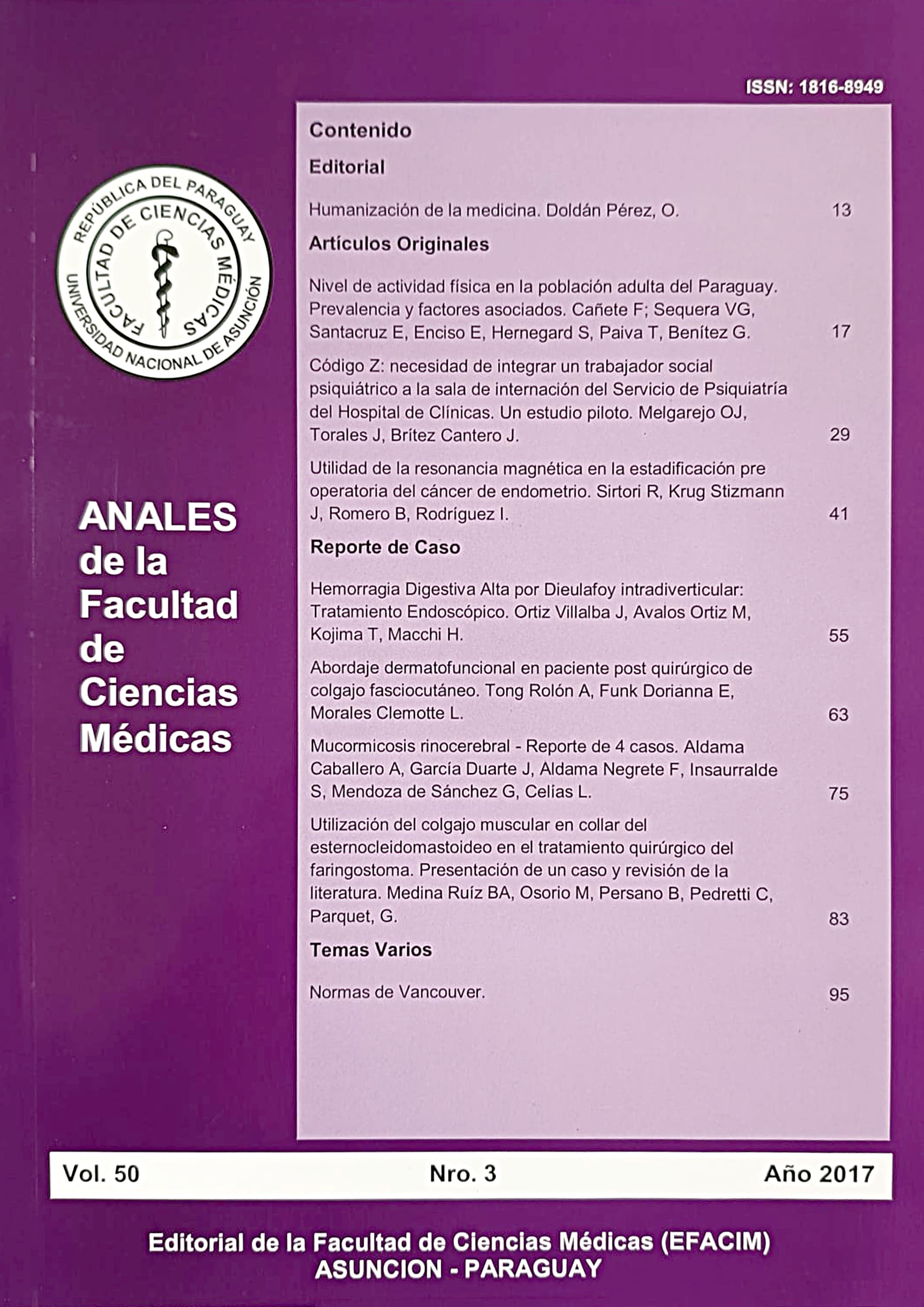
Level of physical activity among adult population in Paraguay. Prevalence and associates factors
DOI:
https://doi.org/10.18004/anales/2017.050(03)17-028Keywords:
Physical activity, lifestyle, determinants of health, surveillance, ParaguayAbstract
Introduction: Physical activity levels determine health conditions and diseases in whole populations. The study attempts to determine the prevalence of physical activity (PA) levels in Paraguay and to identify factors associated with physical inactivity. Methods: A cross-sectional population-type survey with national representatively, included people aged between 15 and 74 years old. Sampling was probabilistic, tri-stage without replacement. STEPSwise was the methodology and survey applied during June-September 2011. The levels of physical activity were considered according to the Global Physical Activity Questionnaire (GPAQ). The PA values were estimated in MET. The determined values were distributed according to sociodemographic and clinical variables. Logistic regression was made for estimate the association between the variables in odd ratios with 95% confidence intervals. Results: 2536 participants were included. 27,2% of the population was inactive, 20,1% and 31,3% men and women, respectively. The groups that showed a higher prevalence of PA with statistically significant differences were: women, the age group over 55 years old, living in the urban area, having a higher level of studies and a higher level of income. Overweight and obesity were associated with a higher prevalence of physical inactivity, mainly in males. Conclusions: The study is the first to present the prevalence and differences of levels of global physical activity in Paraguay and related factors. This first step of surveillance of chronic diseases is very useful to provide a baseline for new interventions in public health.
References
1. Das P, Horton R. Physical activity-time to take it seriously and regularly. Lancet [Internet]. 2016
Sep;388(10051):1254–5. Available from: http://linkinghub.elsevier.com/retrieve/pii/S0140673616310704
2. Lee D, Artero EG, Xuemei Sui, Blair SN. Review: Mortality trends in the general population: the
importance of cardiorespiratory fitness. J Psychopharmacol [Internet]. 2010 Nov 5;24(4_suppl):27–35.
Available from: http://journals.sagepub.com/doi/10.1177/1359786810382057
3. Kruk J, Czerniak U. Physical activity and its relation to cancer risk: updating the evidence. Asian Pac J Cancer
Prev [Internet]. 2013;14(7):3993–4003. Available from: http://www.ncbi.nlm.nih.gov/pubmed/23991944
4. Stewart AL, King AC, Haskell WL. Endurance exercise and health-related quality of life in 50-65 yearold
adults. Gerontologist [Internet]. 1993 Dec; 33(6):782–9. Available from:
http://www.ncbi.nlm.nih.gov/pubmed/8314105
5. Hainer V, Toplak H, Stich V. Fat or Fit: What Is More Important? Diabetes Care [Internet]. 2009 Nov
1;32(suppl_2):S392–7. Available from: http://care.diabetesjournals.org/cgi/doi/10.2337/dc09-S346
6. Blair SN, LaMonte MJ, Nichaman MZ. The evolution of physical activity recommendations: how much
is enough? Am J Clin Nutr [Internet]. 2004 May;79(5):913S – 920S. Available from:
http://www.ncbi.nlm.nih.gov/pubmed/15113739
7. Andersen LB, Mota J, Di Pietro L. Update on the global pandemic of physical inactivity.Lancet [Internet]. 2016
Sep; 388(10051):1255–6. Available from: http://linkinghub.elsevier.com/retrieve/pii/S0140673616309606
8. WHO. The WHO STEPwise approach to noncommunicable disease risk factor
surveillance (STEPS) [Internet]. 3.0 ed. WHO, editor. Geneva; 2004. Available from:
http://www.who.int/chp/steps/instrument/STEPS_Instrument_V3.0.pdf
9. Booth FW, Roberts CK, Laye MJ. Lack of Exercise Is a Major Cause of Chronic Diseases.
Comprehensive Physiology [Internet]. Hoboken, NJ, USA: John Wiley & Sons, Inc.; 2012. Available
from: http://doi.wiley.com/10.1002/cphy.c110025
10. Primera Encuesta Nacional de Factores de Riesgo para Enfermedades No Transmisibles [Internet]. Asunción;
2012. Available from: http://www.mspbs.gov.py/dvent/encuesta-nacional-factores-de-riesgo-2011/
11. ISPAH, Lancet Physical Activity Series Working Group. Global Observatory for Physical Activity
[Internet]. 2015. Available from: http://www.globalphysicalactivityobservatory.com/
12. DGEEC. Compendio estadístico 2014. DGEEC publicaciones. 2013. 1689-1699 p.
13. Creber RMM, Smeeth L, Gilman RH, Miranda JJ. Physical activity and cardiovascular risk factors among rural
and urban groups and rural-to-urban migrants in Peru: a cross-sectional study. Rev Panam Salud Pública
[Internet]. 2010 Jul;28(1). Available from: http://www.scielo.br/scielo.php?script=sci_arttext&pid=S1020-
49892010000700001&lng=en&nrm=iso&tlng=en
14. Encuesta Nacional de Salud 2009-2010. Chile [Internet]. Santiago de Chile; 2013. Available from:
http://web.minsal.cl/portal/url/item/bcb03d7bc28b64dfe040010165012d23.pdf
15. Dyck D Van, Cardon G, Deforche B, De Bourdeaudhuij I. Urban–Rural Differences in Physical Activity
in Belgian Adults and the Importance of Psychosocial Factors. J Urban Heal [Internet]. 2011 Feb
28;88(1):154–67. Available from: http://link.springer.com/10.1007/s11524-010-9536-3
16. Fan JX, Kowaleski-Jones L, Wen M. Walking or dancing: patterns of physical activity by cross-sectional
age among U.S. women. J Aging Health [Internet]. 2013 Oct;25(7):1182–203. Available from:
http://www.ncbi.nlm.nih.gov/pubmed/23867628
17. Bennett KJ, Probst JC, Pumkam C. Obesity among working age adults: the role of county-level
persistent poverty in rural disparities. Health Place [Internet]. 2011 Sep;17(5):1174–81. Available from:
http://www.ncbi.nlm.nih.gov/pubmed/21665515
18. González S, Sarmiento OL, Lozano O, Ramírez A, Grijalba C. Niveles de actividad
física de la población colombiana: desigualdades por sexo y condición
socioeconómica. Biomédica [Internet]. 2014 May 13;34(3). Available from:
http://www.revistabiomedica.org/index.php/biomedica/article/view/2258
19. Álvarez-castaño LS, Goez-Rueda JD, Carreño-Aguirre C. Social and economic factors associated with
obesity: the effects from inequality and poverty. Rev Gerenc y Políticas Salud. 2010;11(23):98–110.
20. Arteaga A, Bustos P, Soto R, Velasco N, Amigo H. Actividad física y su asociación con factores de
riesgo cardiovascular: Un estudio en adultos jóvenes. Rev Med Chil [Internet]. 2010 Oct;138(10).
Available from: http://www.scielo.cl/scielo.php?script=sci_arttext&pid=S0034-
98872010001100001&lng=en&nrm=iso&tlng=en
21. Uddin R, Khan A, Burton NW. Prevalence and sociodemographic patterns of physical activity among
Bangladeshi young adults. J Health Popul Nutr [Internet]. 2017 Jul 14;36(1):31. Available from:
http://www.ncbi.nlm.nih.gov/pubmed/28709469
22. Cañete F, Fretes G, Sequera V, Turnes C, Santacruz E, Paiva T, et al. EPIDEMIOLOGY OF OBESITY
IN PARAGUAY. An la Fac Ciencias Médicas [Internet]. 2016 Dec 30;49(2):17–26. Available from:
http://scielo.iics.una.py/scielo.php?script=sci_arttext&pid=S1816-
89492016000200002&lng=es&nrm=iso&tlng=es
23. Asp M, Simonsson B, Larm P, Molarius A. Physical mobility, physical activity, and obesity among
elderly: findings from a large population-based Swedish survey. Public Health [Internet]. 2017
Jun;147:84–91. Available from: http://www.ncbi.nlm.nih.gov/pubmed/28404503
24. Varí R, Scazzocchio B, D’Amore A, Giovannini C, Gessani S, Masella R. Gender-related differences
in lifestyle may affect health status. Ann Ist Super Sanita [Internet]. 52(2):158–66. Available from:
http://www.ncbi.nlm.nih.gov/pubmed/27364389
25. Ruiz-Casado A, Alejo LB, Santos-Lozano A, Soria A, Ortega MJ, Pagola I, et al. Validity of the Physical
Activity Questionnaires IPAQ-SF and GPAQ for Cancer Survivors: Insights from a Spanish Cohort. Int
J Sports Med [Internet]. 2016 Nov;37(12):979–85. Available from:
http://www.ncbi.nlm.nih.gov/pubmed/27557405
26. Sitthipornvorakul E, Janwantanakul P, van der Beek AJ. Correlation between
pedometer and the Global Physical Activity Questionnaire on physical activity measurement
in office workers. BMC Res Notes [Internet]. 2014;7(1):280. Available from:
http://bmcresnotes.biomedcentral.com/articles/10.1186/1756-0500-7-280
27. Wanner M, Hartmann C, Pestoni G, Martin BW, Siegrist M, Martin-Diener E. Validation of the
Global Physical Activity Questionnaire for self-administration in a European context.
BMJ Open Sport Exerc Med [Internet]. 2017 May 8;3(1):e000206. Available from:
http://bmjopensem.bmj.com/lookup/doi/10.1136/bmjsem-2016-000206
28. Blair SN. Physical inactivity: the biggest public health problem of the 21st century. Br J Sports Med [Internet]. 2009 Jan;43(1):1–2. Available from: ttp://www.ncbi.nlm.nih.gov/pubmed/19136507
29. Ding D, Lawson KD, Kolbe-Alexander TL, Finkelstein EA, Katzmarzyk PT, van Mechelen W, et al. The economic burden of physical inactivity: a global analysis of major non-communicable diseases. Lancet (London, England) [Internet]. 2016 Sep 24;388(10051):1311–24. Available from: http://www.ncbi.nlm.nih.gov/pubmed/27475266