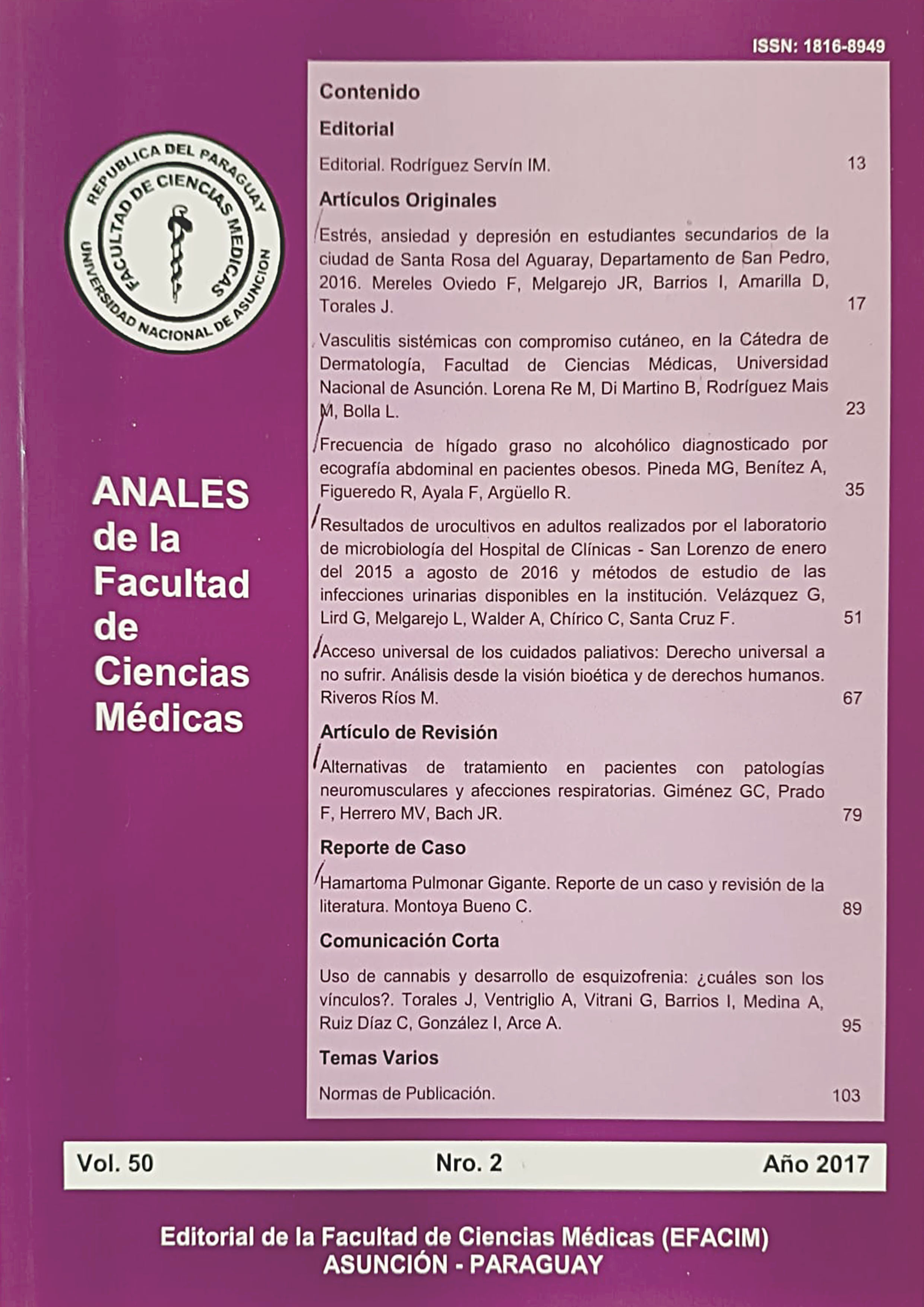
Results of urine culture in adults carried out by the microbiology laboratory of the Clinics Hospital - San Lorenzo from january 2015 to august 2016 and methods of study of urinary infections available in the institution
DOI:
https://doi.org/10.18004/anales/2017.050(02)51-066Keywords:
antimicrobial susceptibility, urinary tract infections, urine culture, dipstick test, bacterial isolation, antibiogram, ParaguayAbstract
Introduction: The objectives of this work are: to present the methods of study of urinary infections currently available in the Laboratory of Microbiology of the Hospital de Clínicas and to show the data of the urine cultures evaluated retrospectively.
Material and method: in order to study the available methods in urine cultures in the Laboratory, we have used the laboratory file whose data were consecutively loaded in an Excel data processing form of Microsoft Office ®. The results of the urine cultures were evaluated from January 2015 to August 2016, in a retrospective, observational, cross-sectional study of adults of both sexes. Samples for urine culture are received and processed in the laboratory, following pre-established steps.
Results: The predominant microorganisms were Escherichia coli in 60% of women and 32%of men, Klebsiella pneumonia 19% of men and 14% of women. Other isolated organisms were Candida sp., Enterococcus faecalis, Enterobacter cloacae, Pseudomonas aeruginosa, Proteus mirabilis, Staphylococcus aureus, and Acinetobacter baumanii. Escherichia coli resistance to nitrofurantoin was seen in 6% of men and 1% of women and meropenem resistance to E. coli was also low. As for Klebsiella pneumoniae in women, resistance to meropenem was seen in 3% of cases. In men, the antibiotics tested for Klebsiella pneumoniae showed resistance greater than 30% except for meropenem. Uropathogens producing Extended-Spectrum -lactamase (ESBL ) and Carbapenemase were found.
Discussion: Urine collection for urine culture is done following clear guidelines emanating from the laboratory. With the use of media currently available in the laboratory, it is possible to typify the genus and species of both Gram negative and positive bacteria as well as fungi.
Conclusion: The structure of the Laboratory of Microbiology has had advances that allow the precise identification of the germs of the urine cultures, as well as the prevalence and resistance to certain antibiotics. These contributions are particularly useful for the cases of Escherichia coli and Klebsiella pneumoniae due to their high prevalence. It was also possible to verify the emergence of spread spectrum beta-lactamases (ESBL) and carbapenemases.
References
1. Andreu A, Cacho J, Coira A, Lepe JA. Diagnóstico microbiológico de las infecciones del tracto urinario. Enferm Infecc Microbiol Clin 2011;29:52-7.
2. Esparza GF, Motoa G, Robledo C, Villegas MV. Aspectos microbiológicos en el diagnóstico de infecciones del tracto urinario. Infectio 2015;19:150-160.
3. Moreno E, Andreu A, Pigrau C, Kuskowski MA, Johnson JR, Prats G. Relationship between Escherichia coli strains causing acute cystitis in women and the fecal E. Coli population of the host. J Clin Microbiol. 2008;46:2529-34.
4. Bartoloni A, Sennati S, Di Maggio T, Mantella A, Riccobono E, Strohmeyer M et al. Antimicrobial susceptibility and emerging resistance determinants (blaCTX-M, rmtB, fosA3) in clinical isolates from urinary tract infections in the Bolivian Chaco.Int J Infect Dis. 2016;43:1-6.
5. Baron EJ, Miller JM, Weinstein MP, Richter SS, Gilligan PH, Thomson RB Jr, et al. A guide to utilization of the microbiology laboratory for diagnosis of infectious diseases: 2013 recommendations by the Infectious Diseases Society of America (IDSA) and the American Society for Microbiology (ASM) (a). Clin Infect Dis. 2013;57:e22-e121.doi: 10.1093/cid/cit278.
6. Frazee BW, Frausto K, Cisse B, White DE, Alter H. Urine collection in the emergency department: what really happens in there? West J Emerg Med. 2012;13:401-5.
7. Tosif S, Baker A, Oakley E, Donath S, Babl FE. Contamination rates of different urine collection methods for the diagnosis of urinary tract infections in young children: an observational cohort study. J Paediatr Child Health. 2012;48:659-64.
8. Anacleto FE, Resontoc LP, Padilla GH. Bedside diagnosis of outpatient childhood urinary tract infection using three-media dipslide culture test.PediatrNephrol 2009;24:1539-43
9. Burd EM, andKehl KS. A Critical Appraisal of the Role of the Clinical Microbiology Laboratory in the Diagnosis of Urinary Tract Infections. J ClinMicrobiol. 2011;49(9 Suppl): S34–S38. doi:10.1128/JCM.00788-11
10. Kim Y, Park KG, Lee K, Park YJ. Direct Identification of Urinary Tract Pathogens From Urine Samples Using the Vitek MS System Based on Matrix-Assisted Laser Desorption Ionization-Time of Flight Mass Spectrometry.Ann Lab Med. 2015;35:416-22.
11. Kerremans JJ, Goessens WH, Verbrugh HA, Vos MC. Accuracy of identification and susceptibility results by direct inoculation of Vitek 2 cards from positive BACTEC cultures. Eur J ClinMicrobiolInfectDis. 2004;23:892-8.
12. Álvarez E, Espino M, Contreras R. Determinación de la susceptibilidad de Escherichia coli en aislamientos del tracto urinario por el sistema DIRAMIC. Rev Panam Infectol. 2006;8:10-15.
13. Álvarez LC. Infecciones de vías urinarias en el Hospital Universidad del Norte. SaludUninorte. 2007;23:9-18.
14. Orenstein R. Wong ES.Urinary tract infections in adults. Am Fam Physician. 1999;59:1225-34.
15. Nzalie RN, Gonsu HK, Koulla-Shiro S. Bacterial Etiology and Antibiotic Resistance Profile of Community-Acquired Urinary Tract Infections in a Cameroonian City. Int J Microbiol. 2016;2016:3240268. doi: 10.1155/2016/3240268.
16. Kuroda M, Yamashita A, Hirakawa H, Kumano M, Morikawa K, Higashide M, et al. Whole genome sequence of Staphylococcus saprophyticusreveals the pathogenesis of uncomplicated urinary tract infection. Proc Natl AcadSci USA. 2005;102:13272–13277.
17. Hooton TM. Uncomplicated Urinary Tract Infection. N Engl J Med 2012; 366:1028-1037
18. García-Hernández AM, García-Vázquez E, Hernández-Torres A, Ruiz J, Yagüe G, Herrero JA, Gómez J. Bacteraemia due to Escherichia coli producing extended-spectrum beta-lactamases (ESBL): clinical relevance and today's insights. RevEspQuimioter. 2011;24: 57-66.
19. François M, Hanslik T, Dervaux B, Le Strat Y, Souty C, Vaux S, et al. The economic burden of urinary tract infections in women visiting general practices in France: a cross-sectional survey. BMC HealthServ Res. 2016;16(a):365. doi: 10.1186/s12913-016-1620-2.
20. Sohn AJ, Hickner JM, Alem F Use of Point-of-CareTests (POCTs) by US Primary Care Physicians. J Am Board Fam Med. 2016;29:371-6.
21. Taniguchi T, Tsuha S, Shiiki S, Narita M. Gram-stain-based antimicrobial selection reduces cost and overuse compared with Japanese guidelines. BMC Infect Dis. 2015 Oct 26;15:458. doi: 10.1186/s12879-015-1203-6.
22. Kass, EH. Asymptomatic infections of the urinary tract.J Urol 2002;167:1016-1020.
23. Bou G, Fernández-Olmos, A, García, C, Sáez-Nieto, J. A, Valdezate, S. Métodos de identificación bacteriana en el laboratorio de microbiología. EnfermInfeccMicrobiolClín. 2011;29:601-608.
24. De Toro-Peinado I, Mediavilla-Gradolph MC, Tormo-Palop N, Palop-Borrás, B. Diagnóstico microbiológico de las infecciones urinarias. EnfermInfeccMicrobiolClín 2015;33(Supl.2):34-39