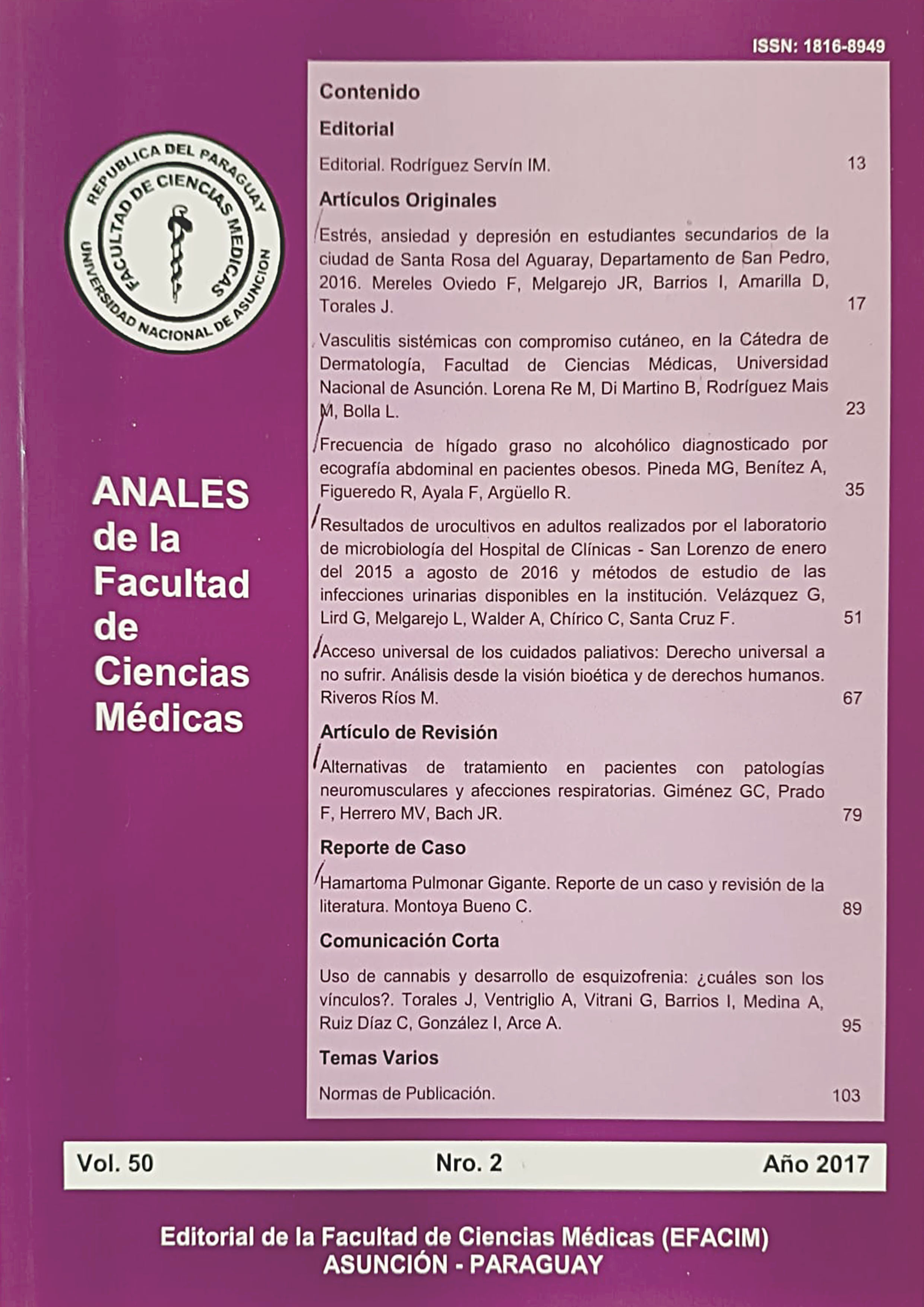
Systemic vasculitis with cutaneous involvement, in the Department of Dermatology, Faculty of Medical Sciences, National University of Asuncion
DOI:
https://doi.org/10.18004/anales/2017.050(02)23-034Keywords:
systemic vasculitis, cutaneous vasculitis, epidemiology, ParaguayAbstract
Introduction: Systemic vasculitis has multiple and varied organ involvement; Ranging from benign to deadly. Its clinical manifestations, treatment and prognosis will depend on the vessel involved, and on the extent and location of the lesion. Objectives: To determine epidemiological, clinical, and histopathological characteristics, and the treatment of systemic vasculitis with cutaneous manifestations in the Department of Dermatology Hospital of Clinics, FCM-UNA. Materials and Methods: A descriptive, observational, retrospective, cross-sectional study with an analytical component from January 2004 to December 2015. A spreadsheet was drawn up to record the variables obtained from clinical and histopathological records. Results: We found 11 patients with systemic vasculitis with cutaneous involvement, (0,0098% of the consultations). The male sex predominated (63,63%). The mean age was 30.18 years. 18,18% were children, all of them male. The most frequent elemental lesion was the papule (72,72%), the predominant location, lower limbs (72,72%). The most frequent symptoms were abdominal pain (63,63%) and arthralgia (54,54%). The 81.81% corresponded to vasculitis of small vessels. In 72,72%, the inflammatory component was neutrophils. 72,72% corresponded to Shönlein-Henoch purpura (PSH), 18,18% to Microscopic Polyangeitis (PAM), and 9,09% to Granulomatosis with Polyangeitis (GPA). In 72,72%, the treatment was Prednisone. Conclusion: Since this pathology is infrequent, with few studies that have studied its epidemiology, this work, with its limitations, could contribute for future studies.
References
1. Pulido A., Avilés J., Suárez R. Vasculitis cutáneas. Actas Dermosifiliogr. 2012;103(3):179-191.
2. Marzano A., Vezzoli P., Berti E. Skin involvement in cutaneous and systemic vasculitis. Autoimmun Rev. 2013;12(4):467–476.
3. Carlson J., Ng B., Chen K. Cutaneous Vasculitis Update: Diagnostic Criteria, Classification, Epidemiology, Etiology, Pathogenesis, Evaluation and Prognosis. Am J Dermatopathol 2005;27(6):504–528.
4. Barbado-Hernández FJ., Diaz R., Rios J., Gómez J., López M., Casado M., et al. Perspectiva histórica de la clasificación de las vasculitis. Actas Dermosifiliogr. 2007;98(9):627-38.
5. Gota C., Mandell B. Vasculitis necrosante sistémica. En: Wolf K., Goldsmith L., Katz S., Gilchrest B., Paller A., y Leffell D., editores. Fitzpatrick Dermatología en Medicina General. Vol 3. 7ª ed. España: Médica Panamericana; 2010. p. 1606 – 1616.
6. Carlson J., and Chen K. Cutaneous Vasculitis Update: Small Vessel Neutrophilic Vasculitis Syndromes. Am J Dermatopathol 2006;28(6):486–506.
7. Jennette J., Falk R., Bacon P., Basu N., Cid M., Ferrario F., et al. 2012 Revised International Chapel Hill Consensus Conference Nomenclature of Vasculitides. Arthritis Rheum. 2013;65(1):1–11. DOI 10.1002/art.37715
8. Zazueta B., Flores L. Ruta y retos diagnósticos en vasculitis primarias. Reumatol Clin. 2011;7(S3):S1–S6
9. Carlson J., Chen K. Cutaneous Vasculitis Update: Neutrophilic Muscular Vessel and Eosinophilic, Granulomatous, and Lymphocytic Vasculitis Syndromes. Am J Dermatopathol 2007;29(1):32–43.
10. Ochoa D., Ramírez F., Quintana G., Toro C., Cañas C., Osio L., et al. Epidemiología de las vasculitis primarias en Colombia y su relación con lo informado para Latinoamérica. Rev Colomb Reumatol 2009;16(3):248-263.
11. Brítez M., Hidalgo A., Ullón N. PARAGUAY. Proyección de la Población Nacional, Áreas Urbana y Rural por Sexo y Edad, 2000-2025. Revisión 2015. Dgeecpublicaciones. Disponible en: www.dgeec.gov.py.
12. Ting T. Diagnosis and Management of Cutaneous Vasculitis in Children. Pediatr Clin N Am. 2014;61(2):321–346.
13. Gardner J., Dolezalova P., Cummins C., Southwood T. Incidence of Henoch-Schönlein purpura, Kawasaki disease and rare vasculitides in children of diff erent ethnic origins. Lancet 2002; 360(9341):1197-202.
14. López D., Amaro P., Segovia L., Balestrini C. Vasculitis cutánea de vasos pequeños. Revisión clínica en 32 casos. Rev Méd Chile 2004; 132(2): 165-170.
15. Villavicencio A., Hidalgo L., Reyes E., Flores L., Orozco R. Causas de vasculitis cutánea en 59 pacientes mexicanos. Experiencia de un centro de tercer nivel. Dermatol Rev Mex. 2011;55(6): 334-34.
16. Audemard-Verger A., Pillebout E., Guillevina L., Thervet E., Terrier B. IgA vasculitis (Henoch–Shönlein purpura) in adults: Diagnostic and therapeutic aspects. Autoimmun Rev. 2015;14(7): 579-585.
17. Yang Y., Yu H., Chiang B. The diagnosis and classification of Henoch–Schönlein purpura: An updated review. Autoimmun Rev. 2014; 13(4-5):355-8. doi: 10.1016/j.autrev.2014.01.031. Epub 2014 Jan 12.
18. Rúa-Figueroa I., y Erausquin C. Tratamiento de las vasculitis sistémicas asociadas a ANCA. Reumatol Clin. 2010;6(3):161–172.
19. Goeser M., Laniosz V., Wetter D. A Practical Approach to the Diagnosis, Evaluation, and Management of Cutaneous Small-Vessel Vasculitis. Am J Clin Dermatol. 2014;15(4):299-306. DOI 10.1007/s40257-014-0076-6.