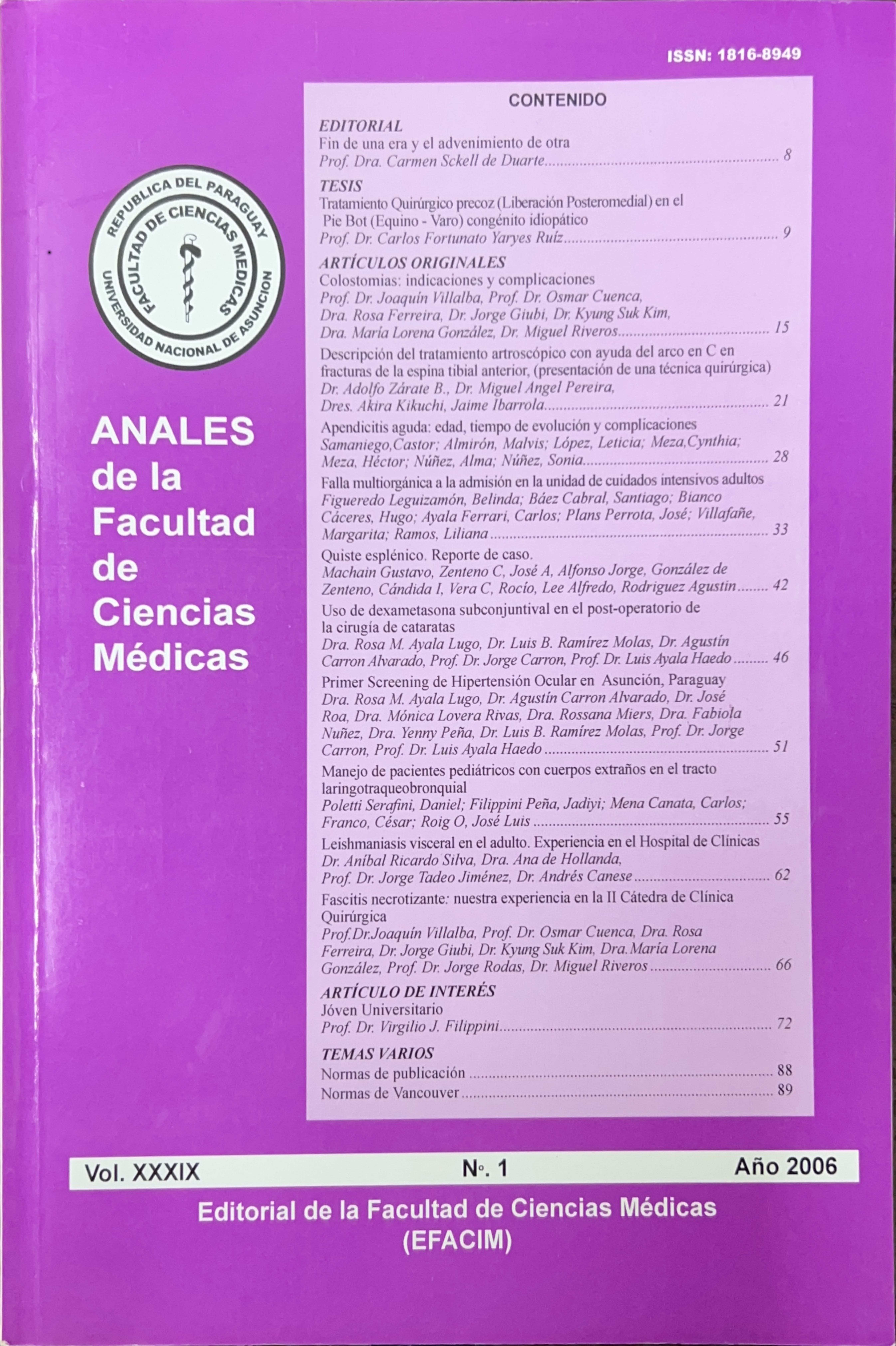
Visceral Leishmaniasis in Adults. Experience in the Hospital de Clínicas
DOI:
https://doi.org/10.18004/Keywords:
leishmaniasis, zoonosis, lutzomyiaAbstract
Visceral Leishmaniasis is a parasitic disease, transmitted to human by flebotomos infected by protozoos of the Leishmania genus. It is estimated 2 million cases per year worldwide with a prevalence of 12 million of infected people. The diagnosis of the infection can be carried out by many methods. Currently, the use of serum tests are most frequently, such as ELISA test, based on a recombinant antigen of 39 amino acids of Leishmania chagasi (rK39). Antimonial pentavalent derivatives, such as antimoniato of meglumina, appear to be the cutting edge treatment selection.
A retrospective and observational study was completed between January of 1996 and December of 2006. Patients with diagnosis of Visceral Leishmaniasis were admitted to the Medical Clinic services at Hospital de Clinicas.
It was arrived to the diagnosis of visceral leishmaniasis in 9 patients, more frequent in people of low socioeconomic level. Fever, asthenia, hepatoesplenomegalia, anemia and leucopenia were present in all the cases. The most sensitive diagnosis method was ELISA-rK39, positive in 9 (100%), and bone narrow aspiration was initially positive in 7 (78%) of the cases. The antimoniato of meglumina was initially indicated in 8 patients (88,8%) with a 20 mg/kp/day dosage. Seven patients (87,5%) completed 28 days of treatment without presenting side effects. One patient (12,5%) presented cutaneous rash reason why it was decided to use liposomal Anfotericina B 1 mg/kp/day in this case. In 1 patient (11,2%) the use of the stibogluconato of sodium 10mg/kp/day was indicated. Seven patients (77,7%) evolved satisfactorily and 2 (22,3%) passed away, one co infected with HIV, the other with intrahospitalary sepsis produced by staphylococcus meticilin resistant.