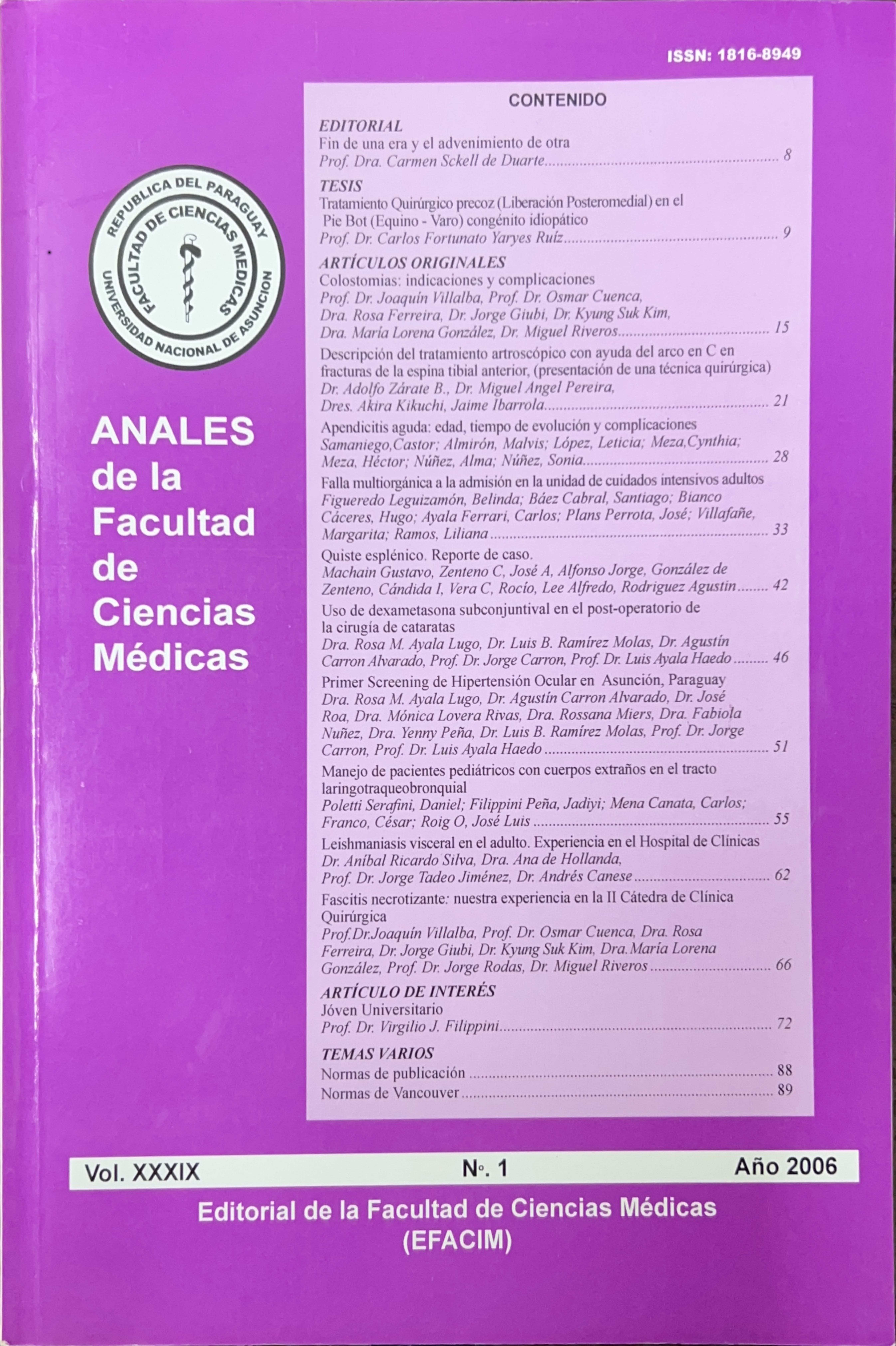
Management of pediatric patient with foreign bodies in the laryngotracheobronchial tract
DOI:
https://doi.org/10.18004/Keywords:
Foreign bodies, airway aspiration, laryngotraheobronchial tract, rigid bronchoscopy, pediatricsAbstract
Aspiration ot foreign bodies (FB) is a frequent accident in early childhood, especially in pre-school age children.
Objectives: lo determine the most frequently allected population of children, determine the type and location ot the foreign body, to investigate the circumstances leading to the accident and maneuvers attempted betore arrival at our service, and to establish the most frequently used procedure, and patient course.
Population and Methods: retrospective, observational, descriptive, transverse cut study. The methodology was based on the review of 54 patient records, of patients admitted to the ottorhynolaryngology sendee at the Hospital de Clinicas in Asuncion with a diagnosis or suspicion of foreign body in the airway, from January 2000 to November 2004.
Results: In 41 patients (75.92%) the age range was below 5 years of age. There was a slight predominance of the male sex. In 92.5% (50) the patients were not from the capital city. In 35.2% of cases, patients had the foreign body in place for some hours. This ranged to a maximum of one month in 2 cases. Main symptoms were respiratory difficulty in 43 patients (77.77%), cough in 38 (70.3%), cyanosis in 26 (48.11%). In 22.2% (12 patients) previous maneuvers had been attempted by parents — all were unsuccessful. The circumstances of the accident were food-related in 32 cases. The diagnostic test used was the chest X ray (91%), which only showed the presence of metallic foreign bodies (4 cases).
Extraction procedures used were: rigid bronchoscopy (45 patients; 83%), direct laryngoscopy (7 patients, 13%), tracheotomy (1 patient, 2%). The type of foreign body was organic in 38 cases (79.2%), 30 of which were seeds. The foreign bodies were most frequently found in the right bronchus (19/48 cases, 40%), followed by the trachea (12 cases, 25%), the glottis and subglottis (9 cases, 19 /«), and left mam bronchus(6 cases. 13%). The average t ,me inhospi - ml was 2.4 day ,Complication* occurred m 7 cases (13%), the most frequent of which was pneumonia. There were no deaths.
Conclusion: The population most affected were 1 and 2 year olds. The most frequently found foreign budy were organic material (watermelon seeds) and the most frequent location was the right main bronchus, The circumstances leading to the accident were feeding, games, and, less frequently, accidents. Previous maneuvers were attempted in few patients, with back slapping, shaking, mouth to mouth ventilation, digital exploration and direct laryngoscopy. All were unsuccessful. Rigid bronchoscopy was the most frequently used procedure for the extraction of foreign bodies. All patients evolved favorably. There no deaths or sequelae.