

 Un vistazo a nuestro día a día en la oficina de Memorias del IICS
Infecciones subclínicas por nematodos gastrointestinales en ovinos de San Pedro: un enfoque de Una Salud para el control de parásitos y análisis conceptual de manejo
DOI:
https://doi.org/10.18004/mem.iics/1812-9528/2026.e24142601Palabras clave:
NGI, prevalencia, parasitologiaResumen
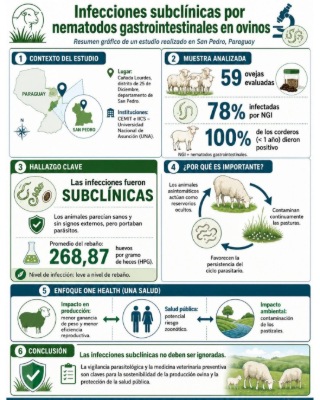
Las infecciones por nematodos gastrointestinales (NGI) continúan siendo una de las principales limitantes sanitarias en los sistemas de producción de pequeños rumiantes pudiendo afectar la productividad, comprometer la eficiencia reproductiva y aumentar los costos de producción. Recientemente, se ha agregado un nuevo desafío: el potencial riesgo zoonótico. El objetivo de este estudio fue presentar evidencia de campo sobre la presencia, prevalencia e intensidad de infecciones por NGI en ovinos clínicamente asintomáticos e integrarla en una revisión crítica de su relevancia productiva y sanitaria, sirviendo como base para el diseño de estrategias de control. Se realizó un estudio descriptivo de corte transversal en una finca del departamento de San Pedro, Paraguay. Se recolectaron muestras fecales directamente del recto de 59 ovinos y se analizaron mediante técnicas de flotación cualitativa y el método de McMaster para determinar la presencia huevos por gramo de heces (HPG). Se detectaron huevos de NGI en el 78% (46/59) de los animales llegándose solo a la identificación a nivel de familia. La intensidad media de infección fue de 268.87 HPG, indicando infecciones leves a nivel de rebaño. La elevada prevalencia junto con baja intensidad evidencia la presencia de parasitismo subclínico en ovinos aparentemente sanos. Estos hallazgos resaltan la importancia del monitoreo rutinario para identificar portadores asintomáticos que contribuyen a la contaminación de pasturas y representan un riesgo sanitario. A la luz de la literatura actual, se subraya la relevancia de las infecciones subclínicas por NGI para la salud animal, la productividad y el desarrollo de estrategias sostenibles de control parasitario en sistemas de pequeños rumiantes con potencial riesgo zoonótico.
Descargas
Referencias
1. Kaplan RM. Biology, Epidemiology, Diagnosis, and Management of Anthelmintic Resistance in Gastrointestinal Nematodes of Livestock. Veterinary Clinics of North America - Food Animal Practice. 2020. https://doi.org/10.1016/j.cvfa.2019.12.001
2. Charlier J, van der Voort M, Kenyon F, Skuce P, Vercruysse J. Chasing helminths and their economic impact on farmed ruminants. Trends Parasitol. 2014; 30(7): 361–7. https://doi.org/10.1016/j.pt.2014.04.009 PMID: 24888669
3. Boreham RE, McCowan MJ, Ryan AE, Allworth AM, Robson JMB. Human trichostrongyliasis in Queensland. Pathology. 1995; 27(2): 182–5. https://doi.org/10.1080/00313029500169842 PMID: 7567150
4. Bhat AH, Tak H, Malik IM, Ganai BA, Zehbi N. Trichostrongylosis: A zoonotic disease of small ruminants. Journal of Helminthology. 2023; 97. https://doi.org/10.1017/S0022149X2300007X PMID: 36810301
5. Du B, Zhang L, Dang W, Sun X, Wu S, Zhang L, et al. A sheepherder with a severe diarrhea caused by Trichostrongylus colubriformis. Travel Med Infect Dis. 2022; 48. https://doi.org/10.1016/j.tmaid.2022.102325 PMID: 35367667
6. Tesfaye T. Prevalence, species composition, and associated risk factors of small ruminant gastrointestinal nematodes in South Omo zone, South-western Ethiopia. J Adv Vet Anim Res. 2021; 8(4): 597–605. https://doi.org/10.5455/javar.2021.h550
7. Zajac AM, Garza J. Biology, Epidemiology, and Control of Gastrointestinal Nematodes of Small Ruminants. Vet Clin North Am Food Anim Pract. 2020; 36(1): 73–87. https://doi.org/10.1016/j.cvfa.2019.12.005 PMID: 32029190
8. Mathison BA, Pritt BS. Parasites of the Gastrointestinal Tract. In: Encyclopedia of Infection and Immunity. Elsevier; 2022. p. 136–203. https://doi.org/10.1016/B978-0-12-818731-9.00107-5
9. Hoste H, Torres-Acosta JFJ. Non chemical control of helminths in ruminants: Adapting solutions for changing worms in a changing world. Vet Parasitol. 2011; 180(1–2): 144–154. https://doi.org/10.1016/j.vetpar.2011.05.035 PMID: 21705144
10. Idris OA, Wintola OA, Afolayan AJ. Helminthiases; prevalence, transmission host-parasite interactions, resistance to common synthetic drugs and treatment. Heliyon. 2019; 5. https://doi.org/10.1016/j.heliyon.2019.e01161
11. Chigerwe M, Heller MC. Diagnosis and Treatment of Infectious Enteritis in Adult Ruminants. Vet Clin North Am Food Anim Pract. 2017; 34(1): 119. https://doi.org/10.1016/J.CVFA.2017.10.004 PMID: 29248200
12. Vadlejch J, Petrtýl M, Zaichenko I, Čadková Z, Jankovská I, Langrová I, et al. Which McMaster egg counting technique is the most reliable? Parasitol Res. 2011; 109(5): 1387–94. https://doi.org/10.1007/S00436-011-2385-5/METRICS PMID: 21526406
13. Van Wyk JA, Cabaret J, Michael LM. Morphological identification of nematode larvae of small ruminants and cattle simplified. Vet Parasitol. 2004; 119(4): 277–306. https://doi.org/10.1016/j.vetpar.2003.11.012 PMID: 15154594
14. van Wyk JA, Mayhew E. Morphological identification of parasitic nematode infective larvae of small ruminants and cattle: A practical lab guide. Onderstepoort J Vet Res. 2013; 80(1): 14. https://doi.org/10.4102/ojvr.v80i1.539 PMID: 23718204
15. Wagener MG, Neubert S, Punsmann TM, Wiegand SB, Ganter M. Relationships between body condition score (Bcs), famacha©-score and haematological parameters in alpacas (vicugna pacos), and llamas (lama glama) presented at the veterinary clinic. Animals. 2021; 11(9): 2517. https://doi.org/10.3390/ANI11092517/S1
16. Van Wyk JA, Bath GF. The FAMACHA system for managing haemonchosis in sheep and goats by clinically identifying individual animals for treatment. Vet Res. 2002; 33(5). https://doi.org/10.1051/vetres:2002036
17. Hoste H. Prévenir et guérir les maladies infectieuses dans le concept One Health. In: Présentation Lycée Descartes, Tours. Tours, France; 2018. p. 29.
18. Hoste H, Paolini V, Paraud C, Chartier C. Gestion non chimique du parasitisme par les nématodes chez les petits ruminants. Bulletin des GTV. 2004; (Hors-série): 131–5.
19. Hoste H, Cabaret J, Grosmond G, Guitard JP. Alternatives aux traitements anthelminthiques en élevage biologique des ruminants. Productions Animales. 2009; 22(3). https://doi.org/10.20870/productions-animales.2009.22.3.3351
20. Charlier J, Morgan ER, Rinaldi L, Van Dijk J, Demeler J, Höglund J, et al. Practices to optimise gastrointestinal nematode control on sheep, goat and cattle farms in Europe using targeted (selective) treatments. Vet Rec. 2014; 175(10): 250–5. https://doi.org/10.1136/vr.102512 PMID: 25217603
21. Rodríguez-Vivas RI, Grisi L, De León AAP, Villela HS, De Jesús Torres-Acostaa JF, Sánchez HF, et al. Potential economic impact assessment for cattle parasites in Mexico. Review. Revista Mexicana De Ciencias Pecuarias. 2017; 8. https://doi.org/10.22319/rmcp.v8i1.4305
22. Molento MB, Fortes FS, Pondelek DAS, Borges F de A, Chagas AC de S, Torres-Acosta JF de J, et al. Challenges of nematode control in ruminants: Focus on Latin America. Vet Parasitol. 2011; 180(1–2): 126–32. https://doi.org/10.1016/j.vetpar.2011.05.033 PMID: 21684690
23. Garcia HH, Moro PL, Schantz PM. Zoonotic helminth infections of humans: Echinococcosis, cysticercosis and fascioliasis. Curr Opin Infect Dis. 2007; 20: 489–94. https://doi.org/10.1097/QCO.0b013e3282a95e39 PMID: 17762782
24. Bernstein AS, Ando AW, Loch-Temzelides T, Vale MM, Li BV, Li H, et al. The costs and benefits of primary prevention of zoonotic pandemics. Science Advances. 2022; 8: 4183. https://doi.org/10.1126/sciadv.abl4183 PMID: 35119921
25. Cooperación multisectorial logra lista priorizada de enfermedades zoonóticas de Paraguay para reforzar sus estrategias de prevención, preparación, vigilancia y control. OPS/OMS; 2025. https://www.paho.org/es/noticias/8-5-2025-cooperacion-multisectorial-logra-lista-priorizada-enfermedades-zoonoticas
26. van Wyk JA, Hoste H, Kaplan RM, Besier RB. Targeted selective treatment for worm management—How do we sell rational programs to farmers? Vet Parasitol. 2006; 139(4): 336–46. https://doi.org/10.1016/J.VETPAR.2006.04.023 PMID: 16774807
27. Connor DJ, Loomis RS, Cassman KG. Crop Ecology: Productivity and Management in Agricultural Systems. 2011; 570 p.
28. Zvinorova PI, Halimani TE, Muchadeyi FC, Katsande S, Gusha J, Dzama K. Management and control of gastrointestinal nematodes in communal goat farms in Zimbabwe. Trop Anim Health Prod. 2017; 49(2): 361–7. https://doi.org/10.1007/s11250-016-1200-9 PMID: 27924414
29. Torres H P, Arcos B A, Villa A E, Cerna D O, Torres H P, Arcos B A, et al. Brote familiar por el nematodo Trichostrongylus colubriformis en una zona rural de la provincia de Valdivia: una zoonosis de rara ocurrencia. Rev Chil Infectol. 2021; 38(3): 455–60. https://doi.org/10.4067/S0716-10182021000300455 PMID: 34479306
30. Castells D. Epidemiología y control de nematodos gastrointestinales de ovinos en el Uruguay. INIA Serie Actividades de Difusión. 2004; (359).
31. Hanson D, Hitt MA, Duane IR. Strategic management: competitiveness and globalisation. 2014. 442–448 p.
32. Kawas JR, Andrade-Montemayor H, Lu CD. Strategic nutrient supplementation of free-ranging goats. Small Ruminant Research. 2010; 89(2–3): 234–43. https://doi.org/10.1016/j.smallrumres.2009.12.050
33. Kay C. Rural poverty and development strategies in Latin America. Journal of Agrarian Change. 2006; 6(4): 455–508. https://doi.org/10.1111/J.1471-0366.2006.00132.X
34. Kingston-Smith AH, Edwards JE, Huws SA, Kim EJ, Abberton M. Plant-based strategies towards minimising livestock's long shadow. Proc Nutr Soc. 2010; p. 613–20. https://doi.org/10.1017/S0029665110001953 PMID: 20682089
35. Hurrell JA. Urban Ethnobotany in Argentina: Theoretical advances and methodological strategies. Ethnobiology and Conservation. 2014; 3. https://doi.org/10.15451/ec2014-6-3.3-1-11
36. Greer AW, Van Wyk JA, Hamie JC, Byaruhanga C, Kenyon F. Refugia-Based Strategies for Parasite Control in Livestock. Vet Clin North Am Food Anim Pract. 2020; 36(1): 31–43. https://doi.org/10.1016/J.CVFA.2019.11.003 PMID: 32029187
37. Besier RB. Refugia-based strategies for sustainable worm control: Factors affecting the acceptability to sheep and goat owners. Vet Parasitol. 2012; 186(1–2). https://doi.org/10.1016/j.vetpar.2011.11.057
38. Jawad H, Gellatly D, Lei Y, Thompson S, Borzouei S, Osonowo O, et al. Candidate serum metabolite biomarkers of subclinical Haemonchus contortus infection in sheep. Sci Rep. 2025; 15(1): 34203. https://doi.org/10.1038/s41598-025-15690-6 PMID: 41034410
39. Sykes AR. The effect of subclinical parasitism in sheep. Vet Rec. 1978; 102(2): 32–4. https://doi.org/10.1136/VR.102.2.32 PMID: 345596
40. Hoste H, Huby F, Mallet S. Strongyloses gastro-intestinales des ruminants: conséquences physiopathologiques et mécanimses pathogéniques. 1997; 28: 53–9.
41. Torres-Acosta JFJ, Hoste H. Alternative or improved methods to limit gastro-intestinal parasitism in grazing sheep and goats. Small Ruminant Research. 2008; 77(2–3). https://doi.org/10.1016/j.smallrumres.2008.03.009
42. Tetley JH. The Egg-Laying Function of a Nematode as Shown by Study of Nematodirus Eggs in Utero. J Parasitol. 1941; 27(6): 481. https://doi.org/10.2307/3272523
43. Ahmed SA, Penhale WJ, Talal N. Sex hormones, immune responses, and autoimmune diseases. Mechanisms of sex hormone action. Am J Pathol. 1985; 121: 531–51. PMID: 3907369
44. Charlier J, Höglund J, Morgan ER, Geldhof P, Vercruysse J, Claerebout E. Biology and Epidemiology of Gastrointestinal Nematodes in Cattle. Vet Clin North Am Food Anim Pract. 2020; 36(1): 1–15. https://doi.org/10.1016/j.cvfa.2019.11.001 PMID: 32029177
45. Rose Vineer H, Verschave SH, Claerebout E, Vercruysse J, Shaw DJ, Charlier J, et al. GLOWORM-PARA: a flexible framework to simulate the population dynamics of the parasitic phase of gastrointestinal nematodes infecting grazing livestock. Int J Parasitol. 2020; 50(2): 133–44. https://doi.org/10.1016/J.IJPARA.2019.11.005 PMID: 31981671
Publicado
Número
Sección
Licencia
Derechos de autor 2026 Memorias del Instituto de Investigaciones en Ciencias de la Salud

Esta obra está bajo una licencia internacional Creative Commons Atribución 4.0.