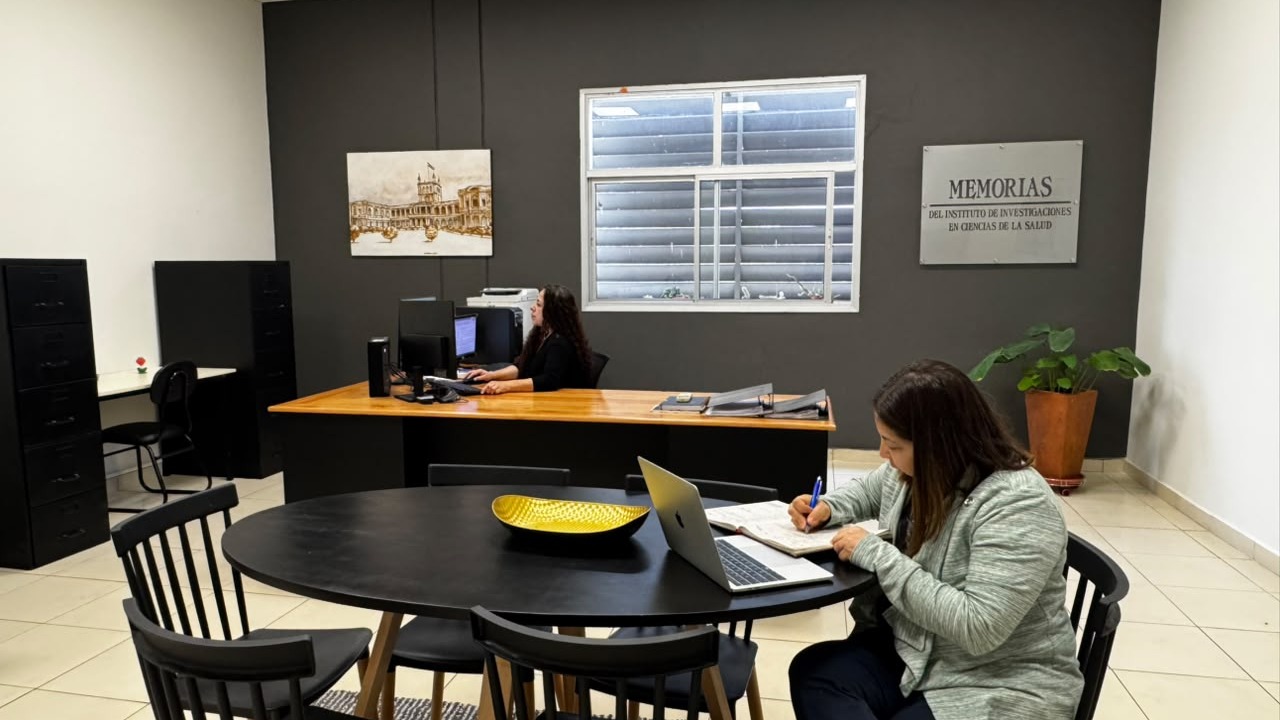
Our day-to-day at Memorias del IICS

A glimpse into our day-to-day at the Memorias del IICS office

Leer más

About

Memorias del Instituto de Investigaciones en Ciencias de la Salud (Mem. Inst. Investig. Cienc. Salud) is the official publication of the Institute of Research in Health Sciences (IICS) of the National University of Asunción (UNA), Paraguay. It publishes original scientific contributions in clinical medicine, biomedical research, microbiology, molecular biology, dentistry, nursing, nutrition, public health, health biotechnology, genetics, biochemistry, and related disciplines. Founded in 1983, the journal adopted its current name in 2002 and has been published exclusively online since 2015, incorporating XML article dissemination as of 2024. Since 2023, it operates under a continuous publication model. The journal accepts manuscripts in Spanish and English as original research articles, reviews, case studies, and brief communications. All content is available in open access, free of charge for authors and readers, under the Creative Commons Attribution 4.0 International License, in accordance with the Budapest Open Access Initiative (BOAI). It is indexed in BVS, SciELO Paraguay, HINARI, LILACS, DOAJ, Latindex, MIAR, Dialnet, CiteFactor, Google Scholar, LivRe, BASE, EBSCO, and Web of Science – SciELO Citation Index. The journal is funded by IICS-UNA, supports the OAI-PMH protocol for metadata harvesting, and uses the LOCKSS system for digital preservation of its contents.

 
Leer más

Peer Review Process

Manuscripts submitted to Memorias del Instituto de Investigaciones en Ciencias de la Salud undergo a double-blind peer review process, in which the identities of both authors and reviewers remain anonymous throughout the evaluation. Each manuscript is assessed by a minimum of two external reviewers with expertise in the relevant subject area, who are given a period of 30 days to submit their evaluation. Reviewers assess the originality, methodological rigor, scientific relevance, and clarity of presentation of each work. Based on the reviewers' reports, the Editorial Committee decides whether to accept, request revisions, or reject the manuscript, and communicates the decision to the authors as promptly as possible. This process ensures impartiality, transparency, and the scientific quality of published articles.

Leer más

Call for Papers

The Institute of Research in Health Sciences (IICS) of the National University of Asunción (UNA) invites researchers, academics, and health professionals to submit their manuscripts for consideration in the 2026 Volume of Memorias del Instituto de Investigaciones en Ciencias de la Salud (Mem. Inst. Investig. Cienc. Salud). The journal accepts original and unpublished contributions in Spanish as original research articles, review articles, case studies, and brief communications, in the areas of clinical medicine, biomedical research, microbiology, molecular biology, dentistry, nursing, nutrition, public health, health biotechnology, genetics, biochemistry, and related disciplines. The call for submissions is open and ongoing, and manuscripts may be submitted at any time of the year through the journal's online submission system. All received manuscripts undergo double-blind peer review. The journal is open access, with no charges for authors or readers. For further information on submission guidelines, please refer to the author instructions available on the journal's website.

Leer más

Community epidemiological surveillance system “Bonis”. Current status and future projections

Authors

  • Xabier Basogain Universidad del País Vasco – Euskal Herriko Unibertsitatea, España
  • MA Olabe Universidad del País Vasco – Euskal Herriko Unibertsitatea, España
  • K Espinosa Universidad del País Vasco – Euskal Herriko Unibertsitatea, España
  • MA Gómez Universidad del País Vasco – Euskal Herriko Unibertsitatea, España
  • JL Larrabe Universidad del País Vasco – Euskal Herriko Unibertsitatea, España
  • P Galván Instituto de Investigaciones en Ciencias de la Salud. Universidad Nacional de Asunción, Paraguay
  • V Cane Instituto de Investigaciones en Ciencias de la Salud. Universidad Nacional de Asunción, Paraguay
  • MB Cabral Instituto de Investigaciones en Ciencias de la Salud. Universidad Nacional de Asunción, Paraguay
  • M Ascurra Instituto de Investigaciones en Ciencias de la Salud. Universidad Nacional de Asunción, Paraguay
  • M Samudio Instituto de Investigaciones en Ciencias de la Salud. Universidad Nacional de Asunción, Paraguay
  • I Allende Ministerio de Salud Pública y Bienestar Social, Dirección General de Vigilancia de la Salud, Asunción, Paraguay
  • A Cabello Ministerio de Salud Pública y Bienestar Social, Dirección General de Vigilancia de la Salud, Asunción, Paraguay
  • M Paéz Ministerio de Salud Pública y Bienestar Social, Dirección General de Vigilancia de la Salud, Asunción, Paraguay
  • G Troche Ministerio de Salud Pública y Bienestar Social, Dirección General de Vigilancia de la Salud, Asunción, Paraguay

Keywords:

Information and Communication Technologies (ICTs), Community Epidemiological Surveillance, telephony, web technologies, data base, febrile syndromes, Bonis

Abstract

The current system of epidemiologic surveillance in the area of Mutual Aid Centre and Health for All (CAMSAT in Spanish) in the “Bañado Sur” in Asuncion is based on routine screening of possible febrile cases through home visits made by community agents from the Primary Health Care Unit (USF in Spanish). Each of the ten community agents are assigned to 150 households and the results of these home visits are recorded on sheets that are reported through traditional means (paper, internal mail, fax, etc.) to the DGVS of the Ministry of Health. The consequence of this working system is that often the blocking actions arrive late with the social and economic costs that this implies. The Bonis system uses the mobile phone as a catalyst to transform the routine screening of
potential feverish cases in a proactive action and the web technology and databases for patient records and appropriate follow-up by health personnel. The use of these information and communication technologies of (ICTs) transforms the Epidemiological
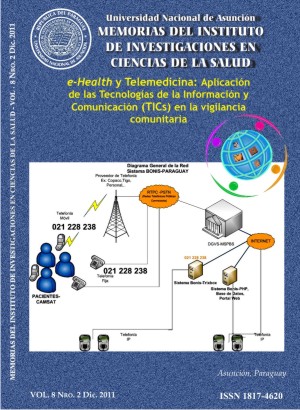
Surveillance System in a study case of e-Health in Paraguay. This document describes the current status and future projections of the community epidemiological surveillance system Bonis which uses Information and Communication Technologies (ICTs) to prevent, warn, monitor and control the spread of febrile syndromes in a catchment area of Barrio Obrero Hospital (HBO), Unit of Primary Health Care Center Mutual Aid and Health for All, Asuncion, Paraguay. 

Downloads
Download data is not yet available.

Downloads

Published

2010-12-01

Issue

Section

Tema de actualidad

How to Cite

Basogain, X., Olabe, M., Espinosa, K., Gómez, M., Larrabe, J., Galván, P., Cane, V., Cabral, M., Ascurra, M., Samudio, M., Allende, I., Cabello, A., Paéz, M., & Troche, G. (2010). Community epidemiological surveillance system “Bonis”. Current status and future projections. Memorias Del Instituto De Investigaciones En Ciencias De La Salud, 8(2), 44-57. https://revistascientificas.una.py/index.php/RIIC/article/view/2951