
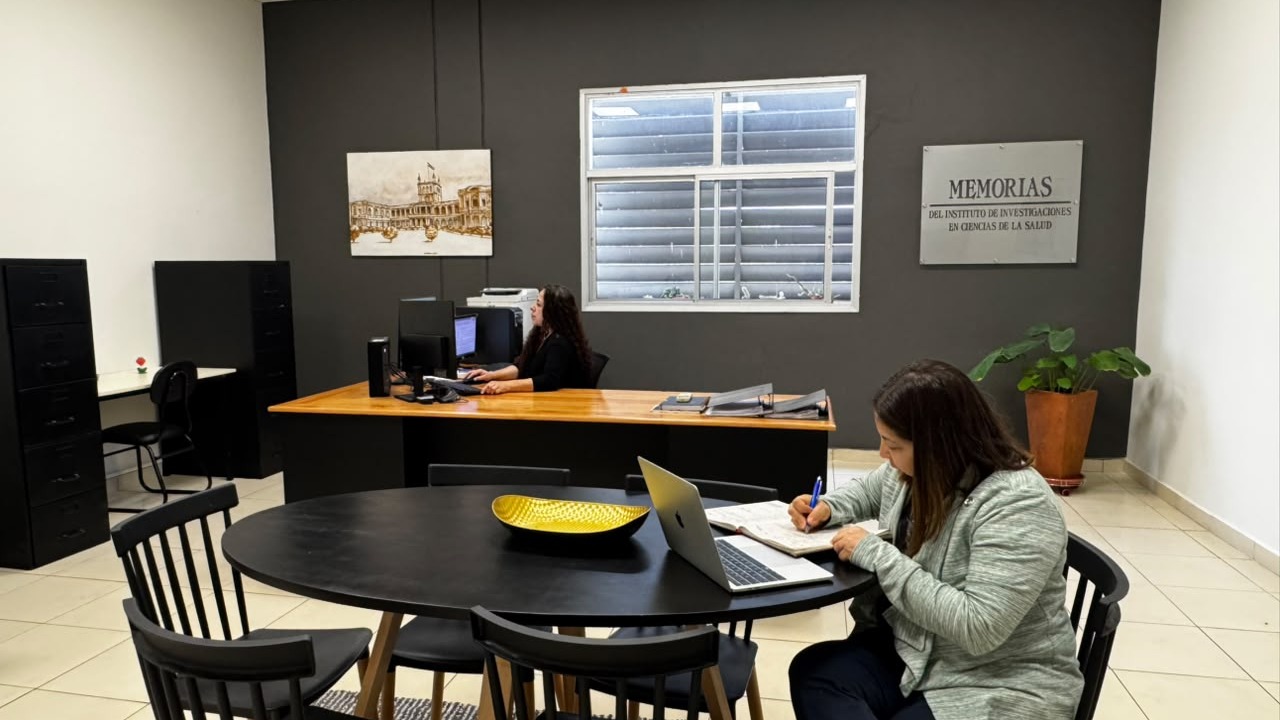
Our day-to-day at Memorias del IICS

A glimpse into our day-to-day at the Memorias del IICS office

Leer más

About

Memorias del Instituto de Investigaciones en Ciencias de la Salud (Mem. Inst. Investig. Cienc. Salud) is the official publication of the Institute of Research in Health Sciences (IICS) of the National University of Asunción (UNA), Paraguay. It publishes original scientific contributions in clinical medicine, biomedical research, microbiology, molecular biology, dentistry, nursing, nutrition, public health, health biotechnology, genetics, biochemistry, and related disciplines. Founded in 1983, the journal adopted its current name in 2002 and has been published exclusively online since 2015, incorporating XML article dissemination as of 2024. Since 2023, it operates under a continuous publication model. The journal accepts manuscripts in Spanish and English as original research articles, reviews, case studies, and brief communications. All content is available in open access, free of charge for authors and readers, under the Creative Commons Attribution 4.0 International License, in accordance with the Budapest Open Access Initiative (BOAI). It is indexed in BVS, SciELO Paraguay, HINARI, LILACS, DOAJ, Latindex, MIAR, Dialnet, CiteFactor, Google Scholar, LivRe, BASE, EBSCO, and Web of Science – SciELO Citation Index. The journal is funded by IICS-UNA, supports the OAI-PMH protocol for metadata harvesting, and uses the LOCKSS system for digital preservation of its contents.

 
Leer más

Peer Review Process

Manuscripts submitted to Memorias del Instituto de Investigaciones en Ciencias de la Salud undergo a double-blind peer review process, in which the identities of both authors and reviewers remain anonymous throughout the evaluation. Each manuscript is assessed by a minimum of two external reviewers with expertise in the relevant subject area, who are given a period of 30 days to submit their evaluation. Reviewers assess the originality, methodological rigor, scientific relevance, and clarity of presentation of each work. Based on the reviewers' reports, the Editorial Committee decides whether to accept, request revisions, or reject the manuscript, and communicates the decision to the authors as promptly as possible. This process ensures impartiality, transparency, and the scientific quality of published articles.

Leer más

Call for Papers

The Institute of Research in Health Sciences (IICS) of the National University of Asunción (UNA) invites researchers, academics, and health professionals to submit their manuscripts for consideration in the 2026 Volume of Memorias del Instituto de Investigaciones en Ciencias de la Salud (Mem. Inst. Investig. Cienc. Salud). The journal accepts original and unpublished contributions in Spanish as original research articles, review articles, case studies, and brief communications, in the areas of clinical medicine, biomedical research, microbiology, molecular biology, dentistry, nursing, nutrition, public health, health biotechnology, genetics, biochemistry, and related disciplines. The call for submissions is open and ongoing, and manuscripts may be submitted at any time of the year through the journal's online submission system. All received manuscripts undergo double-blind peer review. The journal is open access, with no charges for authors or readers. For further information on submission guidelines, please refer to the author instructions available on the journal's website.

Leer más

First characterization of preantral follicles in the ovaries of adult alpaca

Authors

  • Luisa Echevarria Universidad Peruana Cayetano, Facultad de Medicina Veterinaria y Zootecnia. Heredia, Lima, Perú
  • Johanna Leiva-Revilla Centro para el Desarrollo de la Investigación Científica (CEDIC), Asunción, Paraguay
  • Roy Andrade Universidad Peruana Cayetano, Facultad de Medicina Veterinaria y Zootecnia. Heredia, Lima, Perú
  • Johan Smitz Follicle Biology Laboratory, Vrije Universiteit Brussel. Laarbeeklaan 101, B-1090 Brussels, Belgium
  • José Ricardo Figueiredo Universidad Estatal de Ceará, Laboratorio de Manipulación de Oocitos y Folículos Preantrales. Fortaleza, CE, Brasil

DOI:

https://doi.org/10.18004/mem.iics/1812-9528/2019.017.02.102-106

Keywords:

Alpaca, follicle, ovary, histology

Abstract

It is a fact that while even basic reproductive information on alpacas is unavailable, the normal ovarian reserve of this species in comparison to other species is also unidentified. In this study, the ovarian preantral follicles in healthy adult alpacas were characterized in order to establish a general model to in vitro studies. Ten ovaries were collected from five adult alpacas. The ovarian cortex samples were fixed with paraformaldehyde and histological analysis was done. Normal and degenerated follicles percentages were determined. The normal follicles were measured and classified in primordial, transitional, primary and secondary stages. Most of the preantral follicles present in the ovarian cortex of alpacas were primordial and transitional stages; primary (6.10%) and secondary (0.37%) follicles were rarely found. The primary and secondary follicles were larger in diameter when compared with the primordial and transitional follicles. The largest oocyte diameter was recorded in the secondary follicles (P < 0.05). This study serves to establish a biological model for future reproduction studies in Alpacas or as possible biological model for studies of folliculogenesis in humans.

Downloads

Download data is not yet available.

References

Bravo PW, Stabenfeldt GH, Lasley BL, Fowler ME. The effect of ovarian follicle size on pituitary and ovarian responses to copulation in domesticated South American camelids. Biol Reprod. 1991 Oct;45(4):553–9.

Sumar JB. Reproduction in female South American domestic camelids. J Reprod Fertil Suppl. 1999;54: 169–78.

Vaughan JL, Tibary A. Reproduction in female South American camelids: A review and clinical observations. Small Rumin Res. 2006 Feb;61(2–3):259–81.

Fortune J. The early stages of follicular development: activation of primordial follicles and growth of preantral follicles. Anim Reprod Sci. 2003 Oct;78(3–4):135–63.

van Wezel IL, Rodgers RJ. Morphological characterization of bovine primordial follicles and their environment in vivo. Biol Reprod. 1996 Nov;55(5):1003–11.

Araújo VR, Gomes CM, Deborah M, Modesto G, Báo SN, Viana JR, et al. Effect of Bone Morphogenetic Protein-7 (BMP-7) on in vitro survival of caprine preantral follicles. Pesq Vet Bras. 2010;30(4):305–10.

Cahill LP, Mauléon P. A study of the population of primordial and small follicles in the sheep. J Reprod Fertil. 1981 Jan;61(1):201–6.

Arias P, Feder F-H, Porcel R, Cox J. Estudio histológico comparativo del aparato reproductivo de llama hembra (Lama guanicoe glama). Anat Histol Embryol. 1992 Dec;21(4):314–23.

Amorim CA, Rondina D, Rodrigues APR, Costa SHF, Gonçalves PBD, de Figueiredo JR, et al. Isolated ovine primordial follicles cryopreserved in different concentrations of ethylene

glycol. Theriogenology. 2003 Sep;60(4):735–42.

Figueiredo JR, Hulshof SC., Van den Hurk R, Ectors FJ, Fontes RS, Nusgens B, et al. Development of a combined new mechanical and enzymatic method for the isolation of intact preantral follicles from fetal, calf and adult bovine ovaries. Theriogenology. 1993 Oct;40(4):789–99.

Silva-Santos KC, Santos GMG, Siloto LS, Hertel MF, Andrade ER, Rubin MIB, et al. Estimate of the population of preantral follicles in the ovaries of Bos taurus indicus and Bos taurus taurus cattle. Theriogenology. 2011 Oct;76(6):1051–7.

Magalhães-Padilha DM, Andrade PM, Sales ET, Araujo VR, Lima IMT, Castro S V, et al. Effect of sequential medium on in vitro culture of goat ovarian cortical tissue. Anim Reprod Sci. 2012 Jun;132(3–4):159–68.


Downloads

Published

2019-08-01

Issue

Section

Short communications

How to Cite

Echevarria, L., Leiva-Revilla, J., Andrade, R., Smitz, J., & Figueiredo, J. R. . (2019). First characterization of preantral follicles in the ovaries of adult alpaca. Memorias Del Instituto De Investigaciones En Ciencias De La Salud, 17(2), 102-106. https://doi.org/10.18004/mem.iics/1812-9528/2019.017.02.102-106