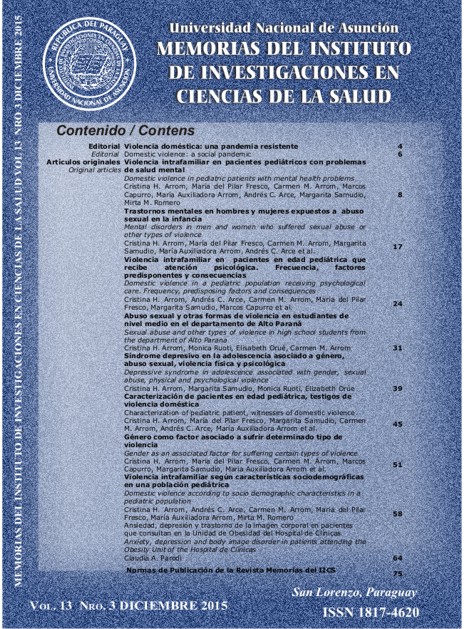

Caracterización de pacientes en edad pediátrica, testigos de violencia doméstica
Keywords:
violencia intrafamiliar, niñez y adolescencia, testigo de violencia domésticaAbstract
El impacto que tiene en la salud de la población pediátrica el ser testigo de violencia doméstica (VD), presupone una situación de riesgo con eventuales consecuencias para su salud mental. El objetivo del estudio fue caracterizar el contexto familiar de los pacientes en edad pediátrica testigos de violencia doméstica que reciben tratamiento en el Servicio Ambulatorio de Psiquiatría de la Facultad de Ciencias Médicas en Paraguay. Estudio trasversal, descriptivo. Se revisaron 145 fichas clínicas de pacientes que consultaron en el Servicio entre el 2010 y 2013, de las cuales 101 contaban con la información requerida. El 53,5% (n=54) de los pacientes reportó ser testigo de violencia entre padres; el 35,6% (n=36) sufrió otro tipo de situación traumática. Se encontró asociación (p=0,00156) entre convivencia en familia nuclear y menor presencia de VD; vivir en familia monoparental y ser testigo de VD (p=0,016); ser testigo de VD y ser víctima de violencia física (p=0,002); ser testigo y ser víctima de violencia psicológica (p=0,03). El porcentaje de población testigo está acorde a la prevalencia en América Latina. Los resultados evidencian menor presencia de población infantil testigo de VD en familias nucleares y mayor en monoparentales. Se constata que la población estudiada no solo es testigo, sino también sufre violencia física y psicológica. Se consideran insuficientes las categorías para determinar a las familias como factores protectores o de riesgo, por lo cual se deberían incluir otros indicadores que hagan referencia a la dinámica.
Downloads
References
Ulloa Ch F. Violencia familiar y su impacto sobre el niño. Rev.Chil.Pediatr. 1996;67(4):88-96.
UNICEF [Internet]. Asunc ión-Paraguay: Base Educativa y Comunitaria de Apoyo (BECA), UNICEF; [citado 11 de junio 2013]. Disponible en PDF:http://www.unicef.org/paraguay/spanish/py_ resources__Estudio_Maltrato.pdf
Vitriol G. Relación entre psicopatología adulta y antecedentes de trauma infantil. Rev. chil. neuro-psiquiatr. 2005;43(2):88-96.
Viola L. Repercusión de la violencia doméstica en la salud mental infantil. Valoración del daño psíquico. Rev Psiquiatr Urug. 2010;74(1):73-83.
Giléde RP. Experiences of Violence and Moral Reasoning in a Context of Vengeance. Rev. colomb. psicol. 2012;21(2):197-212.
Rey A, César A. Habilidades Pro Sociales, Rasgos de Personalidad de Género y Aceptación de la Violencia Hacia la Mujer, en Adolescentes que han Presenciado Violencia entre sus Padres. Act. Colom. Psicol. 2008;11(1):107-18.
Fernández-Montalvo J, Echeburúa E. Variables psicopatológicas y distorsiones cognitivas de los maltratadores en el hogar: un análisis descriptivo. Análisis y modificación de conducta.1997;23:151-80.
Stiles MM. Witnessing Domestic Violence: The Effect on Children. Am Fam Physician. 2002;66(11):2052-67.
UNICEF [Internet]. Buenos Aires-Argentina: UNICEF, Ministerio de Desarrollo Social de la Provincia de Buenos Aires; [citado 10 junio 2013]. Disponible en PDF:
http://www.unicef.org/argentina/spanish/abo rdajes.pdf
Organización Mundial de la Salud-Oficina Regional para las Américas-Organización Panamericana de la Salud [Internet]. Washington D.C., EEUU: OPS-OMS; [citado 2 abril 2014]. Disponible en:
http://apps.who.int/iris/bitstream/10665/988
/1/WHO_RHR_12.36_spa.pdf?ua=1
Orue I, Calvete E. Justification of violence as a mediator between exposure to violence and aggressive behavior in children. Psicothema [serial on the Internet]. [cited November 1, 2015]. 2012;24(1):42-7. Available from: PsycINFO
Kishor S, Johnson K. Profiling domestic violence – a multi-country study. Calverton, MD, ORC Macro, 2004.
Abramsky T et al. What factors are associated with recent intimate partner violence? Findings from the WHO multicountry study on women’s health and domestic violence. BioMed Central Public Health, 11:109.
Arrom C, Samudio M, Arrom CM, Lampert N, Arrom MA, Orué E. Violencia intrafamiliar, de pareja íntima y abuso sexual en puerperio inmediato. Su relación con depresión. Revista Paraguaya de Psiquiatría. 2013;1(2):17-23.
Galeano A, Orrego B, Pérez M, Ruiz V, Arrom MA, Ruoti M, Arrom C, Arrom CM, Fresco MP, Capurro M. Violencia intrafamiliar sufrida por mujeres en un Hospital Público. Revista Paraguaya de Psiquiatría. 2015;3(1):42-9.
Heise L, Garcia Moreno C. La violencia en la pareja. En: Krug EG, Dahlberg LL, Mercy JA, Zwi AB. Informe mundial sobre la violencia y la salud. Publicación Científica y Técnica No.588. Washington, D.C., Organización Panamericana de la Salud, 2003: pp. 95-131.
Fresco MP, Arrom C, Samudio M, Arrom CM, Capurro M, Arrom MA, Arce A, Fresco M. Psicopatología en adultos con antecedentes de violencia intrafamiliar. Revista Paraguaya de Psiquiatría. 2015;3(1):8-12.
Holt S, Buckley H, Whelan S. The impact of exposure to domestic violence on children and young people: a review of the literature. Child Abuse & Neglect. 2008;32(8):797-810.
Gazmararian JA, Adams MM, Saltzman LE, Johnson CH, Bruce FC, Marks JS, et al. The relationship between pregnancy intendedness and physical violence in mothers of newborns. Obstetrics & Gynecology. 1995;85(6):1031–38.