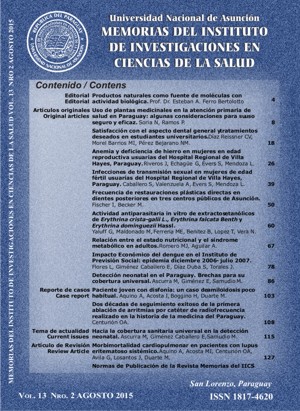


Dos décadas de seguimiento exitoso de la primera ablación de arritmias por catéter de radiofrecuencia realizado en la historia de la medicina del Paraguay
Keywords:
Ablación por radiofrecuencia del haz anómalo de Kent, estudio electrofisiológico, síndrome de Wolff-Parkinson-White, taquicardia paroxística supraventricularAbstract
La técnica de mapeo endocárdico durante el estudio electrofisiológico ha sido extensamente empleada en el análisis de las taquicardias paroxísticas supraventriculares (TPS). Mediante este mapeo endocárdico y el análisis meticuloso de los electrogramas endocárdicos y los respectivos intervalos de conducción, es posible localizar el sitio de origen de las arritmias y así facilitar su tratamiento ablativo por medio de catéteres de radiofrecuencia. Se describe el caso de un hombre de 29 años con síndrome de Wolff-Parkinson-White (WPW) que manifiestó que presentaba varios episodios documentados
de TPS con serio compromiso hemodinámico que motivaba su frecuente internación en terapia intensiva. El mapeo electrofisiológico endocárdico meticuloso demostró la presencia de un haz anómalo de Kent auriculoventricular izquierdo en posición posteroseptal. El período refractario absoluto del haz anómalo de Kent fue de 240 ms. La primera emisión de radiofrecuencia a través de un catéter adecuadamente posicionado previo terminó la taquicardia. La taquicardia permaneció no inducible a partir de entonces. En estas dos décadas de seguimiento clínico, el paciente no ha presentado ni
un solo episodio de taquicardia. La curación definitiva generada por la ablación del haz anómalo de Kent ha proporcionado un cambio drástico, total y beneficioso en la calidad de vida al paciente. Los beneficios clínicos y socioeconómicos son mayores cuanto más temprano en la evolución se realice el procedimiento de ablación de arritmias.
Downloads
References
Wellens HJ, Durrer D. Patterns of ventriculoatrial conduction in the Wolff-Parkinson-White syndrome. Circulation. 1974; 49(1):22-31.
Svenson RH, Miller HC, Gallagher JJ, Wallace AG. Electrophysiological evaluation of the Wolff-Parkinson-White syndrome: Problems in assessing antegrade and retrograde conduction over the accessory pathway. Circulation. 1975;
(4):552-62.
Narula OS. Retrograde pre-excitation: Comparison of antegrade and retrograde conduction intervals in man. Circulation. 1974; 50(6):1129-43.
Becker AE, Anderson RH, Durrer D, Wellens HJ. The anatomical substrates of Wolff-Parkinson-White syndrome: A clinicopathologic correlation in seven patients. Circulation. 1978;57(5):870-9.
Jackman WM, Friday KJ, Yeung-Lai-Wah JA, Fitzgerald DM, Beck B, Bowman AJ, et al. New catheter technique for recording left free-wall accessory atrioventricular pathway activation:
Identification of pathway fiber orientation. Circulation. 1988;78(3):598-611.
Critelli G, Gallagher JJ, Monda V, Coltorti F, Scherillo M, Rossi L. Anatomic and electrophysiologic substrate of the permanent form of junctional reciprocating tachycardia. J AM Coll Cardiol. 1984; 4 (3):601-10.
De la fuente D, Sasyniuk B, Moe GK. Conduction through a narrow isthmus in isolated canine atrial tissue: A model of the
W-P-W syndrome. Circulation 1971; 44 (5):803-9.
Della Bella P, Brugada P, Talajic M, Lemery R, Torner P, Lezaun R, et al. Atrial fibrillation in patients with an accessory pathway: Importance of the conduction properties of the accessory pathway. J Am Coll Cardiol. 1991;17(6):1352-6.
Fananapazir L, German LD, Gallagher JJ, Lowe JE, Prystowsky EN. Importance of preexcited QRS morphology during induced
atrial fibrillation to the diagnosis and localization of multiple accessory pathways.
Centurión OA • Primera Ablación de Arritmias en Paraguay
Mem. Inst. Investig. Cienc. Salud, 2015;13(2):108-14 114
Circulation 1990;81(2):578-85.
Robinson K, Rowland E, Krikler DM. Wolff-Parkinson-White syndrome: Atrial fibrillation as the presenting arrhythmia. Br Heart J. 1988;59 (5):578-80.
Sharma AD, Klein GJ, Guiraudon GM, Milstein S. Atrial fibrillation in patients with Wolff-Parkinson-White syndrome: Incidence after surgical ablation of the accessory pathway.
Circulation 1985; 72(1):161-9.
Bauerfeind RA, Wyndham CR, Swiryn SP, Palileo EV, Strasberg B, Lam W, et al. Paroxysmal atrial fibrillation in the Wolff-Parkinson-White syndrome. Am J Cardiol. 1981; 47(3):562-9.
Campbell RW, Smith RA, Gallagher JJ, Pritchett EL, Wallace AG. Atrial fibrillation in the pre-excitation syndrome. Am J Cardiol. 1977; 40(4):514-20.
Amat-y-Leon F, Dhingra RC, Wu D, Denes P, Wyndham, C, Rosen KM. Catheter mapping of retrograde atrial activation: Observations during ventricular pacing an AV nodal re-entrant
paroxysmal tachycardia. Br Heart J. 1976;38 (4):355-62.
Kastor JA, Goldreyer BN, Moore EN, Shelburne JC, Manchester JH. Intraventricular conduction in man studied with an endocardial electrode catheter mapping technique: Patients with normal QRS and right bundle branch block. Circulation. 1975; 51(5):786-96.
Centurión OA, Fukatani M, Shimizu A, Konoe A, Isomoto S, Tanigawa M, et al. Anterograde and retrograde decremental conduction over left -sided accessory atrioventricular pathways in the Wolff-Parkinson- White syndrome. Am Heart J. 1993; 125(4):1038-47.
Centurión OA, Isomoto S, Hayano M, Yano K. Evidence of quadruple anterograde atrioventricular nodal pathways in a patient with atrioventricular node reentry. J Electrocardiol.
; 27(1):71-8.
Centurión OA, Isomoto S, Konoe A, Shimizu A, Hayano M, Yano K. Electrophysiologic demonstration of anterograde fast and slow pathways within the His bundle in patients with
normal intraventricular conduction. Int J Cardiol. 1994; 44(3):251-60.
Kaibara M, Konoe A, Isomoto S, Centurión OA, Hirata T, Hano O, et al. Radiofrequency catheter ablation for atrioventricular node reentry tachycardia with multiple slow
atrioventricular node pathways. Jap Circulation J. 1995;59(4):224-30.
Centurión OA, Kaibara M, Isomoto S, Konoe A, Yano K. Unmasking of fast and slow atrioventricular nodal pathways by
successful radiofrequency ablation of two accessory atrioventricular connections. Clin Cardiol. 1996;20(1):75-8.
Jackman WM, Wang X, Friday KJ, Roman CA, Moulton KP, Beckman KJ, et al. Catheter ablat ion of accessory atrioventricular pathways (Wolff-Parkinson-White syndrome) by radiofrequency current. N Engl J Med. 1991; 324(23):1601-11.
Calkins H, Kim YN, Schmaltz S, Sousa J, el -Atassi R, Leon A, et al. Electrogram criteria for identification of appropiate target sites for radiofrequency catheter ablation of accessory atrioventricular connections. Circulation. 1992; 85(2):565-73.
Centurión OA, Shimizu A, Isomoto S, Konoe A. Mechanism for the genesis of paroxysmal atrial fibrillation in the Wolff-
Parkinson-White syndrome: Intrinsic atrial muscle vulnerability vs electrophysiological properties of the accessory pathway.
Europace. 2008; 10(3):294-302.
Centurión OA. Atrial fibrillation in the Wolff-Parkinson-White syndrome. JA FB. 2011;4 (1):22-38.