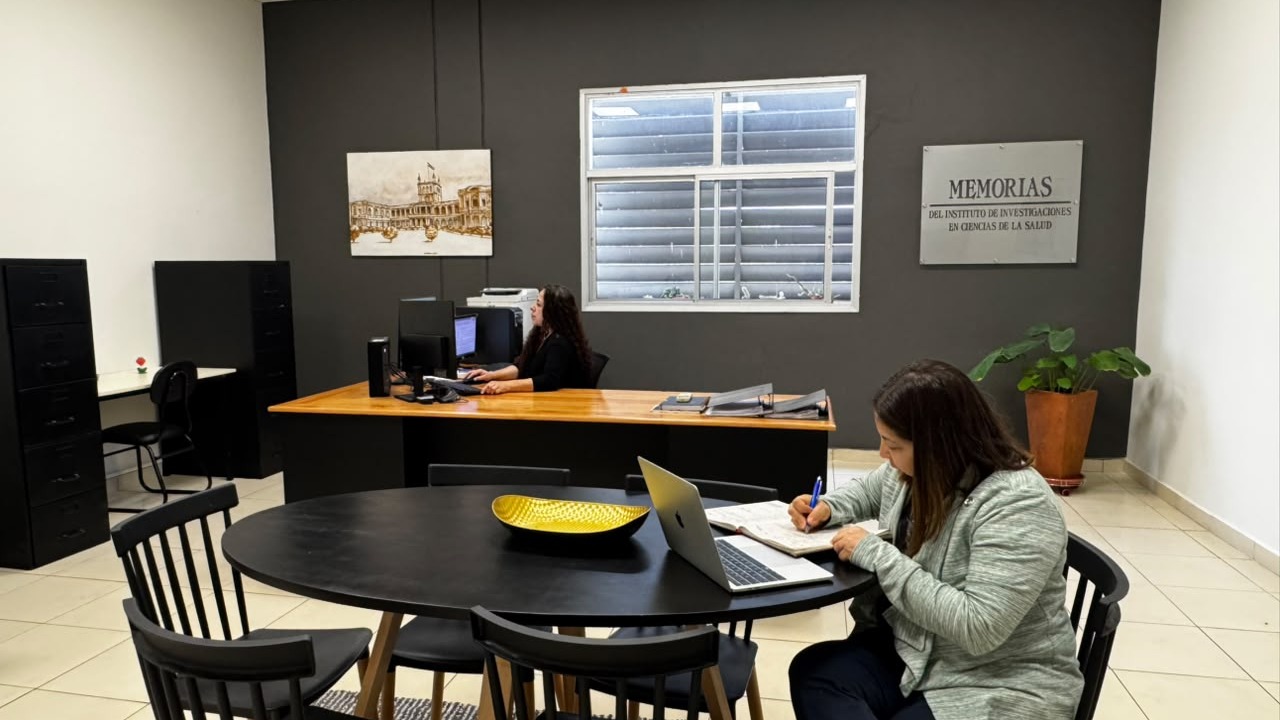
Our day-to-day at Memorias del IICS

A glimpse into our day-to-day at the Memorias del IICS office

Leer más

About

Memorias del Instituto de Investigaciones en Ciencias de la Salud (Mem. Inst. Investig. Cienc. Salud) is the official publication of the Institute of Research in Health Sciences (IICS) of the National University of Asunción (UNA), Paraguay. It publishes original scientific contributions in clinical medicine, biomedical research, microbiology, molecular biology, dentistry, nursing, nutrition, public health, health biotechnology, genetics, biochemistry, and related disciplines. Founded in 1983, the journal adopted its current name in 2002 and has been published exclusively online since 2015, incorporating XML article dissemination as of 2024. Since 2023, it operates under a continuous publication model. The journal accepts manuscripts in Spanish and English as original research articles, reviews, case studies, and brief communications. All content is available in open access, free of charge for authors and readers, under the Creative Commons Attribution 4.0 International License, in accordance with the Budapest Open Access Initiative (BOAI). It is indexed in BVS, SciELO Paraguay, HINARI, LILACS, DOAJ, Latindex, MIAR, Dialnet, CiteFactor, Google Scholar, LivRe, BASE, EBSCO, and Web of Science – SciELO Citation Index. The journal is funded by IICS-UNA, supports the OAI-PMH protocol for metadata harvesting, and uses the LOCKSS system for digital preservation of its contents.

 
Leer más

Peer Review Process

Manuscripts submitted to Memorias del Instituto de Investigaciones en Ciencias de la Salud undergo a double-blind peer review process, in which the identities of both authors and reviewers remain anonymous throughout the evaluation. Each manuscript is assessed by a minimum of two external reviewers with expertise in the relevant subject area, who are given a period of 30 days to submit their evaluation. Reviewers assess the originality, methodological rigor, scientific relevance, and clarity of presentation of each work. Based on the reviewers' reports, the Editorial Committee decides whether to accept, request revisions, or reject the manuscript, and communicates the decision to the authors as promptly as possible. This process ensures impartiality, transparency, and the scientific quality of published articles.

Leer más

Call for Papers

The Institute of Research in Health Sciences (IICS) of the National University of Asunción (UNA) invites researchers, academics, and health professionals to submit their manuscripts for consideration in the 2026 Volume of Memorias del Instituto de Investigaciones en Ciencias de la Salud (Mem. Inst. Investig. Cienc. Salud). The journal accepts original and unpublished contributions in Spanish as original research articles, review articles, case studies, and brief communications, in the areas of clinical medicine, biomedical research, microbiology, molecular biology, dentistry, nursing, nutrition, public health, health biotechnology, genetics, biochemistry, and related disciplines. The call for submissions is open and ongoing, and manuscripts may be submitted at any time of the year through the journal's online submission system. All received manuscripts undergo double-blind peer review. The journal is open access, with no charges for authors or readers. For further information on submission guidelines, please refer to the author instructions available on the journal's website.

Leer más

Contaminación microbiana de colirios utilizados por pacientes en la consulta externa de oftalmología

Authors

  • JC Ginés
  • Margarita Samudio
  • Norma Fariña
  • Ramona Sanabria
  • Florentina Laspina
  • F Peña
  • P Bedoya
  • R Duerksen
  • H Miño de Kaspar

Keywords:

contaminación, colirios, microorganismos

Abstract

Los colirios contaminados representan una causa potencial de infección ocular prevenible. Como toda medicación terapéutica tópica, los colirios deben estar libres de agentes contaminantes. La frecuencia de contaminación varía entre 0,07% y 35,6% en los estudios publicados; no existiendo estudios publicados sobre este tema en nuestro país. Este estudio tiene como objetivo determinar la frecuencia de contaminación de las gotas oftálmicas utilizadas por pacientes que consultan en la Fundación Visión en Asunción, Paraguay. A todos los pacientes que acudieron a la consulta externa en el Servicio de Oftalmología de la Fundación Visión, de agosto de 2007 a julio de 2008 se les solicitó que entregaran sus envases de gotas oftálmicas que estuvieron utilizando por dos o más semanas, además se registraron sus datos demográficos y relacionados al uso del colirio. Los envases fueron enviados al Instituto de Investigaciones en Ciencias de la Salud (IICS), de manera que la medicación restante en el interior de los mismos fuera cultivada en los medios microbiológicos convencionales. De los 73 envases recolectados, 8 (11%) presentaron cultivos positivos, siendo los gérmenes aislados Estafilococo coagulasa negativo, Propionibacterium acnes, Serratia marcescens, Corynebacterium sp y Alcaligenes faecalis, además del hongo oportunista Aspergillus fumigatus. La contaminación de los colirios utilizados por estos pacientes es relevante. Estos resultados coinciden con reportes de otros países y señala la importancia de dar orientaciones a los pacientes en cuanto al modo de utilización, almacenamiento y tiempo de recambio de los colirios por parte de los oftalmólogos.

Downloads

Download data is not yet available.

References

Hogan M. The preparation and sterilization of ophthalmic solutions. Calif Med. 1949; 71(6): 414–6.

Belmonte Martínez J. Editorial: Monodosis. Microcirugía ocular [Internet] 2002 Set [Citado en Julio de 2012]; (3). Disponible en: http://www.oftalmo.com/secoir/secoir2002/rev02-3/02c-01.htm.

Porges Y, Rothkoff L, Glick J, Cohen S. Sterility of glaucoma medications among chronic users in the community. J Ocul Pharmacol Ther. 2004; 20(2):123-8.

Clark PJ, Ong B, Stanley CB. Contamination of diagnostic ophthalmic solutions in primary eye care settings. Mil Med. 1997; 162(7):501-6.

Raynaud C, Laveran H, Rigal D, Bonicel P. Bacterial contamination of eyedrops in clinical use. J Fr Ophthalmol. 1997; 20(1):17-24.

Geyer O, Bottone EJ, Podos SM, Schumer RA, Asbell PA. Microbial contamination of medications used to treat glaucoma. Br J Ophthalmol. 1995; 79(4):376-9.

Koneman E, Allen S, Janda W, Schreckenberger P, Winn(h) W. Diagnóstico microbiológico: Texto y atlas color. 5º Ed. Buenos Aires: Médica Panamericana; 1999.

Wessels IF, Bekendam P, Calvin WS, Zimmerman GJ. Open drops in ophthalmology offices: expiration and contamination. Ophthalmic Surg Lasers 1999;30:540–6.

Brudieu E, Duc DL, Masella JJ, Croize J, Valence B, Meylan I, et al. Bacterial contamination of multi-dose ocular solutions. A prospective study at the Grenoble Teaching Hospital. Pathol Biol (Paris) 1999;47:1065–70.

Betbeze CM, Stiles K, Krohne SG. Assesment of bacterial contamination of three multidose ophthalmic solutions. Vet Ophthalmol. 2007; 10(2):81-3.

Taayli H, Coayar G. Microbial contamination of eye drops. Cent Eur J Public Health. 2001; 9(3):162-4.

Rahman MQ, Tejwani D, Wilson JA, Butcher I, Ramaesh K. Microbial contamination of preservative free eye drops in multiple application containers. Br J Ophthalmol 2006;90:139–41

Downloads

Published

2012-12-01

Issue

Section

Original Articles

How to Cite

Ginés, J., Samudio, M., Fariña, N., Sanabria, R., Laspina, F., Peña, F., Bedoya, P., Duerksen, R., & Miño de Kaspar, H. (2012). Contaminación microbiana de colirios utilizados por pacientes en la consulta externa de oftalmología. Memorias Del Instituto De Investigaciones En Ciencias De La Salud, 10(2). https://revistascientificas.una.py/index.php/RIIC/article/view/1732