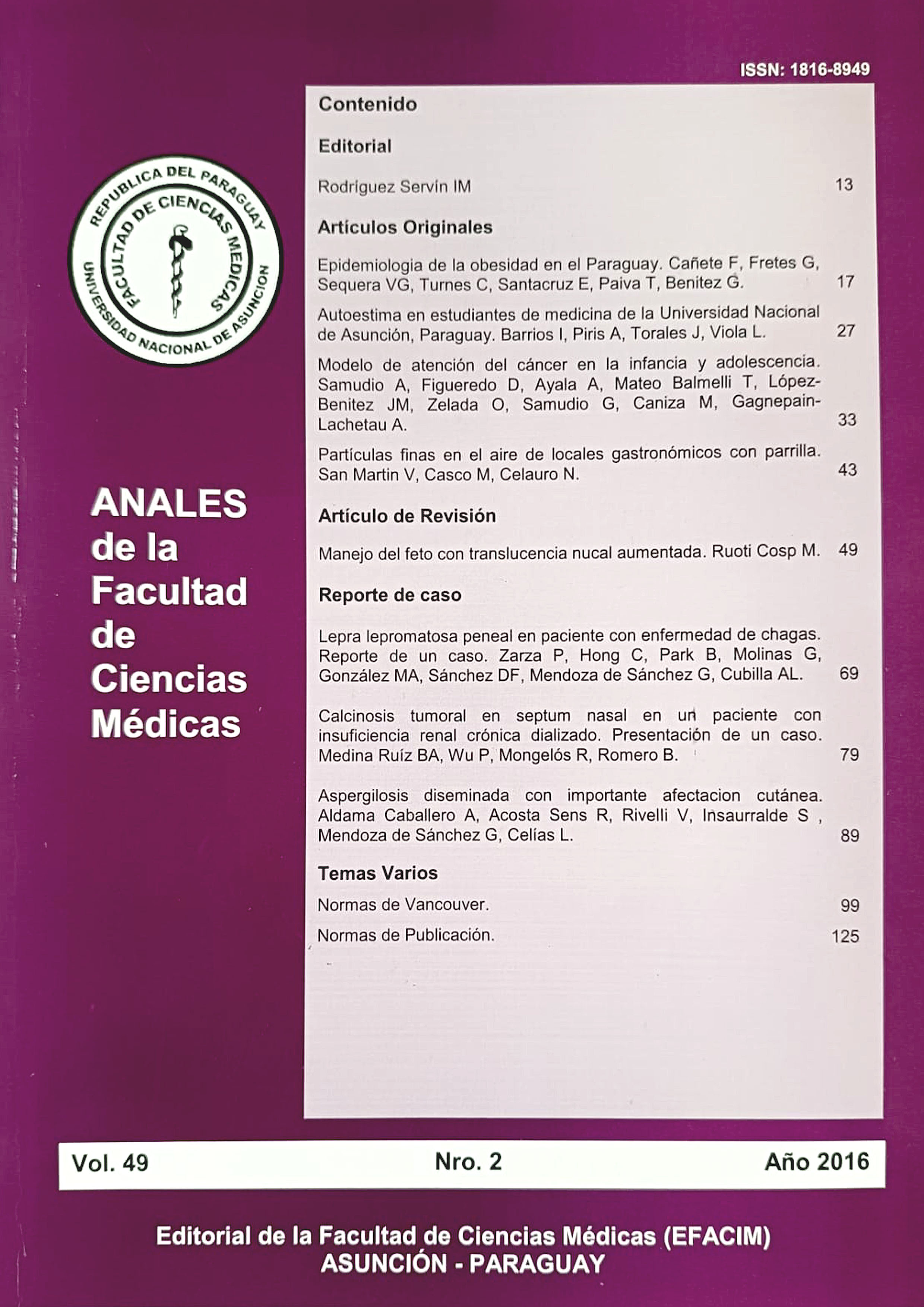
MANEJO DEL FETO CON TRANSLUCENCIA NUCAL AUMENTADA
DOI:
https://doi.org/10.18004/anales/2016.049(02)49-068Palabras clave:
trasnlucencia nucal, cromosomopatías, ecografía semana 11 – 13+6, cribado, ParaguayResumen
La medida de la Translucencia Nucal (TN) es un método ampliamente aceptado en el cribado de anomalías cromosómicas. Su técnica está bien descrita y estandarizada, refiriéndose como aumentada cuando la medida está por encima del percentil 95.
Su combinación con la edad materna, hueso nasal y marcadores bioquímicos, pueden detectar aproximadamente el 90% de los fetos con Trisomía 21 y en forma aislada el 70% con una tasa de falsos positivos del 5%.
Se han atribuido como causa de su aumento a la falla cardíaca, alteración en la composición de la matriz extracelular, hipoproteinemia fetal, congestión venosa en cabeza y cuello, fallo del drenaje linfático, infecciones congénitas o anemia fetal.
Su aumento se ha asociado a abortos o muertes fetales, anomalías fetales mayores y entre ellas las cardíacas o bien Síndromes genéticos, asociado a infecciones, macrosomía e incluso retraso en el desarrollo, por lo que no solamente se circunscribe a las alteraciones cromosómicas. De ahí radica su importancia de conocer el manejo de estas pacientes, en especial si el cariotipo es normal.
Referencias
1. Nicolaides KH. Nuchal translucency and other first-trimester sonographic markers of chromosomal abnormalities. Am J Obstet Gynecol 2004;191(1):45-67.
2. Cicero S, Bindra R, Rembouskos G, Spencer K, Nicolaides KH. Integrated ultrasound and biochemical screening for trisomy 21 using fetal nuchal translucency, absent fetal nasal bone, free beta-hCG and PAPP-A at 11 to 14 weeks. Prenat Diagn 2003;23(4):306-10.
3. Malone FD, Canick JA, Ball RH, Nyberg DA, Comstock CH, Bukowski R, et al, for the First - and Second - Trimester Evaluation of Risk (FASTER) Research Consortium. First-trimester or second-trimester screening, or both, for Down's syndrome. N Engl J Med 2005;353(19):2001-11.
4. A, C, N . A . L - 6 . N . L 200 -98.
5. Von Kaisenberg CS, Huggon I, Hyett JA, Farzaneh F, Nicolaides KH. Cardiac expression of sarcoplasmic reticulum calcium ATPase in fetuses with trisomy 21 and trisomy 18 presenting with nuchal translucency. Fetal Diagn Ther 1997;12:270-3.
6. Clur SA, Oude Rengerink K, Mol BW, Ottenkamp J, Bilardo CM. Fetal cardiac function between 11 ’ . U G 20 8–56.
7. Bilardo CM, Muller MA, Zikulnig L, Schipper M, Hecher K. Ductus venosus studies in fetuses at high risk for chromosomal or heart abnormalities: relationship with nuchal translucency measurement and fetal outcome. Ultrasound Obstet Gynecol 2001;17:288-94.
8. Von Kaisenberg CS, Brand-Saberi B, Christ B, Vallian S, Farzaneh F, Nicolaides KH. Collagen type VI gene expression in the skin of trisomy 21 fetuses. Obstet Gynecol 1998;91: 319-23.
9. Von Kaisenberg CS, Krenn V, Ludwig M, Nicolaides KH, Brand-Saberi B. Morphological classification of nuchal skin in fetuses with trisomy 21, 18 and 13 at 12-18 weeks and in a trisomy 16 mouse. Anat Embryol 1998;197:105-24.
10. Nakamura T, Gulick J, Pratt R, Robbins J. Noonan syndrome is associated with enhanced pERK activity, the repression of which can prevent craniofacial malformations. Proc Natl Acad Sci U S A 2009;106(36):15436-41.
11. Souka AP, Von Kaisenberg CS, Hyett JA, Sonek JD, Nicolaides KH. Increased nuchal traslucency with normal karyotype. Am J Obstet Gynecol 2005; 192:1005-21.
12. Souka AP, Skentou H, Geerts L, Bower S, Nicolaides KH. Congenital nephrotic syndrome presenting with increased nuchal translucency in the first trimester. Prenat Diagn 2002;22:93-5.
13. Smrcek JM, Germer U, Krokowski M, Berg C, Krapp M, Geipel A, et al. Prenatal ultrasound diagnosis and management of body stalk anomaly: analysis of nine singleton and two multiple pregnancies. Ultrasound Obstet Gynecol 2003;21:322-8.
14. Sebire NJ, Snijders RJM, Davenport M, Greenough A, Nicolaides KH. Fetal nuchal translucency thickness at 10–14 weeks of gestation and congenital diaphragmatic hernia. Obstet Gynecol 1997;90:943-7.
15. Bekker MN, van den Akker NM, Bartelings MM, Arkesteijn JB, Fischer SG, Polman JA, et al. Nuchal edema and venous-lymphatic phenotype disturbance in human fetuses and mouse embryos with aneuploidy. J Soc Gynecol Investig 2006;13:209–16.
16. De Mooij YM, van den Akker NM, Bekker MN, Bartelings MM, van Vugt JM, Gittenberger-de Groot AC. Aberrant lymphatic development in euploid fetuses with increased nuchal translucency including Noonan syndrome. Prenat Diagn 2011;31:159–66.
17. Sohan K, Carroll S, Byrne D, Ashworth M, Soothill P. Parvovirus as a differential diagnosis of hydrops fetalis in the first trimester. Fetal Diagn Ther 2000;15:234-6.
18. Clur S, Ottenkamp J, Bilardo C. The nuchal translucency and the fetal heart: a literature review. Prenatal diagnosis 2009;29(8):739-48.
19. Mula R, Goncé A, Bennásar M, Arigita M, Meler E, Nadal A, et al. Increased nuchal translucency and normal karyotype: perinatal and pediatric outcomes at 2 years of age. Ultrasound Obstet Gynecol 2012; 39: 34–41.
20. Michailidis GD, Economides DL. Nuchal translucency measurement and pregnancy outcome in karyotypically normal fetuses. Ultrasound Obstet Gynecol 2001;17:102-5.
21. Ayras O, Tikkanen M, Eronen M, Paavonen J, Stefanovic V. Increased nuchal translucency and pregnancy outcome: a retrospective study of 1063 consecutive singleton pregnancies in a single referral institution. Prenat Diagn 2013;33:856-62.
22. Souka AP, Snijders RJ, Novakov A, Soares W, Nicolaides KH. Defects and syndromes in chromosomally normal fetuses with increased nuchal translucency thickness at 10–14 weeks of gestation. Ultrasound Obstet Gynecol 1998;11:391–400.
23. Bilardo CM, Müller MA, Pajkrt E, Clur SA, Van Zalen MM, Bijlsma EK. Increased nucal traslucency thickness and normal karyotype: time for parental reassurance. Ultrasound Obstet Gynecol 2007; 30:11-18.
24. Pitkanen S, Laitinen P, Yla-Outinen A, Heikkila M, Honkasalo T, et al. Extremely large nuchal translucency measurement predicts adverse pregnancy outcome. J Obstet Gynaecol 2015; 35: 22–4.
25. Westin M, Saltvedt S, Almström H, Grunewald C, Valentin L. By how much does increased nuchal translucency increase the risk of adverse pregnancy outcome in chromosomally normal fetuses? A study of 16.260 fetuses derived from an unselected pregnant population. Ultrasound Obstet Gynecol 2007;29:150–8.
26. Hyett J, Moscoso G, Papapanagiotou G, Perdu M, Nicolaides KH. Abnormalities of the heart and great arteries in chromosomally normal fetuses with increased nuchal translucency thickness at 11-13 weeks of gestation. Ultrasound Obstet Gynecol 1996;7:245-50.
27. Hyett J, Perdu M, Sharland G, Snijders R, Nicolaides KH. Using fetal nuchal translucency to screen for major congenital cardiac defects at 10-14 weeks of gestation: population based cohort study. BMJ 1999;318:81-5.
28. Goetzl L. Adverse Pregnancy Outcomes after Abnormal First Trimester Screening for Aneuploidy. Clin Lab Med 2010; 30(3): 613–28.
29. Makrydimas G, Sotiriadis A, Ioannidis JP. Screening performance of first-trimester nuchal translucency for major cardiac defects: a meta-analysis. Am J Obstet Gynecol 2003;189:1330–5.
30. Mavrides E, Cobian-Sanchez F, Tekay A, Moscoso G, Campbell S, et al. Limitations of using first-trimester nuchal translucency measurement in routine screening for major congenital heart defects. Ultrasound Obstet Gynecol 2001;17:106–10.
31. Muller MA, Clur SA, Timmerman E, Bilardo CM. Nuchal translucency measurement and congenital heart defects: modest association in low-risk pregnancies. Prenat Diagn 2007;27:164–9.
32. Sotiriadis A, Papatheodorou S, Eleftheriades M, Makrydimas G. Nuchal translucency and major congenital heart defects in fetuses with normal karyotype: a meta-analysis. Ultrasound Obstet Gynecol 2013;42:383–9.
33. Bakker M, Pajkrt E, Bilardo CM. Increased nuchal translucency with normal karyotype and anomaly scan: What next?. Best Pract Res Clin Obstet Gynaecol 2014;28:355–66.
34. Salman Guraya S. The associations of nuchal translucency and fetal abnormalities; significance and implications. J Clin Diagn Res 2013;7(5):936-41.
35. Baer RJ, Norton ME, Shaw GM, Flessel CM, Goldmanet S, et al. Risk of selected structural abnormalities in infants after increased nuchal translucency measurement. Am J Obstet Gynecol 2014;211:675.e1-19.
36. Timmerman E, Pajkrt E, Maas SM, Bilardo CM. Enlarged nuchal translucency in chromosomally normal fetuses: strong association with orofacial clefts. Ultrasound Obstet Gynecol 2010;36:427–32.
37. Scott F, Evans J, McLennan A. Perinatal outcome in fetuses with extremely large nuchal translucency measurement. Aust N Z J Obstet Gynaecol 2009;49:254–7.
38. Mangione R, Guyon F, Taine L, Wen ZQ, Roux D, Vergnaud A, et al. Pregnancy outcome and prognosis in fetuses with increased first-trimester nuchal translucency. Fetal Diagn Ther 2001;16:360-3.
39. Souka AP, Krampl E, Bakalis S, Heath V, Nicolaides KH. Outcome of pregnancy in chromosomally normal fetuses with increased nuchal translucency in the first trimester. Ultrasound Obstet Gynecol 2001;18:9-17.
40. Salvesen DR, Goble O. Early amniocentesis and fetal nuchal translucency in women requesting karyotyping for advanced maternal age. Prenat Diagn 1995;15:971-4.
41. Pandya PP, Kondylios A, Hilbert L, Snijders RJM, Nicolaides KH. Chromosomal defects and outcome in 1015 fetuses with increased nuchal translucency. Ultrasound Obstet Gynecol 1995;5:15-9.
42. C ’ , , L J, W JW. Fetal outcome in nuchal translucency with emphasis on normal fetal karyotype. Prenat Diagn 1996;16:537-41.
43. Adekunle O, Gopee A, El-Sayed M, Thilaganathan B. Increased first-trimester nuchal translucency: pregnancy and infant out- ’ antenatal population. Br J Radiol 1999;72:457-60.
44. Chen SH, Lin MY, Chang FM. Prenatal diagnosis of Dandy- Walker syndrome in early pregnancy presenting with increased nuchal translucency and generalized edema at 13 weeks of gestation. Prenat Diagn 2003;23:514-5.
45. Bilardo CM, Pajkrt E, de Graaf IM, Mol BWJ, Bleker OP. Outcome of fetuses with enlarged nuchal translucency and normal karyotype. Ultrasound Obstet Gynecol 1998;11:401–37.
46. Markov D, Jacquemyn Y, Leroy Y. Bilateral cleft lip and palate associated with increased nuchal translucency and maternal cocaine abuse at 14 weeks of gestation. Clin Exp Obstet Gynecol 2003;30:109-10.
47. Ville Y, Lalondrelle C, Doumerc S, Daffos F, Frydman R, Oury JF, et al. First-trimester diagnosis of nuchal anomalies: significance and fetal outcome. Ultrasound Obstet Gynecol 1992;2:314-6.
48. Varlet F, Bousquet F, Clemenson A, Chauleur C, Kopp-Dutour N, Tronchet M, et al. Congenital diaphragmatic hernia. Two cases with early prenatal diagnosis and increased nuchal translucency. Fetal Diagn Ther 2003;18:33-5.
49. Van Vugt JM, Tinnemans BW, Van Zalen-Sprock RM. Outcome and early childhood follow-up of chromosomally normal fetuses with increased nuchal translucency at 10- ’ . Ultrasound Obstet Gynecol 1998;11:407-9.
50. Mangione R, Guyon F, Taine L, Wen ZQ, Roux D, Vergnaud A, et al. Pregnancy outcome and prognosis in fetuses with increased first-trimester nuchal translucency. Fetal Diagn Ther 2001;16:360-3.
51. Schemm S, Gembruch U, Germer U, Janig U, Jonat W, von Kaisenberg CS. Omphalocele – exstrophy - imperforate anus - spinal defects (OEIS) complex associated with increased nuchal translucency. Ultrasound Obstet Gynecol 2003;22:95-7.
52. Brown RN, Nicolaides KH. Increased fetal nuchal translucency: possible association with esophageal atresia. Ultrasound Obstet Gynecol 2000;15:531-2.
53. Fincham J, Pandya PP, Yuksel B, Loong YM, Shah J. Increased first-trimester nuchal translucency as a prenatal manifestation of salt-wasting congenital adrenal hyperplasia. Ultrasound Obstet Gynecol 2002;20:392-4.
54. Flores Anton B, Bonet Serra B, Adiego Burgos B, Martínez Orgado J, Martin Ancel A, Perez-Lescure Picarzo J. Congenital adrenal hyperplasia: an association with increased fetal nuchal translucency. An Pediatr (Barc) 2003;58:52-4.
55. Liao AW, Sebire NJ, Geerts L, Cicero S, Nicolaides KH. Megacystis at 10-14 weeks of gestation: chromosomal defects and outcome according to bladder length. Ultrasound Obstet Gynecol 2003;21:338-41.
56. Hernadi L, Torocsik M. Screening for fetal anomalies in the 12th week of pregnancy by transvaginal sonography in an unselected population. Prenat Diagn 1997;17:753-9.
57. Fukada Y, Yasumizu T, Takizawa M, Amemiya A, Hoshi K. The prognosis of fetuses with transient nuchal translucency in the first and early second trimester. Acta Obstet Gynecol Scand 1998;76:913-6.
58. Hafner E, Schuchter K, Liebhart E, Philipp K. Results of routine fetal nuchal translucency measurement at weeks 10–13 in 4,233 unselected pregnant women. Prenat Diagn 1998;18:29-34.
59. Ben Ami M, Perlitz Y, Haddad S, Matilsky M. Increased nuchal translucency is associated with asphyxiating thoracic dysplasia. Ultrasound Obstet Gynecol 1997;10:297-8.
60. Makrydimas G, Souka A, Skentou H, Lolis D, Nicolaides K. Osteogenesis imperfecta and other skeletal dysplasias presenting with increased nuchal translucency in the first trimester. Am J Med Genet 2001;98:117-20.
61. Viora E, Sciarrone A, Bastonero S, Errante G, Botta G, Franceschini PG, et al. Osteogenesis imperfecta associated with increased nuchal translucency as a first ultrasound sign: report of another case. Ultrasound Obstet Gynecol 2003;21:200-2.
62. Clementschitsch G, Hasenohrl G, Steiner H, Staudach A. Early diagnosis of a fetal skeletal dysplasia associated with increased nuchal translucency with 2D and 3D ultrasound. Ultraschall Med 2003;24:349-52.
63. Monteagudo A, Mayberry P, Rebarber A, Paidas M, Timor-Tritsch IE. Sirenomelia sequence: first-trimester diagnosis with both two- and three-dimensional sonography. Ultrasound Med 2002;21:915-20.
64. Souka AP, Krampl E, Geerts L, Nicolaides KH. Congenital lymphedema presenting with increased nuchal translucency at 13 weeks of gestation. Prenat Diagn 2002;22:91-2.
65. Smrcek JM, Germer U, Krokowski M, Berg C, Krapp M, Geipel A, et al. Prenatal ultrasound diagnosis and management of body stalk anomaly: analysis of nine singleton and two multiple pregnancies. Ultrasound Obstet Gynecol 2003;21:322-8.
66. Cheng C, Bahado-Singh RO, Chen S, Tsai M. Pregnancy outcomes with increased nuchal translucency after routine Down syndrome screening. Int J Gynaecol Obstet 2004;84:5–9.
67. Prefumo F, Homfray T, Jeffrey I, Moore I, Thilaganathan B. A newly recognized autosomal recessive syndrome with abnormal vertebral ossification, rib abnormalities, and nephrogenic rests. Am J Med Genet 2003;120A:386-8.
68. Bilardo CM, Timmerman E, Pajkrt E, van Maarle M. Increased nuchal translucency in euploid fetuses–what should we be telling the parents? Prenat Diagn 2010;30(2):93–102.
69. Sharp P, Haant E, Fletcher JM, Khong TY, Carey WF. First trimester diagnosis of Smith - Lemli - Opitz syndrome. Prenat Diagn 1997;17:355–61.
70. Parra J, Alias L, Also-Rallo E, Martínez-Hernández R, Senosiain R, Medina C, et al. Evaluation of fetal nuchal translucency in 98 pregnancies at risk for severe spinal muscular atrophy: possible relevance of the SMN2 copy number. J Matern Fetal Neonatal Med 2012;25(8):1246-9.
71. Tartaglia M, Mehler EL, Goldberg R, Zampino G, Brunner HG, Kremer H, et al. Mutations in PTPN11, encoding the protein tyrosine phosphatase SHP-2, cause Noonan syndrome. Nat Genet 2001;29:465–8.
72. Houweling AC, de Mooij YM, van der Burgt I, Yntema HG, Lachmeijer AM, Go AT. Prenatal detection of Noonan syndrome by mutation analysis of the PTPN11 and the KRAS genes. Prenat Diagn 2010;30:284–6.
73. Petrikovsky BM, Baker D, Schneider E. Fetal hydrops second- ary to human parvovirus infection in early pregnancy. Prenatal Diagn1999;16(4):342-4.
74. Poon LC, Karagiannis G, Stratieva V, Syngelaki A, Nicolaides KH. First-trimester prediction of macrosomia. Fetal Diagn Ther 2011;29:139–47.
75. Weissmann-Brenner A, Weisz B, Lerner-Geva L, Gindes L, Achiron R. Increased nuchal translucency is associated with large for gestational age neonates in singleton pregnancies. J Perinat Med 2011;39:305–9.
76. Saldanha FA, Brizot Mde L, Moraes EA, Lopes LM, Zugaib M. [Increased fetal nuchal translucency thickness and normal karyotype: prenatal and postnatal follow-up]. Rev Assoc Med Bras 2009;55(5):575-80.
77. Westin M, Saltvedt S, Almstrom H, Grunewald C, Valentin L. By how much does increased nuchal translucency increase the risk of adverse pregnancy outcome in chromosomally normal fetuses? A study of 16,260 fetuses derived from an unselected pregnant population. Ultrasound Obstet Gynecol 2007;29:150–8.
78. Miltoft CB1, Ekelund CK, Hansen BM, Lando A, Petersen OB, Skovbo P, et al. Increased nuchal translucency, normal karyotype and infant development. Ultrasound Obstet Gynecol 2012;39(1):28-33.
79. Sotiriadis A, Papatheodorou S, Makrydimas G. Neurodevelopmental outcome of fetuses with increased nuchal translucency and apparently normal prenatal and/or postnatal assessment: a systematic review. Ultrasound Obstet Gynecol 2012;39:10–9.
80. Timor-T , M, M A, ’ M . of first-trimester screening. Obstet Gynecol 2009;113(2): 402-7.
81. Syngelaki A, Chelemen T, Dagklis T, Allan L, Nicolaides KH. Challenges in the diagnosis of fetal non-chromosomal abnormalities at 11–13 weeks. Prenat Diagn 2011;31:90–102.
82. Becker R, Schmitz L, Kilavuz S, Stumm M, et al. 'Normal' nuchal translucency: a justification to refrain from detailed scan? Analysis of 6858 cases with special reference to ethical aspects. Prenat Diagn 2012;32(6):550-6.
83. Martinez JM, Comas M, Borrell A, Bennasar M, Gómez O, et al. Abnormal first-trimester ductus venosus blood flow: a marker of cardiac defects in fetuses with normal karyotype and nuchal translucency. Ultrasound Obstet Gynecol 2010;35(3):267-72.
84. Maiz N, Valencia C, Emmanuel EE, Staboulidou I, Nicolaides KH. Screening for adverse pregnancy outcome by ductus venosus Doppler at 11-13+6 weeks of gestation. Obstet Gynecol 2008;112(3):598-605.
85. Kempe A, Rosing B, Berg C, Kamil D, Heep A, et al. First - trimester treatment of fetal anemia secondary to parvovirus B19 infection. Ultrasound Obstet Gynecol 2007; 29(2):226-8.
86. Law LW, Lau TK, Fung TY, Leung TY, Wang CC, Choy KW. De novo 16p13.11 microdeletion identified by high-resolution array CGH in a fetus with increased nuchal translucency. BJOG 2008;116(2):339-43.
87. Cheng PJ, Chang SD, Shaw SW, Soong YK. Nuchal translucency thickness in fetuses with chromosomal translocation at 11–12 weeks of gestation. Obstet Gynecol 2005;105(5):1058-62.
88. Lautrup CK, Kjaergaard S, Brondum-Nielsen K, et al. Testing for 22q11 microdeletion in 146 fetuses with nuchal translucency above the 99th percentile and a normal karyotype. Acta Obstet Gynecol Scand 2008;87(11):1252-55