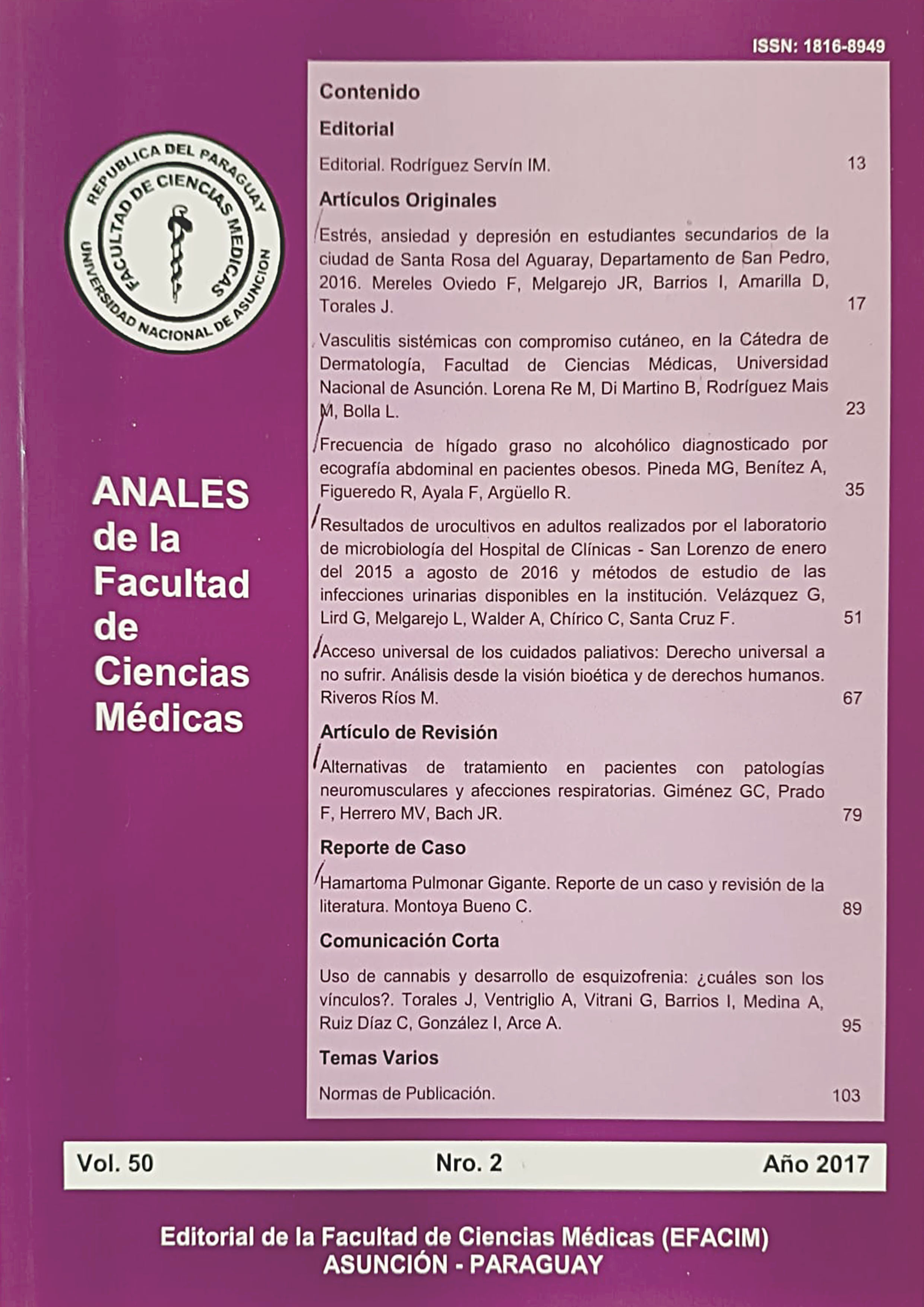
Uso de cannabis y desarrollo de esquizofrenia: ¿cuáles son los vínculos?
DOI:
https://doi.org/10.18004/anales/2017.050(02)95-102Palabras clave:
cannabis, esquizofrenia, psicosis, vulnerabilidad, salud pública, ParaguayResumen
El cannabis es la droga más utilizada por personas con esquizofrenia. Sin embargo, la relación entre el consumo de cannabis y el desarrollo de esquizofrenia aún no ha sido completamente aclarada. Esta comunicación corta pretende destacar algunos vínculos estudiados entre el consumo de cannabis y el desarrollo de esquizofrenia. Los autores resumen algunos de los principales hallazgos de varias investigaciones realizadas sobre este tema, incluyendo estudios sobre la sustancia blanca del cerebro, el circuito de recompensa cerebral, la fisiopatología del hipocampo, el volumen cerebral, la edad de inicio de la psicosis, las características del uso de cannabis y los rasgos de personalidad, la genética, la neuroquímica, así como la respuesta al estrés. Los autores concuerdan con la noción de que hay dos hipótesis más convincentes sobre el vínculo entre el cannabis y la esquizofrenia: 1. Cannabis como causa contribuyente y, 2. Vulnerabilidad compartida. Los autores hacen hincapié en que el consumo de cannabis no provoca por sí mismo un trastorno psicótico; sin embargo, tanto el uso temprano como el uso intensivo del mismo son más probables en individuos con una vulnerabilidad a la psicosis. El uso del cannabis es posiblemente el factor de riesgo medioambiental más modificable de la esquizofrenia, por lo que es necesaria una advertencia de salud pública de que el consumo de cannabis puede aumentar el riesgo de trastornos psicóticos.
Referencias
1. Pulido A., Avilés J., Suárez R. Vasculitis cutáneas. Actas Dermosifiliogr. 2012;103(3):179-191.
2. Cantor-Graae E, Nordstrom LG, McNeil TF. Substance abuse in schizophrenia: a review of the literature and a study of correlates in Sweden. Schizophr Res. 2001;48(1):69-82.
3. Mueser KT, Yarnold PR, Levinson DF, Singh H, Bellack AS, Kee K, et al. Prevalence of substance abuse in schizophrenia: demographic and clinical correlates. Schizophr Bull. 1990;16(1):31-56.
4. Regier DA, Farmer ME, Rae DS, Locke BZ, Keith SJ, Judd LL, et al. Comorbidity of mental disorders with alcohol and other drug abuse. Results from the epidemiologic catchment area (ECA) study. JAMA 264:2511–2518. JAMA. 1990;264(19):2511-2518.
5. Bühler B, Hambrecht M, Löffler W, an der Heiden W, Häfner H. Precipitation and determination of the onset and course of schizophrenia by substance abuse—a retrospective and prospective study of 232 population-based first illness episodes. Schizophr Res. 2002;54(3):243-251.
6. Malchow B, Hasan A, Fusar-Poli P, Schmitt A, Falkai P, Wobrock T. Cannabis abuse and brain morphology in schizophrenia: a review of the available evidence. Eur Arch Psychiatry Clin Neurosci. 2013;263(1):3-13. doi: 10.1007/s00406-012-0346-3
7. Cookey J, Bernier D, Tibbo PG. White matter changes in early phase schizophrenia and cannabis use: An update and systematic review of diffusion tensor imaging studies. Schizophr Res. 2014;156(2-3):137-142. doi: 10.1016/j.schres.2014.04.026
8. Fischer AS, Whitfield-Gabrieli S, Roth RM, Brunette MF, Green AI. Impaired functional connectivity of brain reward circuitry in patients with schizophrenia and cannabis use disorder: Effects of cannabis and THC. Schizophr Res. 2014;158(1-3):176-182. doi: 10.1016/j.schres.2014.04.033
9. Solowij N, Walterfang M, Lubman DI, Whittle S, Lorenzetti, Styner M, et al. Alteration to hippocampal shape in cannabis users with and without schizophrenia. Schizophr Res. 2013;143(1):179-184. doi: 10.1016/j.schres.2012.10.040
10. Van Haren NE, Cahn W, Hulshoff Pol HE, Kahn RS. Confounders of excessive brain volume loss in schizophrenia. Neurosci Biobehav Rev. 2013;37(10Pt1):2418-2423. doi: 10.1016/j.neubiorev.2012.09.006
11. Clausen L, Hjorthøj CR, Thorup A, Jeppesen P, Petersen L, Bertelsen M, et al. Change in cannabis use, clinical symptoms and social functioning among patients with first-episode psychosis: a 5-year follow-up study of patients in the OPUS trial. Psychol Med. 2014;44(1):117-126. doi: 10.1017/S0033291713000433
12. Di Forti M, Sallis H, Allegri F, Trotta A, Ferraro L, Stilo SA, et al. Daily Use, Especially of High-Potency Cannabis, Drives the Earlier Onset of Psychosis in Cannabis Users. Schizophr Bull. 201;40(6):1509-1517. doi: 10.1093/schbul/sbt181
13. Davis GP, Compton MT, Wang S, Levin FR, Blanco C. Association between cannabis use, psychosis, and schizotypal personality disorder: Findings from the National Epidemiologic Survey on Alcohol and Related Conditions. Schizophr Res. 2013;151(1-3):197-202. doi: 10.1016/j.schres.2013.10.018
14. Power RA, Verweij KJ, Zuhair M, Montgomery GW, Henders AK, Heath AC, et al. Genetic predisposition to schizophrenia associated with increased use of cannabis. Mol Psychiatry. 2014;19(11):1201-1204. doi: 10.1038/mp.2014.51
15. United Nations Office on Drugs and Crime. World Drug Report 2013. New York: United Nations; 2013. 151 p. Available from: https://www.unodc.org/unodc/secured/wdr/wdr2013/World_Drug_Report_2013.pdf
16. Green B, Young R, Kavanagh D. Cannabis use and misuse prevalence among people with psychosis. Br J Psychiatry. 2005;187:306-313. doi: 10.1192/bjp.187.4.306
17. Morgan CJA, Freeman TP, Powell J, Curran HV. AKT1 genotype moderates the acute psychotomimetic effects of naturalistically smoked cannabis in young cannabis smokers. Transl Psychiatry. 2016;6:e738. doi: 10.1038/tp.2015.219
18. Manseau MW, Goff DC. Cannabinoids and Schizophrenia: Risks and Therapeutic Potential. Neurotherapeutics. 2015 Oct;12(4):816-24. doi: 10.1007/s13311-015-0382-6
19. Fakhoury M. Could cannabidiol be used as an alternative to antipsychotics? J Psychiatr Res. 2016;80:14-21. doi: 10.1016/j.jpsychires.2016.05.013
20. Deiana S. Medical use of cannabis. Cannabidiol: A new light for schizophrenia?. Drug Test Anal. 2013;5(1):46-51. doi: 10.1002/dta.1425
21. Saito A, Ballinger MDL, Pletnikov MV, Wong DF, Kamiya A. Endocannabinoid system: Potential novel targets for treatment of schizophrenia. Neurobiol Dis. 2013 May;53:10-7. doi: 10.1016/j.nbd.2012.11.020
22. Kamiya A, Sedlak TW, Pletnikov MV. DISC1 pathway in brain development: exploring therapeutic targets for major psychiatric disorders. Front Psychiatry. 2012;3:25. doi: 10.3389/fpsyt.2012.00025
23. O’Tuathaigh CM, Hryniewiecka M, Behan A, Tighe O, Coughlan C, Desbonnet L, et al. Chronic Adolescent Exposure to Δ-9-Tetrahydrocannabinol in COMT Mutant Mice: Impact on Psychosis-Related and Other Phenotypes. Neuropsychopharmacology. 2010;35(11):2262-2273. doi:10.1038/npp.2010.100.
24. Selemon LD, Zecevic N. Schizophrenia: a tale of two critical periods for prefrontal cortical development. Transl Psychiatry. 2015;5:e623. doi: 10.1038/tp.2015
25. Laviolette SR, Grace AA. The roles of cannabinoid and dopamine receptor systems in neural emotional learning circuits: implications for schizophrenia and addiction. Cell Mol Life Sci. 2006;63(14):1597-613. doi: 10.1007/s00018-006-6027-5
26. O’Tuathaigh CM, Clarke G, Walsh J, Desbonnet L, Petit E, O’Leary C, et al. Genetic vs. pharmacological inactivation of COMT influences cannabinoid-induced expression of schizophrenia-related phenotypes. Int J Neuropsychopharmacol. 2012;15(9):1331-1342. doi: 10.1017/S1461145711001581
27. Monteleone P, Di Filippo C, Fabrazzo M, Milano W, Martiadis V, Corrivetti G, et al. Flattened cortisol awakening response in chronic patients with schizophrenia onset after cannabis exposure. Psychiatry Res. 2014;215(2):263-267. doi: 10.1016/j.psychres.2013.12.016
28. Ksir C, Hart CL. Cannabis and Psychosis: a Critical Overview of the Relationship. Curr Psychiatry Rep. 2016;18(2):12. doi: 10.1007/s11920-015-0657-y
29. Gage SH, Hickman M, Zammit S. Association Between Cannabis and Psychosis: Epidemiologic Evidence. Biol Psychiatry. 2016;79(7):549-56. doi: 10.1016/j.biopsych.2015.08.001