

Valoración de hábitos saludables y su relación con el riesgo cardiovascular, fuerza muscular, Vitamina D y Calidad de Vida en pacientes obesos
DOI:
https://doi.org/10.18004/mem.iics/1812-9528/2025.e23122507Palabras clave:
calidad de la dieta, actividad física, obesidad, horas de sueño, calidad de vidaResumen
La obesidad promueve el desarrollo de ECV, sarcopenia, deficiencia de vitamina D, lo cual puede
empeorar la calidad de vida (CV). EL objetivo fue determinar la calidad de la dieta, nivel de actividad
física (AF) y horas de sueño en pacientes obesos y su relación con el riesgo cardiovascular, fuerza
muscular (FM), niveles de vitamina D y CV. El estudio de diseño observacional analítico de corte
transversal en el que se evaluaron 43 adultos de ambos sexos con diagnóstico de obesidad que
acudieron a un consultorio clínico privado de la Ciudad de Luque – Paraguay. Se evaluaron variables
sociodemográficas, antropométricas, circunferencia de cintura, FM, niveles de vitamina D, calidad
de la dieta, AF, horas de sueño y CV. Para explorar correlación entre las variables se aplicó la prueba
del coeficiente de correlación de Pearson. Aproximadamente 3 de cada 4 pacientes fueron mujeres
y la edad promedio fue de 38,02±9,36 años. Nueve de cada 10 tuvo riesgo cardiovascular alto y
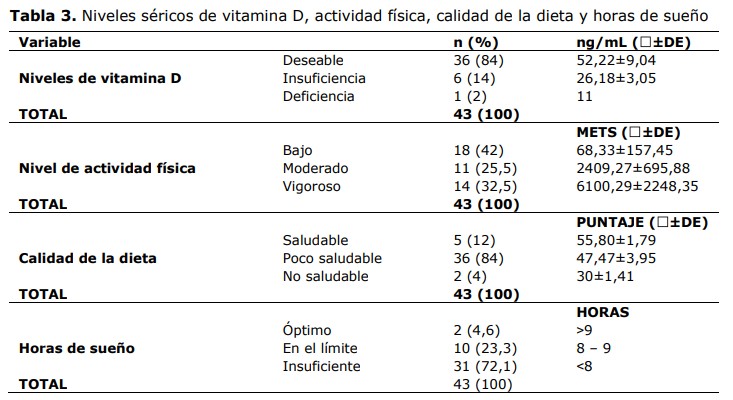
casi la mitad mostró FM y nivel de AF bajas. Más de ¾ presentaron niveles de vitamina D deseables
y dieta poco saludable. Más de la mitad estuvo moderadamente ansioso/deprimido y tenía horas
insuficientes de sueño. Se evidenció una correlación positiva entre la calidad de la dieta y el Índice
de CV, la AF y horas de sueño con la FM y el Índice de CV. Los pacientes con mayores valores en
calidad de la dieta, nivel de AF y horas de sueño presentaron mayor índice de Calidad de Vida.
Descargas
Referencias
1. Lin X, Li H. Obesity: Epidemiology, Pathophysiology, and Therapeutics. Front Endocrinol (Lausanne). 2021; 12: 706978.
2. Dicken SJ, Batterham RL. The Role of Diet Quality in Mediating the Association between Ultra-Processed Food Intake, Obesity and Health-Related Outcomes: A Review of Prospective Cohort Studies. Nutrients. 2021; 14 (1): 23.
3. Petersen KS, Kris-Etherton PM. Diet Quality Assessment and the Relationship between Diet Quality and Cardiovascular Disease Risk. Nutrients. 2021 Nov 28; 13 (12): 4305.
4. Barrett M, McClure R, Villani A. Adiposity Is Inversely Associated with Strength in Older Adults with Type 2 Diabetes Mellitus. Eur Geriatr Med. 2020; 11: 451–458.
5. Leong DP, Teo KK, Rangarajan S. Prognostic value of grip strength: findings from the Prospective Urban Rural Epidemiology (PURE) study. Lancet. 2015; 386 (9990): 266-273.
6. Yuzbashian E, Asghari G, Hedayati M, Zarkesh M, Mirmiran P, Khalaj A. Determinants of vitamin D receptor gene expression in visceral and subcutaneous adipose tissue in non-obese, obese, and morbidly obese subjects. J Steroid Biochem Mol Biol. 2019; 187: 82-87.
7. Borel P, Caillaud D, Cano NJ. Vitamin D bioavailability: state of the art. Crit Rev Food Sci Nutr. 2015; 55(9): 1193-205.
8. Jiang X, Xia L, Tang T, Fan X, Wang R, Wang M, et al. Decreased vitamin D bioavailability with altered DNA methylation of its metabolism genes in association with the metabolic disorders among the school-aged children with degree I, II, and III obesity. J Nutr Biochem. 2024; 129: 109627.
9. Wang H, Chen W, Li D, Yin X, Zhang X, Olsen N, et al. Vitamin D and Chronic Diseases. Aging Dis. 2017 May 2;8(3): 346-353.
10. Pereira-Santos M, Costa PR, Assis AM, Santos CA, Santos DB. Obesity and vitamin D deficiency: a systematic review and meta-analysis. Obes Rev. 2015;16(4):341-9.
11. Popkin, B. Ultra-Processed Foods' Impacts on Health. 2030—Food, Agriculture and Rural Development in Latin America and the Caribbean, No. 34. Santiago de Chile. FAO. 2019.
12. Zobel EH, Hansen TW, Rossing P, von Scholten BJ. Global Changes in Food Supply and the Obesity Epidemic. Curr Obes Rep. 2016; 5(4): 449-455.
13. Popkin BM, Adair LS, Ng SW. Global nutrition transition and the pandemic of obesity in developing countries. Nutr Rev. 2012; 70 (1): 3-21.
14. Tapsell LC, Neale EP, Satija A, Hu FB. Foods, Nutrients, and Dietary Patterns: Interconnections and Implications for Dietary Guidelines. Adv Nutr. 2016 May 16; 7(3): 445-54.
15. English LK, Ard JD, Bailey RL. Evaluation of Dietary Patterns and All-Cause Mortality: A Systematic Review. JAMA Netw Open. 2021; 4 (8): e2122277.
16. Mozaffarian D, Ludwig DS. Dietary guidelines in the 21st century--a time for food. JAMA. 2010 Aug 11; 304 (6): 681-2.
17. Maltos-Gómez F, Brito-López A, Uriarte-Ortiz JB, Guízar Sánchez DP, Muñoz-Comonfort A, Sampieri-Cabrera R. Association Between Diet, Physical Activity, Smoking, and Ultra-Processed Food and Cardiovascular Health, Depression, and Sleep Quality. Cureus. 2024; 16 (8): e66561.
18. Hartmann-Boyce J, Theodoulou A, Oke JL, Butler AR, Bastounis A, Dunnigan A, et al. Long-Term Effect of Weight Regain Following Behavioral Weight Management Programs on Cardiometabolic Disease Incidence and Risk: Systematic Review and Meta-Analysis. Circ Cardiovasc Qual Outcomes. 2023; 16 (4): e009348.
19. Meza Miranda ER. Influencia de la actividad física en la calidad de la dieta y la calidad del sueño en adultos. RICCAFD. 2024; 13(3): 274-85.
20. Rodríguez ALB, Amarilla NJD, Rodríguez MMT, Martínez BEN, Meza-Miranda ER. Processed and ultra-processed foods consumption in adults and its relationship with quality of life and quality of sleep. Rev Nutr. 2022; 35: e220173.
21. Aráuz-Hernández AN, Guzmán-Padilla S, Roselló-Araya M. La circunferencia abdominal como indicador de riesgo de enfermedad cardiovascular. Acta méd costarric. 2013; 55 (3): 122-127.
22. Ross R, Neeland IJ, Yamashita S, Shai I, Seidell J, Magni P, et al. Waist circumference as a vital sign in clinical practice: a Consensus Statement from the IAS and ICCR Working Group on Visceral Obesity. Nat Rev Endocrinol. 2020; 16(3): 177–89.
24. Guzmán-Guzmán IP, Delgado-Floody P, Gutiérrez-Pérez IA, Caamaño-Navarrete F, Jerez-Mayorga D, Zaragoza-García Ó, et al. Association between relative handgrip strength and abdominal obesity, type-2 diabetes and hypertension in a Mexican population. Nutr Hosp. 2022; 39(1): 82-92.
24. Valenzuela PL, Maffiuletti NA, Tringali G, De Col A, Sartorio A. Obesity-associated poor muscle quality: prevalence and association with age, sex, and body mass index. BMC Musculoskelet Disord. 2020; 21(1): 200.
25. Tuttle CSL, Thang LAN, Maier AB. Markers of inflammation and their association with muscle strength and mass: a systematic review and meta-analysis. Ageing Res Rev. 2020; 64: 101185.
26. Gouda W, Mageed L, Shaker Y, Hamimy WI, Afify M. Assessment of Serum Vitamin D and Irisin Levels in Obese Patients. Clin Lab. 2018; 64 (11).
27. Hajhashemy Z, Shahdadian F, Ziaei R, Saneei P. Serum vitamin D levels in relation to abdominal obesity: A systematic review and dose-response meta-analysis of epidemiologic studies. Obes Rev. 2021; 22 (2): e13134.
28. Meza-Miranda ER, Giménez J. Level of physical activity and quality of life associated with health in Paraguay adults. Exercise and Quality of Life. 2021; 13(2): 5-11.
29. Ingram J, Maciejewski G, Hand CJ. Changes in Diet, Sleep, and Physical Activity Are Associated with Differences in Negative Mood During COVID-19 Lockdown. Front Psychol. 2020; 11: 588604.
30. Lin S, Cienfuegos S, Ezpeleta M, Pavlou V, Chakos K, McStay M, et al. Effect of Time-Restricted Eating versus Daily Calorie Restriction on Mood and Quality of Life in Adults with Obesity. Nutrients. 2023; 15 (20): 4313.
31. Govindaraju T, Sahle BW, McCaffrey TA, McNeil JJ, Owen AJ. Dietary Patterns and Quality of Life in Older Adults: A Systematic Review. Nutrients. 2018 Jul 26; 10(8): 971.
32. Genario R, Gil S, Oliveira-Júnior G, Leitão AE, Franco T, Dos Santos Sales RC, et al. Sleep quality is a predictor of muscle mass, strength, quality of life, anxiety and depression in older adults with obesity. Sci Rep. 2023; 13 (1): 11256.
 Un vistazo a nuestro día a día en la oficina de Memorias del IICS