
The Academy in the Covid-19 Pandemic in Paraguay
DOI:
https://doi.org/10.18004/mem.iics/1812-9528/2024.e22152402Resumen
Five years after the detection of the SARS-CoV-2 virus in Wuhan, China, there are several reflections on the roller coaster we experienced as an institution in those days.
To carry out the Covid-19 diagnostic service at the Instituto de Investigaciones en Ciencias de la Salud of the Universidad Nacional de Asunción (IICS-UNA), the authorities formed the Covid-19-IICS-UNA Contingency Technical Committee.
The greatest challenge of the IICS-UNA was first to obtain all the reagents and supplies required to implement the real-time PCR detection technique. This was achieved with multiple donations, such as primers and enzymes donated by the Merieux Foundation, reagents, supplies and personal protective equipment donated by CAPASU and advancing in the pandemic, an important donation received from the International Atomic Energy Agency (IAEA), which apart from reagents and supplies, included several equipment, such as biosafety cabinets, centrifuges, pipettes and even a qPCR thermocycler(1).
The diagnostic service began on April 1st, 2020 with four samples of people suspected of having Covid-19. They were provided by the Hospital de Clínicas of the Faculty of Medical Sciences - UNA.
Despite all the donations, sustaining the diagnosis without interruptions represented a challenge. It was not easy to get enzymes or nucleic acid purification kits. It was not even easy to get tips, tubes or even gloves. We needed to adapt to changing commercial DNA extraction kits with each new purchase or donation. We had to evaluate the performance of each new nucleic acid extraction kit, or each new enzyme, before launching into diagnosis with a whole new system. And all this at a marathon pace. We also had to create several protocol forms for the different enzymes we had available.
All the research groups involved in this diagnosis practically ran out of reagents and supplies, because one day we lacked tubes, the other day ethanol, or enzyme, or simply boxes and more boxes to organize the samples to store them in the saturated freezers of our biobank.
Generating the work areas was a monumental task, removing equipment that was not going to be necessary and taking other equipment that was necessary to the designated areas to manipulate the dreaded samples. Once again, all departments involved lent a centrifuge, a water bath, a set of pipettes, or a chair, to complete the work areas. That feared place was called “the Covid cave.” Many people feared passing in front of the “cave” and believed that when they passed in front of it, they would inevitably be infected with the virus.
For several months, the members of the Contingency team were feared. Our colleagues thought that we would end up getting infected and spreading the virus to everyone. That never happened. Most of the Contingency team got infected a long time after the worst wave of Covid which was in 2021.
We changed the entire dynamics of the institution, delimiting the reception and handling areas of the samples and modifying the accesses to minimize traffic, thus avoiding the much-feared passage in front of the “cave.”
We changed our life routines. We had inconceivable schedules in “normal” times, but despite the long hours, missing weekends and holidays, the team always remained firm, cheerful and selfless. We were always trying to contribute our small grain of sand to serve the community and the country.
We finished the contingency service with more than 13,000 determinations performed, optimizing each part of the process so that our reagents and supplies performed as well as possible and thus be able to offer more determinations to the community, free of charge.
An important lesson that the Covid-19 pandemic taught us is that by joining forces we can go very far. That the sum of knowledge, different personalities, different skills make us stronger and offer us greater opportunities to fulfill our goals and objectives.
Overall, we went through very hard times, dealing with pain, frustration and uncertainty. But as a team. we can say with satisfaction that we put our hearts into offering our contribution to this enormous challenge that was the Covid-19 pandemic.
Descargas
Referencias
1. del-Puerto F, Rojas LE, Díaz Acosta CC, Franco LX, Cardozo F, Galeano ME, Valenzuela A, Rojas A, Martínez M, Ayala-Lugo A, Mendoza L, Ovando FS, Martínez MF, Chung HJ, Webby R, Nara E, Caniza MA. The Experience of Testing for Coronavirus Disease (COVID-19) at a Single Diagnostic Center in Paraguay before the Introduction of Vaccination. Viruses. 2023 May 10;15(5):1136. doi: 10.3390/v15051136. PMID: 37243222; PMCID: PMC10220564.

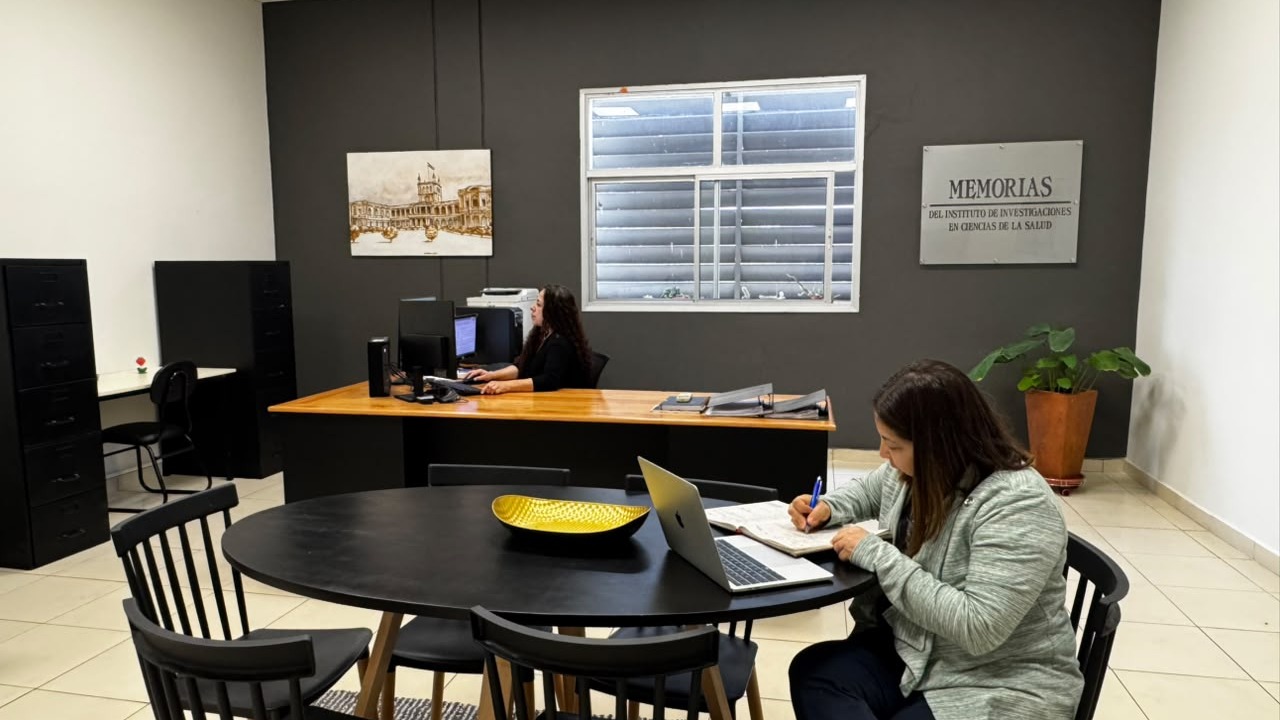 Un vistazo a nuestro día a día en la oficina de Memorias del IICS