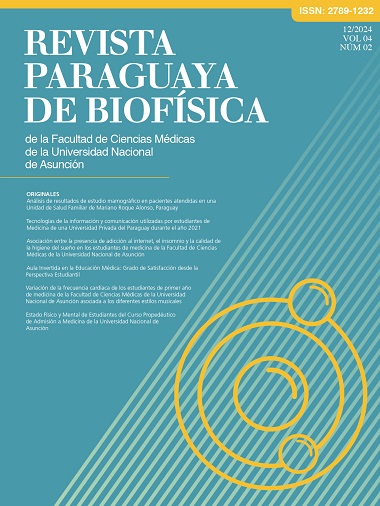
Análisis de resultados de estudio mamográfico en pacientes atendidas en una unidad de salud familiar de Mariano Roque Alonso
Palabras clave:
carcinoma, mama, mujeres, mamografíaResumen
Introducción: La mamografía, es el único método diagnóstico aceptado como técnica de despistaje para el cáncer de mama, permitiendo su detección precoz y reducción de las tasas de mortalidad por cáncer de mama. Para que una prueba de tamizaje sea eficaz y eficiente, se deben cumplir varios requisitos: la enfermedad a tamizar debe tener una incidencia importante, la prueba debe tener una alta sensibilidad y especificidad, su costo debe ser relativamente bajo y asequible, debe ser relativamente fácil de realizar y con mínimos efectos secundarios y/o complicaciones.
Objetivo General: Describir los hallazgos de la evaluación mamográfica realizadas en pacientes de 40 a 70 años en una Unidad de Salud Familiar del Barrio Amistad de Mariano Roque Alonso.
Metodología: Observacional, descriptivo de corte transversal, retrospectivo
Resultados: El grupo etario predominante estuvo entre los 56 y 60 años correspondiente al 27%, con un nivel educativo relativamente alto, ya que la mayoría contaba con instrucción completa. Casi la mitad de las pacientes (46%) requirieron estudios complementarios, específicamente ecografía mamaria, debido a que obtuvieron un resultado de BIRADS 0 en la evaluación inicial. Se constató que 10 (46%) pacientes presentó BIRADS 0 que son estudios inconclusos por lo que se solicitó a las pacientes realizar ecografía mamaria para complementar el estudio mamográfico, 8 (36 %) pacientes con BIRADS 1 que presentan mama en estado normal y 4 (18 %) pacientes con BIRADS 2 que presentan hallazgos benignos no cancerosos, el hallazgos benignos más frecuentes fueron calcificaciones intramurales.
Referencias
(1) Pereira A, Ribeiro A, Miranda G, Silva P, Silva A, Soares J et al. Relação entre a exposição ocupacional a radiação ionizante em trabalhadores da saúde e o desenvolvimento de cancro de mama. RPSO [Internet]. 2024 Jun [citado 2024 Jun 13] ; 17: esub0424.
(2) Iranzo P, Callejo A, Arbej J, Menao S, Isla D, Andrés R. Factores de riesgo de deterioro cognitivo asociado a cáncer en pacientes con carcinoma de mama y colon que reciben tratamiento con quimioterapia. Anales Sis San Navarra [Internet]. 2023 Ago [citado 2024 Jun 13];46(2):e1040.
(3) López-Plaza B, Bermejo LM, Loria-Kohen V, Fernández-Cruz E. El papel de la nutrición en la génesis del cáncer de mama. Nutr. Hosp. [Internet].2023[citado 2024 Jun 13];40(spe2):37-40.
(4) Udicki M, Starcevic I, Galic Biljana S, Dragan T, Radovanovic Z. Proporción del segundo al cuarto dígito en mujeres con cáncer de mama. En t. J. Morfol. [Internet]. 2023 febrero [citado 2024 junio 13];41(1):25-29.
(5) Renck DV et al. Equidad en el acceso al tamizaje mamográfico del cáncer de mama con intervención de mamografía móvil en el sur de Rio Grande do Sul, Brasil. Cuadernos de Salud Pública [en línea]. 2014;30(1) [Consultado el 13 de junio de 2024],88-96.
(6) Aguilera-López J; Lineros-Hurtado JA. Cobertura de mamografía de tamizaje y Plan Decenal para el Control de Cáncer, Colombia 2014. Revista de Salud Pública [online];2014;21(5) [Accedido 13 Junio 2024], 498-505.
(7) Montaño Méndez VE, Barragán Pelcastre O, Monter Pérez GV, Uribe Vázquez Y, Pastén López EE. Frecuencia de pacientes con BIRADS 0 por mastografía con resultado histopatológico de cáncer de mama. Archivos En Medicina Familiar, 2024;26(3), 141–146. https://doi.org/10.62514/amf.v26i3.51
(8) Muñoz Chávez CE. Sistema automático para la interpretación inmediata de mamografías para la determinación del riesgo de cáncer. 2023.
(9) De Positrones MPE, Gamarra JSC. Trabajo académico para optar por el título de especialista en tecnología en medicina nuclear molecular.
(10) Endara Vaca CS. El rol de la mamografía en el tamizaje del cáncer de mama. Revisión sistemática, 2021.
(11) Catalá NC, Cebrián EA. Prevención primaria, secundaria y terciaria. Estilo de vida y cáncer de mama, 12.
(12) Jiménez Rodríguez DE, Pino Postigo DA, Palma González DC, Díaz Córdoba DG. Lesiones intraductales, ¿cómo las diagnosticamos?. Seram, 2022;1(1). Disponible en: https://piper.espacioseram.com/index.php/seram/article/view/9153
(13) Febles G, Pippo R. Análisis de los cánceres perdidos en la mamografía. Revista de Imagenología, 202;23(1):7-10.
(14) Aspron, M. Mamografía. Analógica y digital. Historia, evolución. Revista argentina de mastología, 2019;9:141.
Descargas
Publicado
Número
Sección
Licencia
Derechos de autor 2024 Paola Toffoletti, Ricardo Garay, María Adela Pérez

Esta obra está bajo una licencia internacional Creative Commons Atribución 4.0.