Artículo Original /Original Article
DOI: https://doi.org/1056152/StevianaFacenV18N1A2_2026
Agaricales (Basidiomycota, Fungi) in the Espinilho State Park, Rio Grande do Sul
Pinheiro Velloso, M.A.P.¹*
 ; Pinheiro Velloso, J.R.P.¹ ; Vilazante, L.L.¹; Machado-Teixeira, F.M.¹ ; Souto Dias, J.P.S.¹ ; Klotz Neves, A.L.¹
; Aires Sousa, F.H.A.¹; Putzke, J.¹
1Federal University of Pampa, Rua Aluízio Barros Macedo, s/n. BR-290, Km
423, 97307-020, São Gabriel, RS, Brazil
*corresponding author: andrevelloso3@gmail.com
|
|
 |
Agaricales (Basidiomycota, Fungi)
in the Espinilho State Park,
Rio Grande do Sul. A taxonomic study
based on collections of macrofungi of the order Agaricales was conducted in the Espinilho State Park, located
in Barra do Quaraí, southern Brazil, during three expeditions in April 2023, October 2023, and October
2024, encompassing both the rainy and dry seasons. During the samplings, 430
records were obtained (counted as one record per substrate patch, even when
multiple basidiomata were present), distributed across 7 families
and 11 genera. Abundance was higher during dry periods, decreasing markedly during the
rainy season. We hypothesize that water accumulation in the soil of the sampled
area, predominantly classified as a Haplic Gleysol (characterized by poor
drainage and prolonged water saturation), causes stress to the mycelium, thereby
hindering basidiomata development. This pattern contrasts with commonly
reported findings in the literature, in which basidiomata production is
typically associated with increased moisture and rainfall.
Keywords: Agaricomycetes, water accumulation, surveys,
macrofungi, protected areas
Hongos Agaricales
(Basidiomycota, Fungi) en el Parque Estatal Espinilho, Rio Grande do Sul. Se realizó un estudio taxonómico basado en colecciones de macrohongos del orden Agaricales en el Parque Estadual
do Espinilho, ubicado en Barra do Quaraí, en el sur de Brasil, durante tres
expediciones en abril de 2023, octubre de 2023 y octubre de 2024, abarcando
tanto la temporada lluviosa como la seca. Durante los muestreos se obtuvieron
430 registros (contabilizados como un registro por parche de sustrato, incluso
cuando estaban presentes múltiples basidiomas), distribuidos en 7 familias y 11
géneros. La abundancia fue mayor durante los períodos secos, disminuyendo
notable-mente durante la temporada lluviosa.
Hipotetizamos que la acumulación de agua en el suelo del área muestreada, predominantemente
clasificado como un Gleysol háplico (caracterizado por un drenaje deficiente y
una saturación prolongada de agua), genera estrés en el micelio, dificultando
así el desarrollo de los basidiomas. Este patrón contrasta con los hallazgos
comúnmente reportados en la literatura, en los cuales la producción de
basidiomas se asocia típicamente con un aumento de la humedad y la
precipitación.
Palabras clave:
Agaricomycetes, acumulación de agua, inventarios, macrohongos, áreas protegidas
INTRODUCTION
These fungi play an important ecological role, acting
predominantly as saprobes responsible for the decomposition of organic matter,
thereby contributing to the
biogeochemical nutrient cycle. In addition, some taxa act as symbionts by forming mycorrhizae with phanerogamic plants, enhancing
nutrient uptake and plant resilience, or
participate in the formation of basidiolichens (Dutra et al., 2015; Vanni & Visconti,
2015; Sulzbacher, 2019).
In Rio Grande do Sul, although several studies related to this order
exist, there are few records of Agaricales in the Pampa biome, especially when
compared to the number of studies conducted in
Atlantic Forest from the state. Maia et al. (2015) report only 84
fungal species for the Pampa biome. Andrade et al. (2023), in the
largest review of Pampa biodiversity conducted to date, mention the occurrence
of 149 species of Basidiomycota for the biome, without,
however, specifying the number of Agaricales. Furthermore, most conservation
units in the state are located within the Atlantic Forest, which hinders surveys
in the Pampa region (Brentano
& Foleto, 2015; Rech & Canto-Silva, 2017).
The Espinilho State Park, located within the Pampa,
has soils classified as Solodic Carbonatic Melanic Gleysol, of hydromorphic
character, medium texture, poor drainage, and prolonged water saturation, which
lead to seasonal water-logging. The mean annual temperature is around 20°C, with
maximum values reaching 34°C in summer and average
minimums of 8°C in winter. The mean annual precipitation is 1,100 mm, with
January being the wettest month, averaging 120 mm, and August being the driest,
with an average of 60 mm (Gardin et al., 2016;
Galvani, 2003; Watzlawick, 2014). The predominant vegetation, composed of espinilho
[Vachellia caven (Molina)
Seigler & Ebinger], inhanduvá [Neltuma afinis (Spreng.)
C.E.Hughes & G.P.Lewis] and algarrobo [Neltuma nigra (Griseb.)
C.E.Hughes & G.P.Lewis], is exclusive
both within Rio Grande do Sul and in Brazil, making this
conservation unit an important biodiversity refuge. In addition to this unique vegetation, the park also shelters
rare fauna species, such as the pampas cat (Leopardus munoai) (Silveira et
al., 2018), the pampas deer (Ozotoceros bezoarticus) (Bianchin, 2011) and the yellow cardinal
(Gubernatrix cristata) (Seixas, 2012; Brasil, 2024). However, no efforts
to inventory fungal diversity have been
conducted in this Conservation Unit to date.
Therefore, this study provides the first diversity data of Agaricales for the Espinilho State Park.
MATERIALS AND METHODS
Study area
Espinilho State Park is located in the far west
of Rio Grande do Sul, in the Quaraí Chico stream
microbasin, within the Uruguay River Hydrographic
Basin. Situated in the municipality of Barra do Quaraí, the park covers an area
of 1,617.14 hectares, with UTM coordinates 6654600N 446.500E and 6666400N 463.800E, at the tri-border region between Brazil, Argentina, and Uruguay. The park lies approximately 6 km from the urban center of Barra do Quaraí
and 70 km from Uruguaiana (Brasil, 2024) (Figure 1).
According to Köppen’s climatic classification,
the region presents a Cfa climate type, characterized as subtropical, with
average temperatures above 22 °C in the warmest
month and ranging between -3
°C and 18 °C in the coldest month, resulting in an annual average of around 23.4 °C (Moreno, 1961).
General precipitation is well
distributed throughout the year, with an annual average between 1,300 mm and
1,500 mm (Almeida, 1996), ranging from an average of 120 mm in the wettest month (January) to 60 mm in the driest
month (August) (Gardin et al., 2016).
Collections
Three sampling expeditions were carried
out between 2023 and 2024, specifically in April 2023, October 2023, and October 2024.
These months were strategically selected because the period from October to
April concentrates most of the region’s annual precipitation and erosive
potential. In this study area, the highest rainfall volumes are historically recorded
between October and January, with October exhibiting a historical average
of 153 mm to 192 mm, and January
averaging 142 mm, representing a significant contrast to the drier
winter months (Wrege
et al., 2012). During the surveys,
mushrooms appeared more
frequently and abundantly during soil drying phases after intense rainfall, as
the characteristic waterlogging of the Gleysol temporarily limits mycelial
fructification due to oxygen depletion. Material was collected using the walking survey method (Mueller et al.,
2004), following pre-established trails throughout the conservation unit. After
collection, the specimens were stored in individual plastic containers and
taken to the Laboratory of Fungal
Taxonomy (LATAF), where macro- and
micromorphological analyses were conducted for species identification.
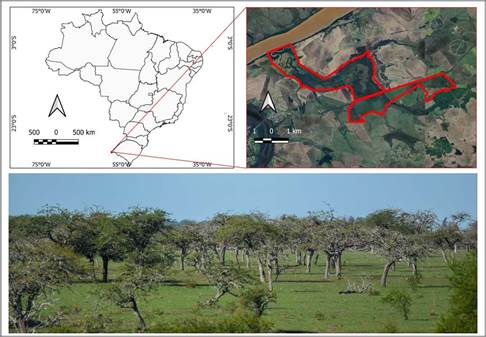
Figure 1. Map of Rio Grande do Sul,
highlighting the area of Espinilho State Park, between UTM coordinates
6654600 (N) 446.500 (E) and
6666400 (N) 463.800 (E). Below, an illustrative photograph of the
characteristic
vegetation of the park
Identification
For measurements of macroscopic structures, a digital caliper was used to measure the number
of lamellae per mm, pileus diameter, and stipe circumference and length. For
microscopic measurements, an Olympus Corporation SZ2-ILST stereomicroscope and a Carl Zeiss Microscopy GmbH AXIO SCOPE.A1 microscope
were used. With these microscopes, visualization and measurements of spores, pileus
cortical layer, lamellar trama, cheilocystidia,
pleurocystidia, and basidia were performed. Whenever possible, at least 50
structures of each type were observed.
RESULTS AND DISCUSSION
A total of 430 records were obtained, distributed among seven families: Agaricaceae (185), Hymenochaetaceae (8), Irpicaceae (6), Bolbitieaceae (9), Strophariaceae (182), Pluteaceae (19), and Physalacriaceae (21),
comprising 11genera:
Pluteus (19), Agaricus (64), Phellinus (8), Leucoagaricus (17), Leucocoprinus (66), Hydnopolyporus (6),
Panaeolus (9), Macrolepiota
(37), Psilocybe (182), Cyptotrama (21), and Macrocybe (1).
Species abundance is presented in Figure 2.
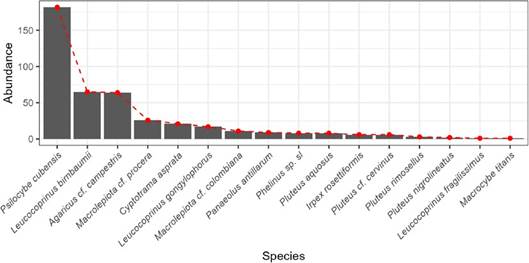
Figure 2. Species
abundance in Espinilho
State Park, Pampa biome, Rio Grande do Sul, Brazil
Species richness was 15 species in the first site, 3
species in the second, and 2 species in the
third, for a total richness of 18 species (Figure 3). The species
richness of Basidiomycetes, analyzed through
rarefaction, differed among the
three phytophysiognomies, and the confidence intervals did not overlap,
indicating significant differences based on the 95% confidence interval. In addition to interpolation (rarefaction), extrapolations were also performed, allowing estimates of species numbers
if sampling effort were
increased.
The Simpson index calculated for the
three sites was 0.787. This relatively high value indicates low diversity,
suggesting the presence of one or a few dominant
species in the area, while the others occur in lower abundance.
In other words, the macrofungal community of Espinilho State Park may be structured by the dominance of a small number of species, reflecting an uneven distribution
of diversity.
The Shannon index value was 1.86, which
suggests moderate diversity, indicating a relatively balanced composition of
species present in the study area.
Obtaining a value
close to 2.0 generally indicates
considerable diversity, although there is still room for greater
richness or evenness within the community. These data
highlight the importance of maintaining and monitoring this diversity, as it may be influenced by environmental
factors, management, or human intervention. Comparing this index with similar
studies may provide additional insights into the ecological status of the
conservation unit and guide more effective conservation strategies.
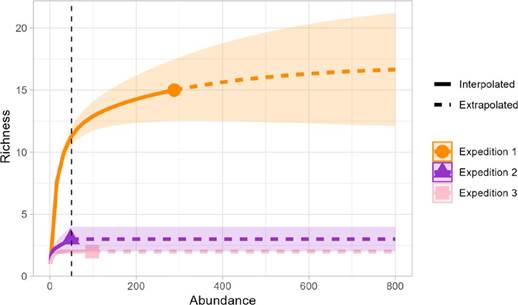
Figure 3. Rarefaction and extrapolation curves
based on abundance for Agaricales fungi collected in Espinilho State Park,
Rio Grande do Sul.
The X axis represents
abundance (number of occurrences) and the Y axis represents richness (number of species). Solid lines represent
interpolated
(observed) richness, and
dashed lines represent extrapolated (estimated) richness. Shaded areas indicate
the 95% confidence interval. The vertical
dashed line indicates the
standardized comparison point (lowest
sampling effort)
During the surveys, mushrooms appeared
more frequently and abundantly during dry periods. This pattern contrasts with
traditional mycological observations where macrofungal richness and abundance
typically peak during the rainy
season, as documented in tropical and subtropical ecosystems (Andrew et al.,
2013; Cavalcante et al.,
2024). While mushroom development
universally requires adequate substrate, temperature, and moisture (Teixeira
et al., 2023), our findings indicate that the
optimal humidity threshold for basidiome emergence in this ecosystem is met only when waterlogged conditions recede. At the sampling sites, the typical
drainage constraints of the Haplic Gleysol lead to prolonged water accumulation
during rainy periods. Rather than favoring
development, this excessive saturation likely hinders basidiome
formation by causing severe physiological or hypoxic stress to
the mycelium, meaning that the specific moisture requirements for fruiting are only satisfied during the better-drained, drier intervals.
Marchiori et al. (2013) reported that the soil
at Espinilho State Park is composed of fine, dry sand, which becomes saturated
when in contact with rain, potentially leaving the area completely waterlogged.
This saturation can compact the sand layer, creating
a barrier that retains water on the
surface. Thus, fungal
hyphae may experience stress during these periods,
hindering reproduction.
Moreover, as shown in Table 1, the distribution of species among the different substrates also
supports this interpretation. It was observed that records of mushrooms on soil
(SOL) and leaf litter (SER) were proportionally lower compared to the other
substrates, especially during rainy periods. These substrates are directly
exposed to water accumulation and to soil compaction, as previously described, which may limit
oxy-gen availability and hinder the development of hyphae and the formation of
basidiomata. On the other hand, mushrooms
found on living trees
(AVV) and dead trees (AMT) occurred more frequently, possibly
because these substrates remain more stable and are less prone to water saturation. Thus, the variation in
abundance among substrates suggests that excessive moisture may be acting
as a limiting factor, explaining the higher occurrence of mushrooms during dry
periods.
Table 1. Distribution of mushroom species by
substrate in each of the phytophysiognomies
studied in Espinilho State Park. AVV =
Live tree, AMT = Dead tree, SOL = Soil, SER =
Leaf litter, EST = Manure
|
|
SOL
|
AVV
|
AMT
|
EST
|
SER
|
|
Macrolepiota cf. colombiana
|
11
|
0
|
0
|
0
|
0
|
|
Phelinus sp.
|
0
|
8
|
0
|
0
|
0
|
|
Leucocoprinus gongylophorus
|
17
|
0
|
0
|
0
|
0
|
|
Irpex rosettiformis
|
0
|
0
|
6
|
0
|
0
|
|
Panaeolus antillarum
|
9
|
0
|
0
|
0
|
0
|
|
Agaricus cf. campestris
|
64
|
0
|
0
|
0
|
0
|
|
Psilocybe cubensis
|
0
|
0
|
0
|
182
|
0
|
|
Pluteus cf. cervinus
|
0
|
0
|
0
|
0
|
6
|
|
Pluteus
aquosus
|
0
|
0
|
0
|
0
|
8
|
|
Pluteus
nigrolineatus
|
0
|
0
|
2
|
0
|
0
|
|
Pluteus rimosellus
|
0
|
0
|
3
|
0
|
0
|
|
Leucocoprinus fragilissimus
|
1
|
0
|
0
|
0
|
0
|
|
Leucocoprinus birnbaumii
|
64
|
1
|
0
|
0
|
0
|
|
Cyptotrama asprata
|
21
|
0
|
0
|
0
|
0
|
|
Macrolepiota cf. procera
|
26
|
0
|
0
|
0
|
0
|
|
Macrocybe titans
|
1
|
0
|
0
|
0
|
0
|
Between
April and October,
a drastic decline in abundance and richness
was observed (Figure 4). This decrease could be linked
to a reduction in average temperature during that period. It has been documented that basidiomata formation
requires specific optimal
temperatures, and temperatures falling below these thresholds can significantly limit mushroom development, as observed in
cultivation trials of subtropical species (Colavolpe & Albertó, 2014).
According to Branco et al. (2022),
fungi possess homeostatic mechanisms to defend
themselves against environmental variations. However, extreme physical
conditions can override these cellular defenses. Griffin (1963) documented that
water-saturated soils induce severe physical stress on the mycelium,
preventing hyphal growth due to oxygen depletion. Following this reasoning, the prolonged waterlogging observed in the Haplic Gleysol of the Espinilho State
Park after intense rainfall events likely imposes a similar hypoxic and
physical stress on the macrofungal mycelium, restricting mushroom emergence during
peak rainy periods.
Furthermore, seasonal thermal extremes
also play a critical role in
limiting community development in the study area, where summer temperatures
regularly reach up to 34 °C. This field observation aligns with empirical laboratory models; for instance, Zhang et al.
(2016) demonstrated that
filamentous fungi exposed to heat stress (such as 33 °C) exhibit significantly
inhibited mycelial growth and reduced hyphal branching due to severe
physiological heat shock. Therefore,
the drastic declines in richness and abundance observed in the park are modulated
by a dual constraint system: severe hypoxic stress during waterlogged rainy
periods and destructive thermal stress during the high-temperature summer months.
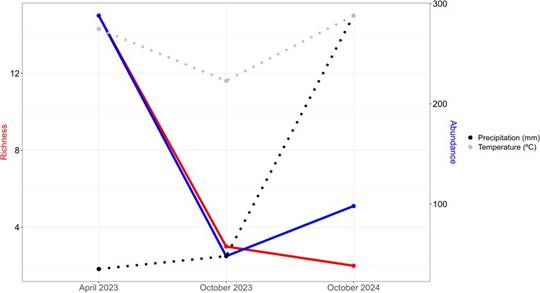
Figure 4. Rainfall
graph with species
abundance and richness
ACKNOWLEDGMENTS
We thank the Laboratory of Fungal Taxonomy – LATAF (UNIPAMPA) for technical
support, and the Coordination for the Improvement of Higher Education
Personnel – Brazil (CAPES) – Finance Code 001, for granting
scholarships to the authors. We also thank
the Research Support Foundation of Rio Grande do Sul
(FAPERGS – project nº 21/2551-0001985-9) and the National Council for Scientific and Technological Development (CNPq – project
nº 405564/2022-8) for
financial support, as well as for the support provided through the Universal
Funga do Brasil project [403547/2023-7].
AUTHORS CONTRIBUTIONS
M.A.
Velloso: Conceptualization, Methodology, Fieldwork, Microscopic analysis,
Statistical analysis, Literature review, Writing – original draft. J.R.
Velloso: Fieldwork, Microscopic analysis, Statistical analysis, Literature
review, Data curation, Visualization. L.L. Vilazante: Fieldwork. F. Machado-Teixeira: Fieldwork. J.P.
Souto Dias: Fieldwork. A.L. Klotz Neves: Fieldwork. F. Aires Sousa:
Fieldwork. J. Putzke: Conceptualization, Supervision,
Methodology, Resources, Writing – review & editing.
CONFLICTS OF INTEREST
The
authors declare that they have
no known competing financial interests or personal relationships that could have appeared to influence the work reported
in this paper.
REFERENCES
Almeida, J. (1996). O solo nos grandes domínios morfoclimáticos do Brasil e
desenvolvimento sustentado-Solo dos Pampas.
Viçosa: Sociedade
Brasileira Ciência do Solo, 288-306.
Andrade, B. O., Dröse, W., Aguiar,
C. A. D., Aires, E. T., Alvares, D. J., Barbieri, R. L., ... & Mendonça Junior, M.
D. S. (2023). 12,500+ and counting: biodiversity of the Brazilian Pampa. Frontiers
of Biogeography, 15(2).
Andrew, E. E., Kinge, T. R.,
Tabi, E. M., Thiobal, N., & Mih,
A. M. (2013). Diversity and distribution of macrofungi (mushrooms)
in the Mount Cameroon Region. Journal of Ecology and the Natural Environment,
5(10), 318-334.
Bianchin, J. F. (2011).
Mastofauna não-voadora do
Parque Estadual do Espinilho, Barra do Quaraí, Rio Grande do Sul, Brasil. Revista
da Graduação, 4(1).
Branco, S., Schauster, A., Liao, H. L., &
Ruytinx, J. (2022). Mechanisms of stress tolerance
and their effects on the ecology and evolution of mycorrhizal
fungi. New Phytologist, 235(6), 2158-2175.
Brentano, B., Follmann, F.
M., & Foleto, E. (2015). Contextualização das unidades de conservação no estado do Rio Grande do Sul, Brasil.
Ciência e Natura, 37(3), 536-554.
Cavalcante, F. S. A., De Souza, D. B., Chaves, R. C., Lima, T. R., Campos,
M. C. C., & Lima,
R. A. (2024). Biodiversity of
macrofungi in Mapinguari National Park, Amazonas, Brazil. Revista de Gestão
Social e Ambiental, 18(11), 1–12.
Colavolpe, M. B., &
Albertó, E. (2014). Cultivation requirements and substrate degradation of the edible
mushroom Gymnopilus pampeanus—A novel
species for mushroom cultivation. Scientia Horticulturae, 180,
161-166.
Dutra, C. A. L. (2015).
Contribuições taxonômicas e filogenéticas ao estudo de Pterulaceae (Agaricales)
coraloides.
Galvani, F. R. (2003).
Vegetação e aspectos
ecológicos do Parque
Estadual do Espinilho, Barra do Quaraí, RS.
Gardin, E., Watzlawick, L.
F., & Mazon, J. A. (2016). Florística e fitossociologia em áreas de Savana Estépica Parque em Barra do Quaraí-RS,
Brasil. Investigación agraria, 18(1), 37-43.
Griffin, D. M. (1963). Physical
soil factors and fungal ecology: I. Soil water potentials and the behavior of Curvularia ramosa. Transactions of the British
Mycological Society, 46(2), 273–280.
Maia, L. C., Carvalho, A. A. D., Cavalcanti, L. D. H., Gugliotta, A. D. M., Drechsler-Santos,
E. R., Santiago, A. L. D. A., ... & Silva,
V. F. D. (2015). Diversity of Brazilian fungi. Rodrigué-sia,
66(4), 1033-1045.
Marchiori, J. N. C., da Silva Alves, F., Deble, L. P., & de Oliveira-Deble,
A. S. (2013). A vegetação no Parque Estadual do Espinilho. 1–Histórico da
ocupação humana e evolução do conhecimento botânico e fitogeográfico sobre o
Pontal do Quaraí. Balduinia, (43), 01-28.
Moreno, J. A. (1961).
Clima do Rio grande do Sul (Vol. 41). Governmentêrno do Estado do Rio Grande do Sul,
Secretaria da Agricultura, Diretoria da Agricultura, Diretoria de Terras e
Colonização, Secção de Geografia.
Mueller, G. M., Bills, G. F.,
& Foster, M. S. (Eds.). (2004). Biodiversity of fungi: inventory and monitoring methods.
Elsevier Academic Press.
Rech, I. F., Perello,
L. F. C., & Canto-Silva, C. R. (2017). Panorama
do uso público em parques estaduais do Rio Grande do Sul. Revista Brasileira de Ecoturismo (RBEcotur), 10(4).
Seixas, S. D. S. (2012). Passeriformes ameaçados do Parque Estadual do Espinilho, RS.
Secretaria do Meio Ambiente
do Estado do Rio Grande do Sul. (s.d.). Parque Estadual do Espinilho. Governo
do Estado do Rio Grande do Sul. Recuperado em 11 de julho
de 2024, de https://www.sema.rs.gov.br/parque-esta-dual-do-espinilho
Silveira, C. T. D., Amaral, L. D. P., Sebem, E., &
Watzlawick, L. F. (2018). Análise
espacial da vegetação arbórea em parcela de estepe estacional savanícola, no
Parque Estadual do Espinilho, RS.
Sulzbacher, M. A., Hamann,
J. J., Fronza, D., Jacques, R. J. S., Giachini, A. J., Grebenc, T., & Antoniolli, Z. I. (2019). Fungos ectomicorrízicos em plantações de nogueirapecã e o potencial da truficultura no Brasil. Ciência Florestal, 29(2), 975–987.
Teixeira, A. L. M., Novais, B. S., Oliveira, K. S.
D., Alcântara, L. S., & Pedroso,
T. A. (2023). Estudo do desenvolvimento
do cogumelo shimeji (Pleurotus ostreatus) em substrato de bagaço-de-cana
de açucar (Saccharum oficinarum).
Vanni, J. J., & Visconti,
M. A. (2015). Interdependência. Agropecuária Catarinense, 28(2), 32-36.
Watzlawick, L. F., Genú, A. M., Caldeira, M. V. W., Longhi, S. J., & Valerio, A. F. (2014).
Aspectos da vegetação arbórea
em fragmento de Estepe Estacional Savanícola, Barra do Quaraí-RS, Brasil. Ciência Florestal,
24(1), 23–36.
Wrege, M. S., Steinmetz, S.,
Reisser Júnior, C., & Almeida, I. R. de. (Eds.). (2012). Atlas climático da Região Sul do Brasil:
Estados do Paraná, Santa
Catarina e Rio Grande do Sul.
Embrapa.
Zhang, X., Ren, A., Li, M. J., Cao, P. F., Chen, T. X., Zhang, G.,
... & Zhao, M. W. (2016). Heat
stress modulates mycelium
growth, heat shock protein expression, ganoderic acid
biosynthesis, and hyphal branching of Ganoderma lucidum via cytosolic
Ca2+. Applied and environ-mental
microbiology, 82(14), 4112-4125.
