Nota
breve-corta/ Short communication
DOI: https://doi.org/1056152/StevianaFacenV17N1A4_2025
Southernmost record and distribution in Argentina of Cotylidia
aurantiaca (Pat.) A.L. Welden (Stereales, Basidiomycota)
Robledo, G.1*  ; Popoff,
O.F.2; Urcelay,
C.3
; Popoff,
O.F.2; Urcelay,
C.3
1Universidad Nacional
de Córdoba, Facultad
de Ciencias Agropecuarias, Centro de Transferencia de Bioinsumos, CONICET, Fundación Fungicosmos, Argentina
2Laboratorio
de Micología, Instituto de Botánica del Nordeste—IBONE, Universidad Nacional
del- Nordeste—UNNE, CC 209, Corrientes W3400, Argentina
3Instituto
Multidisciplinario de Biología Vegetal, Universidad Nacional de Córdoba,
C.C.495, Córdoba, 5000, Argentina
*autor por correspondencia: gerardo.robledo@agro.unc.edu.ar
Southernmost record and distribution in
Argentina of Cotylidia aurantiaca (Pat.) A.L. Welden (Stereales, Basidiomycota). Cotylidia aurantiaca (Pat.) A.L. Welden is one of the most common ste- reoid stipitate fungi in the Neotropical region. Here, we report a noteworthy new record of this species from the Chaco Serrano ecosystem
in central Argentina, marking its
southernmost occurrence in the country. A brief morphological description and
illustrations are provided. Additionally, we plotted the species from Argentina records
on map, and the distribution of the species
in the country is discussed.
Palabras clave: smooth hymenophore, stereoid fungi, Neotropical fungi,
wood-decaying fungi
Registro más austral y distribución en
Argentina de Cotylidia aurantiaca (Pat.) A.L. Welden (Stereales,
Basidiomycota). Cotylidia aurantiaca (Pat.) A.L. Welden es
uno de los hongos estereoides estipitados más comunes de la región Neotropical. Aquí reportamos un nuevo y notable
registro de esta especie
realizado en el Chaco Serrano
en el centro de Argentina, que constituye su ocurrencia
más austral en el país. Se proporcionan una breve descripción morfológica e
ilustraciones. Además, se presentan
los registros de la especie en Argentina
en un mapa y se discute su distribución en el país.
Keywords: himenóforo liso,
hongos de la madera, hongos
estereoides, hongos neotropicales
Steviana, Vol. 17 (1), 2025 pp.36-41 Original recibido el 05/11/2024
Aceptado el 27/02/2025
Todo el contenido de esta revista
está bajo una Licencia
Creative Commons
INTRODUCTION
Cotylidia aurantiaca (Pat.) A.L.Welden is a characteristic fungal
species of neotropical forests (Ryvarden, 2010). It is easily distinguished by
the particular stipitate yellow basidiomata with a smooth hymenophoral surface,
occurring generally in large numbers in the forest floor (Figure
1A-B). The species
is only known from Tropical America
(Reid, 1965; Ryvarden,
2010; Baltazar et al.,
2022) where is, perhaps, one of the most common stereoid stipitate fungi. The
sou- thern limit of distribution of the species known so far reaches Paraguay
(Spegazzini, 1883; Campi et al., 2021), Gallery
Forests/Eastern Chaco Forests of North-Central
Argentina (Spegazzini, 1898), Atlantic Forest of NE Argentina (Wright
and Wright, 2005; Popoff et al., 2014), Southern Brazil (Baltazar et al.,
2022), reaching the southernmost point, 32ºS, in NE Uruguay (Felippone, 1928;
Martínez and Nakasone, 2010).
During the survey
of wood-decaying fungi in Argentina
conducted by the authors, several new species records
were made, one of particular importance being located
further south, at 32°S latitude, in the Chaco Serrano
forests of Córdoba, Central Argentina (Figure 1E).
The objective of this work is to report this record and understand the
distribution of the species in Argentina.
MATERIALS AND METHODS
The specimens were studied following
the ge- neral guidelines
for macrofungi, for both macroand
microscopic analysis described, in Campi et al. (2021) and references
therein. To understand the distribution of the species in Argentina, a search
of bibliographic records and representative herbarium specimens was carried out
(Table 1, Material studied section), and then they were plotted on a map
(Figure 2).
RESULTS
Specimens were
collected on the floor in humid microsites (Figure 1C). Specimens presented
smaller and slightly paler basidiomata when fresh (Figure 1C-D) than those
described from the tropical areas (cfr. Figure 1A-B), however when dry they have the same color. The specimens
agree in all microscopical features
with the concept of Cotylidia
aurantiaca: Basidiomata stipitate, solitary or gregarious, spathulate,
flabellate or infundibuliform, up to 35 mm high and 45 mm wide. Pileus bright yellow,
margin usually fimbriate. Stipe up to 12 mm long, 1.5 mm wide, slightly
swollen at the base. Hyphal
system monomitic, clamps absent.
Cystidia variable, cylindrical, capitate or pyriform,
constricted, septate, 60-120 × 6-25 μm.
Basidia cylindrical, 25-40 × 3-5 μm.
Basidiospores ellipsoid, 5.5-9 × 3-4 μm, thin walled, hyaline.

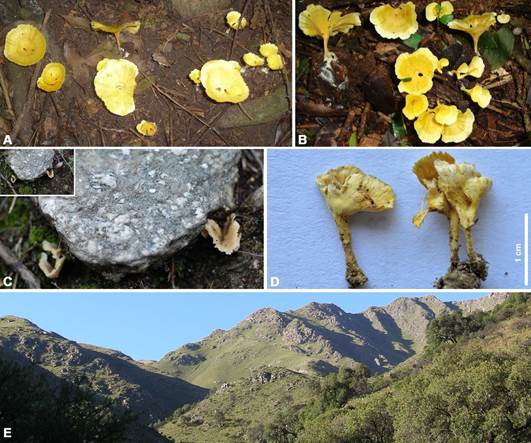
Figure
1.
Cotylidia aurantiaca specimens A, from NW Argentinean Yungas in PN
Calilegua. B, From Paranaense forest of NE Argentina in Caayari reserve. C, From Central Argentina
in the Chaco Forests Robledo 2530. D, detail of the specimen Robledo 2531.
E, General view of the Chaco Serrano
forests where specimens
were collected
To understand this
new record and the distribution of the species in Argentina, we plotted all records of the species based on the
material collected and studied by us (Figure 2). The species is certainly
present in both ecosystems of the Amazon Domain that reach Argentina, i.e. the
Paranaense Forest in the NE and the Yungas Forests in the NW. Among them, there have been records of
the species in the Eastern Chaco/Gallery Forest in the provinces of Chaco and
Formosa (Spegazzini, 1898) and the province of Corrientes (this
work). The species
can probably reach further
south through the gallery forest of the Paraná River.
Material studied: Argentina, Córdoba, San Alberto Department, Los
Hornillos, Quebrada Rio de las Chacras, 1280 msnm, on the ground, 31°54’S 64°58’W,
28.IV.2012, Robledo 2530, 2531
(FCOS). Corrientes, Capital, Riachuelo, 30.IV.1988, Popoff 371; ib., 30.XI.1994, Popoff 2570
(CTES); Mburucuyá, Estancia
Santa Teresa, 03.VI.1962, T. Pedersen s/n (BAFC 24997). Misiones,
Colonia Belgrano, “monte al SE próximo a la estación
forestal”, 29.X.1973, J. Wright et al. M-2455 (BAFC24984); Frontera, 19-20.IV.1957, R. Singer M1128, M1161 (LIL); El Soberbio, 28.IV.1966, C. Gómez
s/n (BAFC 24993); 29.VIII.1964, C.
Gómez s/n (BAFC
24994); Iguazú, Piray Guazú, 24.II.1960, R. Guerrero 69 (LIL); Puerto Iguazú,
11.IV.1957, R. Singer
M915 (LIL).
DISCUSSION
The Chaco Serrano
forests in Córdoba province constitutes an ecosystem quite different from the
tropical forests where the species is common. However, this ecosystem follows
the Yungas forests, the Nonwestern Argentinean Mountain rain forests. The
Sierras Grandes de Córdoba have several elements in flora and fauna that goes
down from Northwestern Yungas, as an example the Polylepis australis
forests and its associated
funga (Robledo et al., 2006). This record in the Chaco Serrano forests
constitutes the southernmost record
of the species in Argentina. Strikingly, the species has
been reported at approximately the same latitude in northeastern Uruguay (Felippone, 1928) (Figure 2). We began compiling records in the literature
and to look for representing herbaria specimens of those records; unfortunately, we found that there is much
material misidentified. Consequently, as some literature reports of C. aurantiaca may
represent different species, we refrain to generate a species
distribution map based on literature records. We found several herbaria specimens identified as C. aurantiaca that correspond to Podoscypha
species. Both genera are easily distinguished by the hyphal system, being
dimitic with clamps and skeletal hypha in Podoscypha and monomitic with simple
septa in Cotylidia (Ryvarden, 2010).
The purported easiness to identify
C. aurantiaca macroscopically and the lack of confirmation by microscopical analyses, is reflected in the misi-
dentification of herbarium collections.
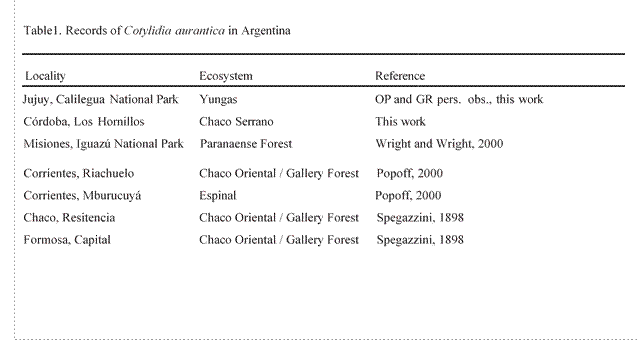
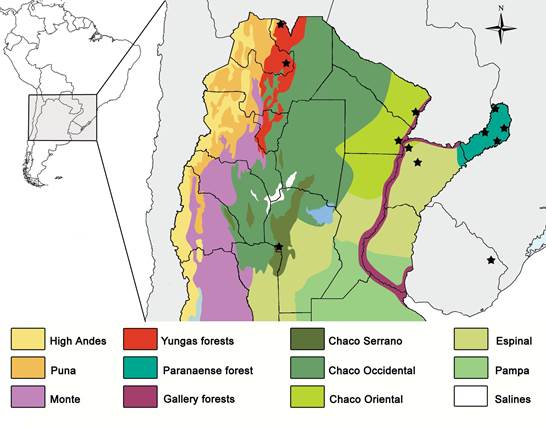
Figure 2. Cotylidia
aurantiaca records (black stars) in Argentina. The point in Uruguay was
reported by Felippone (1928). Map
modified from Robledo and Urcelay 2009, based on Cabrera 1971, Brown and
Pacheco 2006, and Oyarzabal et al.,
2018
The concept
of Cotylidia aurantiaca as a tropical species should now be understood
as tropical to subtropical. There are
numerous records of the species south of the Tropic of Capricorn, and
particularly the discovery of C. aurantiaca in the Chaco Serrano forests
of the province of Córdoba clearly shows that the species reaches a subtropical distribution at its southern
limit. This record, being so far south that it seems disconnected, would not be
unusual. There are previous records of other species of macrofungi with a tropical
or neotropical distribution and/ or that descend through the gallery forests of the Paraná River,
which have been recorded in different ecosystems at latitudes of 30-32
in central Argentina. For example,
Haploporus papyraceus (Cooke) Y.C. Dai & Niemelä, Echinoporia
aculeifera (Berk. & M.A. Curtis) Ryvarden in northeastern Córdoba
or Ceriporia spissa (Schwein.
ex Fr.) Rajchenb. (Robledo & Urcelay 2009). The finding reported here
underscores the need for studies of the diversity
of steroid fungi in Argentina.
ACKNOWLEDGEMENTS
Authors
acknowledge the financial support of FONCYT throughout projects PICT 2010-233
to C. Urcelay, IDEA WILD for
supplement and equipment and the Secretaría de Ambiente for collection permits. The assistance of Universidad
Nacional de Córdoba and Consejo Nacional de Investigaciones Científicas y Técnicas (CONICET), which supported the facilities
used in this work, are kindly acknowledged.
AUTHOR CONTRIBUTIONS
Data collection:
C. Urcelay and G. Robledo, Conceptualization: G. Robledo, C. Urcelay and O.
Popoff. Funding acquisition: C. Urcelay. Morphological analysis
of Specimens: G. Robledo and O.
Popoff. Writing, review and editing of the manuscript:
G. Robledo, O. Popoff and C. Urcelay.
CONFLICT OF INTEREST
The authors declare
that there is no conflicto of interest.
LITERATURE
Baltazar, J. M., Trierveiler-Pereira, L., Gorjón, S. P., & da Silveira, R. M. B. (2022). A synopsis
of stipitate corticioid fungi (Basidiomycota) from Southern Brazil. Lilloa, 59(Suplemento), 125-136.
Brown, A. D.,
& Pacheco, S. (2006). Propuesta de actualización del mapa ecorregional de la Argentina. En A. Brown,
U. Martínez Ortiz,
M. Acerbi, & J. Corcuera (Eds.),
La situación ambiental
Argentina 2005 (pp.
28–31). Fundación Vida
Silvestre Argentina.
Cabrera, A. L.
(1971). Fitogeografía de la República Argentina. Boletín de la Sociedad
Argentina de de Botánica, 14, 1–42.
Campi, M., Maubet, Y., Cristaldo, E., Mancuello,
C., & Robledo, G. (2022). Funga del Parque Nacional Ybycuí: listado
preliminar de especies de macrohongos y nuevas citas
para Paraguay. Steviana,
13(2), 75–96.
Martinez, S., & Nakasone, K. K. (2010). New
records and checklist of corticioid Basidiomycetes from Uruguay. Mycotaxon, 114(4), 281-284.
Popoff, O., Niveiro, N., & Robledo, G. (2014).
Del escritorio al campo: Hongos del Noreste Argentino. Revista Vida
Silvestre, (127).
Felippone, F. (1928). Contribution à la flore
mycologique de l’Uruguay. Annales de Cryptogamie Exotique, 1(4),
338–348.
Oyarzabal, M.,
Clavijo, J., Oakley, L., Biganzoli, F., Tognetti,
P., Barberis, I., Maturo, H. M.,
Aragón, R., Campanello, P. I., Prado, D., Oesterheld, M., & León,
R. J. C. (2018). Unidades de vegetación de la Argentina.
Ecología Austral, 28, 40–63.
Reid, D. A. (1965). A monograph of the
stipitate stereoid fungi. Beihefte zur Nova Hedwigia, 18, 1-382.
Robledo, G. L., & Urcelay, C.
(2009). Hongos de la madera en
árboles nativos del Centro de Argentina (pp. 1–201). Universidad Nacional de
Córdoba.
Robledo, G., Urcelay, C., Domínguez, L., & Rajchenberg, M. (2006). Taxonomy,
ecology and biogeography of
polypores (Basidiomycetes) from Argentinian
Polylepis woodlands. Canadian Journal of Botany, 84, 1561-1572.
Ryvarden, L. (2010). Stereoid fungi of America.
Synopsis Fungorum, 28,
1-208.
Spegazzini, C. (1898). Fungi argentini novi vel critici. Anales del Museo Nacional
de Historia Natural de Buenos Aires, 6, 81-365. Spegazzini, C. (1883). Fungi guaranitici, Pug. I. Anales de la Sociedad
Científica Argentina, 16,
242-248, 272-284.
Ryvarden, L. (2007). New
and interesting wood-inhabiting fungi
from Belize. Synopsis Fungorum, 23, 32-50.

